

Using industrial waste in porous building materials for indoor humidity control
This study investigated the synthesis of porous humidity control materials using waste brick and waste catalyst as raw materials. By utilizing waste materials rich in SiO2 and Al2O3, this study aimed to develop a sustainable and cost-effective approach to producing high-performance humidity control materials. The specific objectives of this study include characterizing the physical and chemical properties of waste brick and waste catalyst. This study also investigated the optimal processing parameters for synthesizing porous humidity control materials, including sintering temperature, pressure forming conditions, and particle size distribution, and evaluated the moisture adsorption capacity, adsorption-desorption rate, and mechanical properties of the synthesized porous humidity control materials.
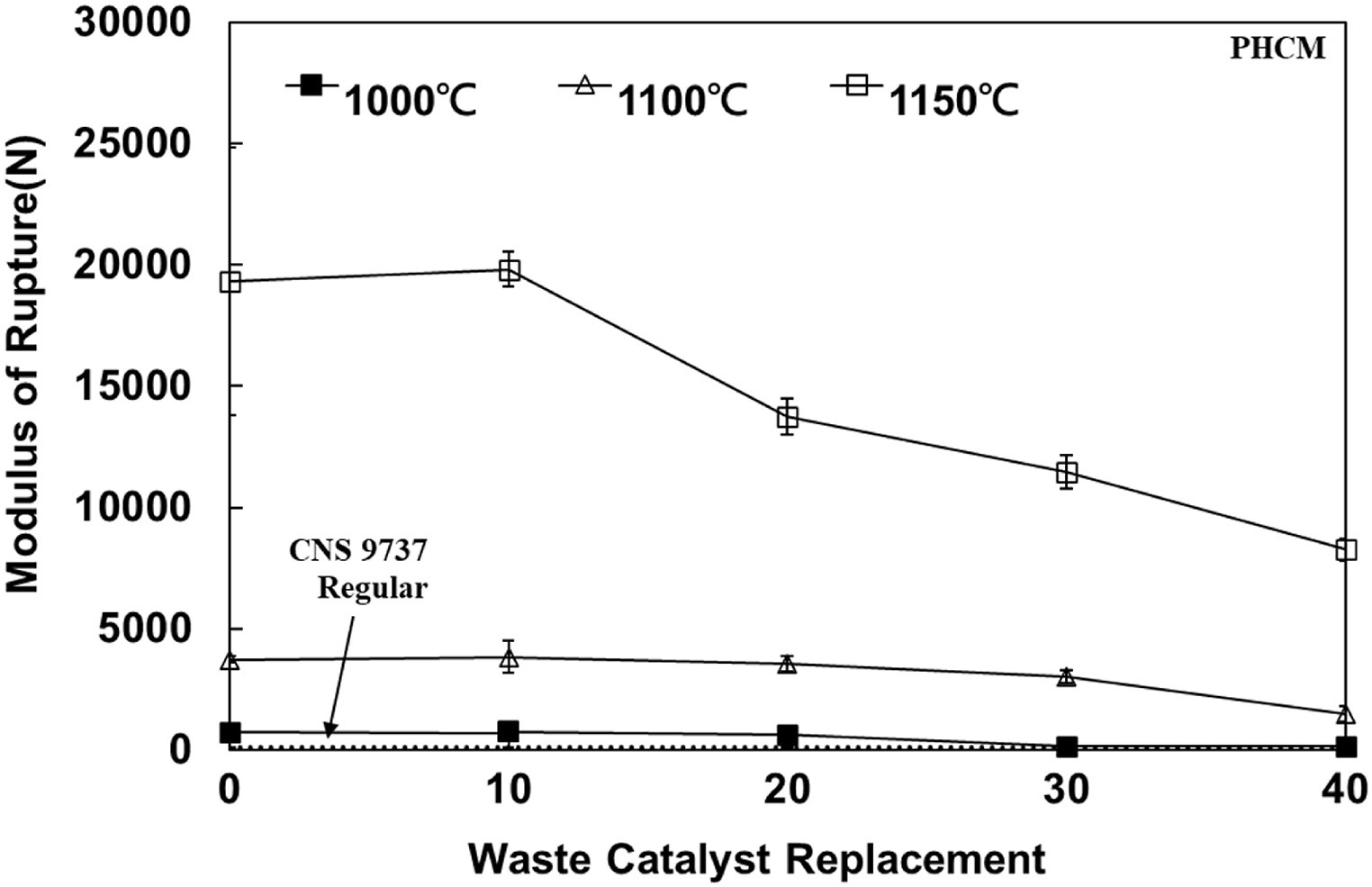
Fig. 9. Modulus of rupture of PHCM.
Technology Overview
Used of waste bricks and catalysts used in PHCM synthesis for sustainable construction materials. PHCM presented highest EMC (2.97 m3/m3) and 12 h moisture adsorption capacity (72.41 g/m2). Synthesizing PHCM from waste bricks & catalysts enhances humidity control and mesopore properties.
Applications & Benefits
Converts waste bricks and catalysts into high-strength, eco-friendly building materials. Exhibits effective humidity control in moderate environments (50%–75% RH). Meets environmental safety standards for heavy metal leaching (TCLP compliant). Outperforms commercial humidity control paints with superior moisture absorption (72.41 g/m²). Promotes sustainable construction and resource recycling through innovative reuse of industrial waste.
Abstract:
This study uses waste bricks and waste catalyst as raw materials in the synthesis of humidity control building materials with high structural strength. This paper explores the feasibility of producing porous humidity control materials (PHCM) through the billet sintering of waste brick with various quantities of waste catalyst (0 %–40 %) for indoor construction. N2 adsorption and desorption isotherms revealed that PHCM exhibits Type-IV adsorption with H3 hysteresis loops, indicating a network of interconnected mesopores with diameters ranging from 3 to 17 nm. Humidity control analysis revealed that increasing the waste catalyst content significantly enhanced the equilibrium moisture content and moisture adsorption and desorption capacity. This study determined that the adsorption of moisture within the PHCM relies on capillary condensation within the mesopores. Under 95 % relative humidity (RH), the highest equilibrium moisture content (2.97 kg/kg) and 12-h moisture adsorption capacity (72.41 g/m2) were obtained in specimens prepared at a sintering temperature of 1000 °C with a 40 % spent catalyst. This excellent adsorption capacity can be attributed to the high surface area of the waste catalyst, which increased the surface area of PHCM from 0.013 to 8.529 m2/g. This study demonstrates the benefits of synthesizing PHCM using waste bricks and catalysts in terms of porous properties, mechanical properties, and humidity control performance.
Using industrial waste in porous building materials for indoor humidity control
Author:Ya-Wen Lin, Bo-Xuan Zhang, Cheng-Han Lin, Yi-Hong Chen, Kae-Long Lin
Year:2024
Source publication:Journal of Building Engineering, Volume 90, 1 August 2024
Subfield Highest percentage:99% Architecture #2 / 203
https://www.sciencedirect.com/science/article/pii/S2352710224009306