

Mechanistic insights into temperature hysteresis in CO oxidation on Cu-TiO2 mesosphere
In this study, we developed a CO temperature-programmed reduction (CO-TPR) tandem oxygen temperature-programmed oxidation (O2-TPO) analysis sequence to validate the oxygen resupply behavior. In addition, we employed operando Raman spectroscopy to uncover crystal structure distortions and in-situ X-ray absorption spectroscopy (XAS) to elucidate variations in the electronic configuration of surface species. The objective of this research was to devise a comprehensive approach aimed at unveiling the reaction mechanism for catalytic CO oxidation by a copper/titanium dioxide system during hysteresis.
Technology Overview
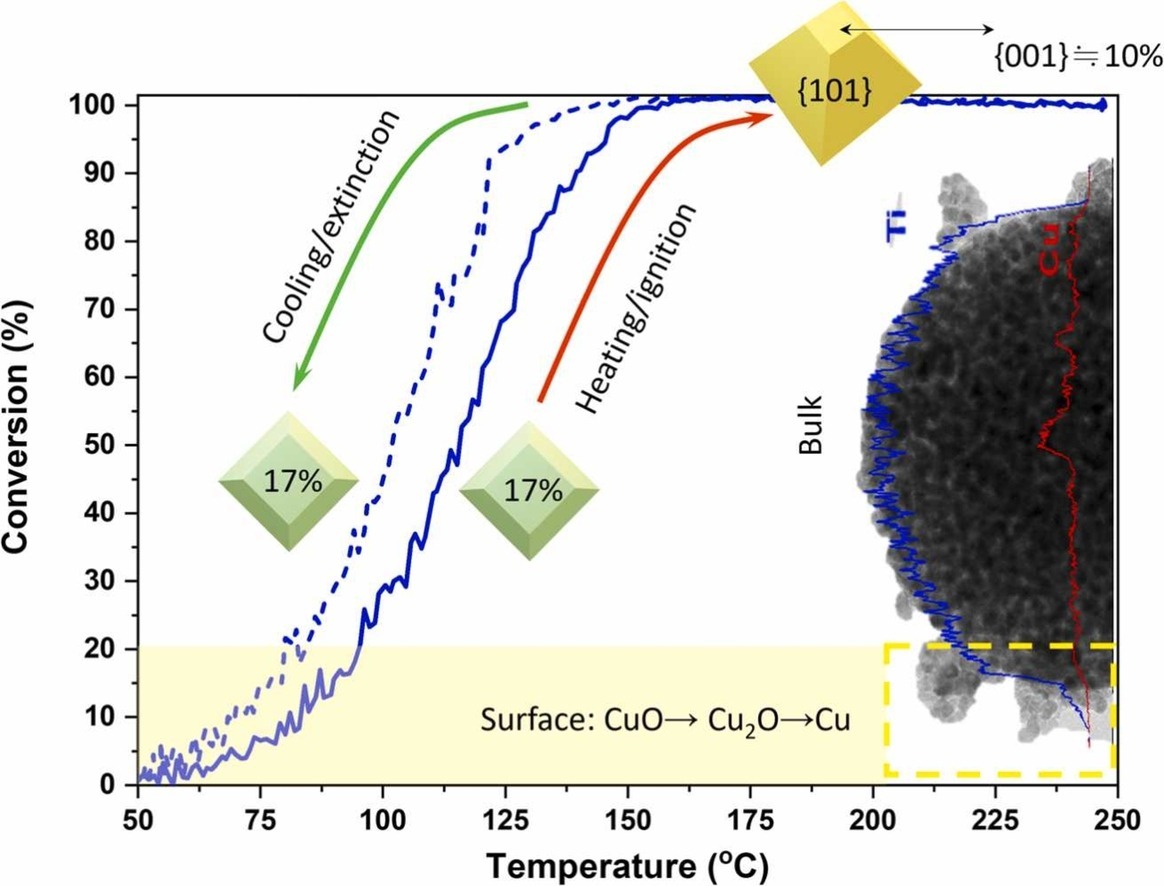
Oxygen replenishment behaviors relate to conversion temperature. Observation of CuO → Cu2O → Cu2O/Cu transformation at low-temperature region. Anatase Eg(1) mode changes highly related to CO oxidation performance in operando Raman monitoring. CuTMS structural distortion leads to crystal facets ratio of {001} slightly decrease from 17% to 10%.
Applications & Benefits
This research offers crucial insights into the catalytic behavior of copper-doped TiO2 for CO oxidation, enabling the design of more efficient catalysts. The findings, particularly the understanding of low-temperature CO oxidation activated by copper suboxides and the oxygen replenishment mechanism, can significantly enhance industrial processes. This knowledge is directly applicable to improving CO reformation and water-gas shift reactions, leading to more efficient hydrogen production and cleaner energy technologies. The ability to monitor structural changes and reaction mechanisms in real-time provides a powerful tool for optimizing catalyst performance and longevity in various industrial catalytic applications.
Abstract:
This study employs in-situ X-ray absorption spectroscopy (XAS) and operando Raman to explore the reaction mechanism of copper/titanium dioxide microspheres (CuTMS) in CO oxidation. A temperature-dependent hysteresis behavior was observed during catalytic CO oxidation, which can be divided into two distinct regions. In the low-temperature region, the transformation of CuO → Cu2O → Cu2O/Cu on the surface of CuTMS is detected via in-situ XAS, highlighting the pivotal role of surface-adsorbed oxygen in initiating this conversion process. Conversely, in the high-temperature region, analysis of Raman peak areas suggests a variation in the {001} and {101} facets of anatase. Specifically, a decrease in the {001} facets from 17% to 10% indicates TiO2-mediated oxygen transportation, which facilitates the reoxidization of reduced Cu species. This integrated approach showcases significant potential for unraveling the mechanistic studies of catalytic reaction mechanisms in copper/titanium systems, including surface copper valence state changes, oxygen replenishment, and crystal structure distortion.
Mechanistic insights into temperature hysteresis in CO oxidation on Cu-TiO2 mesosphere
Author:Wen-Ta Yang, Li Cheng Kao, Xian-Teng Yu, Chung-Li Dong, Sofia Ya Hsuan Liou
Year:2024
Source publication:Applied Catalysis B: Environment and Energy Volume 352, 5 September 2024
Subfield Highest percentage:99% General Environmental Science #1 / 240
https://www.sciencedirect.com/science/article/pii/S092633732400331X