

Decarbonization strategies and achieving net-zero by 2050 in Taiwan: A study of independent power grid region
This research aims to develop comprehensive carbon mitigation scenarios for Taiwan using the Taiwan 2050 Calculator. By assessing various emission trajectories and opportunities, the study seeks to provide a clear roadmap for policymakers to achieve carbon neutrality by 2050. This fills a gap in previous research which often focused on sectoral or technological aspects, offering a holistic pathway especially relevant for regions with self-contained power grids.
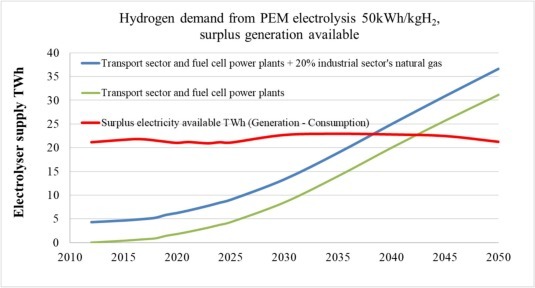
Fig. 11. Available surplus electricity for green hydrogen production in the Intense Mitigation Pathway. (For interpretation of the references to colour in this figure legend, the reader is referred to the web version of this article.)
Technology Overview
This study uses the Taiwan 2050 Calculator to craft customized decarbonization scenarios for Taiwan, a region with a unique autonomous power grid. It integrates local and international energy data to assess emission trajectories. The framework emphasizes a holistic approach, evaluating the combined impact of various "decarbonization pillars" including renewables, hydrogen fuels, BECCS, electrification, and energy efficiency. It also considers advanced industrial strategies like CCS, fuel switching, and green hydrogen, adapting to Taiwan's specific geographic limitations.
Applications & Benefits
The research provides a clear, actionable roadmap for Taiwan's policymakers to achieve net-zero emissions by 2050, offering a tailored alternative to generic solutions. It proposes a carbon tax (at least NT$3000/ton CO2e) as a central policy tool, despite potential initial electricity price increases. Prioritizing decarbonizing electricity generation with mature renewable and carbon capture technologies enhances energy security and creates local jobs. The insights gained from Taiwan's case can also serve as valuable guidance for other autonomous regions facing similar energy import dependencies and geographical constraints in their decarbonization journeys.
Abstract:
Taiwan's 2050 net-zero commitment aligns with global trends, impacting technology forecasting and society. Hence, defined emissions reduction pathways encompass all sectors of the economy, along with a proposed net-zero roadmap. This work relies on the Taiwan 2050 calculator which is a stocks and flows database allowing to tailor emission reduction scenarios involving economic, demographic growth, and technological levers on the supply and demand side. As an independent power grid region heavily reliant on energy imports, Taiwan's transition experiences provide valuable insights for other nations/regions. Decarbonizing the electricity sector and implementing negative emission technologies are key for reaching net-zero. Emission reduction in the industrial sector can be enhanced further when co-firing with biofuels and hydrogen on top of carbon capture and storage and energy efficiency reforms. Massive electrification and biofuel blends will nearly decarbonize the transport sector. However, only a consequent carbon tax can incentivize the reforms and justify the increased production costs. A renewables dominant electricity generation mix will significantly raise electricity prices, but it will simultaneously increase energy security and create local employment opportunities. Lessons from Taiwan's transition can guide other nations/regions in decarbonization, energy security, sustainable growth, and understanding the social implications of these policies.
Decarbonization strategies and achieving net-zero by 2050 in Taiwan: A study of independent power grid region
Author:Emmanuel Binyet, Hsin-Wei Hsu
Year:2024
Source publication:Technological Forecasting and Social Change, Volume 204, July 2024
Subfield Highest percentage:99% Business and International Management #2 / 451
https://www.sciencedirect.com/science/article/pii/S004016252400235X