

Gestures as scaffolding for L2 narrative recall: The role of gesture type, task complexity, and working memory
This study aims to investigate how instructor gestures influence L2 narrative recall, specifically examining the pedagogical impact of different gesture types and the moderating roles of task complexity and learner working memory capacity. The goal is to provide empirical evidence for effective multimodal teaching strategies in second language acquisition.
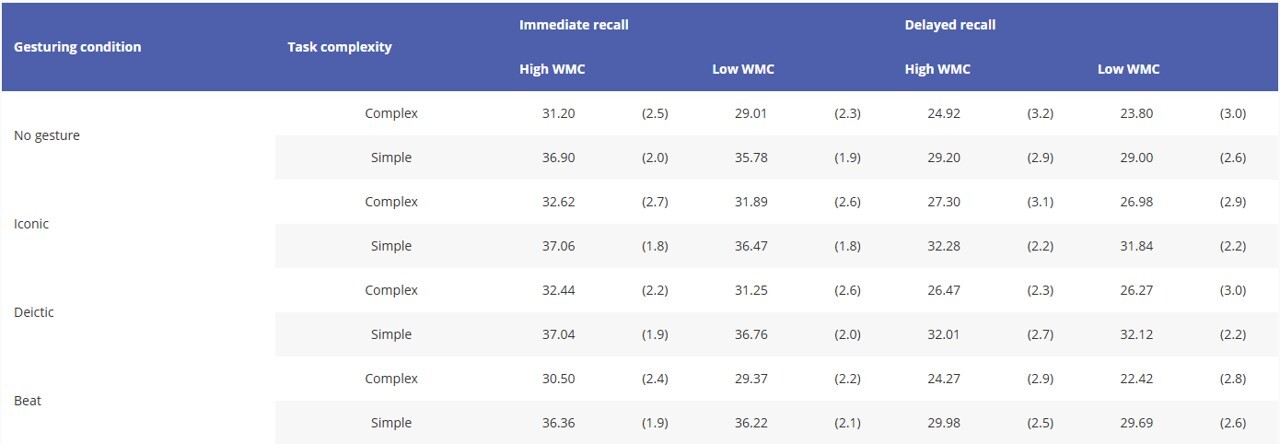
Table 3. Mean scores (with SD) of recall performance across gesturing conditions by learners of different working memory capacity (WMC) levels.
Technology Overview
This study explores the pedagogical effect of instructor gestures on L2 (second language) narrative recall. The core "technology" here isn't a physical device, but rather the human-to-human interaction of gesturing and its impact on learning. The researchers specifically looked at different types of gestures: deictic (pointing, like "here"), iconic (representing something, like miming "eating"), and beat (rhythmic hand movements without specific meaning). They aimed to understand how these gestures help L2 learners remember stories, especially considering factors like task complexity and learners' Working Memory Capacity (WMC).
Applications & Benefits
The study found that viewing deictic and iconic gestures significantly improves long-term retention of L2 narrative information. This means students remember the material for longer. Gestures are particularly beneficial in complex learning tasks (narratives with many scenes, events, or motions). They act as a cognitive scaffold, helping learners break down and process difficult information. Crucially, instructor gestures were found to reduce the impact of individual differences in WMC on recall performance. This is a huge benefit for learners with lower WMC, as gestures help them manage their cognitive load and better process information. Teachers can strategically incorporate different gesture types into their lessons to facilitate the acquisition of specific kinds of information. For instance, deictic gestures are good for event information, and iconic gestures for motion details. The research highlights the importance of training L2 teachers in multimodal competence or gestural competence. By explicitly learning how to use gestures effectively, teachers can reinforce, clarify, and supplement their verbal instruction, ultimately leading to better student comprehension and recall.
Abstract:
This study investigated the extent to which different pedagogical gestures contribute to learners’ foreign or second language (L2) narrative recall, and further discussed how task complexity and task difficulty (i.e. working memory capacity or WMC) influence recall performance. Sixty-four adolescent learners, assigned to four different gesture viewing conditions (iconic gestures, deictic gestures, beat gestures, or no gesture), were required to listen to an instructor telling two stories (one complex and one simple) and then retell both stories twice: once immediately after listening (immediate recall) and a second time two weeks later (delayed recall). Recall performance was evaluated by the number of relevant pieces of event and motion information produced in the participants’ retelling. The results show that L2 learners who were exposed to deictic and iconic gesture conditions outperformed the other gesture groups, particularly in delayed narrative recall, but only in complex tasks where cognitive demands were increased. It was also found that event and motion information was retained for a longer period of time in the deictic and iconic conditions respectively. Although both high and low WMC groups benefitted from viewing gestures, this finding further indicates that the beneficial effect of gestures on learners could possibly compensate for low WMC by providing scaffolding that reduces cognitive burden in narrative recall.
Gestures as scaffolding for L2 narrative recall: The role of gesture type, task complexity, and working memory
Author:Yen-Liang Lin
Year:2024
Source publication:Language Teaching Research, Volume 28, Issue 6, Pages: 2059 - 2081
Subfield Highest percentage:99% Language and Linguistics #4 / 1126
https://journals.sagepub.com/doi/full/10.1177/13621688211044584