

Effect of wind-based climate-responsive design on city breathability of a compact high-rise city
The aim of the present study is to address identified research gaps by investigating the multiple facets linked to wind trends in high-rise buildings. Specifically, the wind speed distributions and the scope of ventilation around structures can explore the potential wind energy harnessing. In addition, how the variations in building density, building configuration, and wind direction affect the realization of urban wind energy are examined in this study. By focusing on these aspects, the comprehensive exploration of multifaceted trends then provides a highlight and more holistic understanding of the subject.
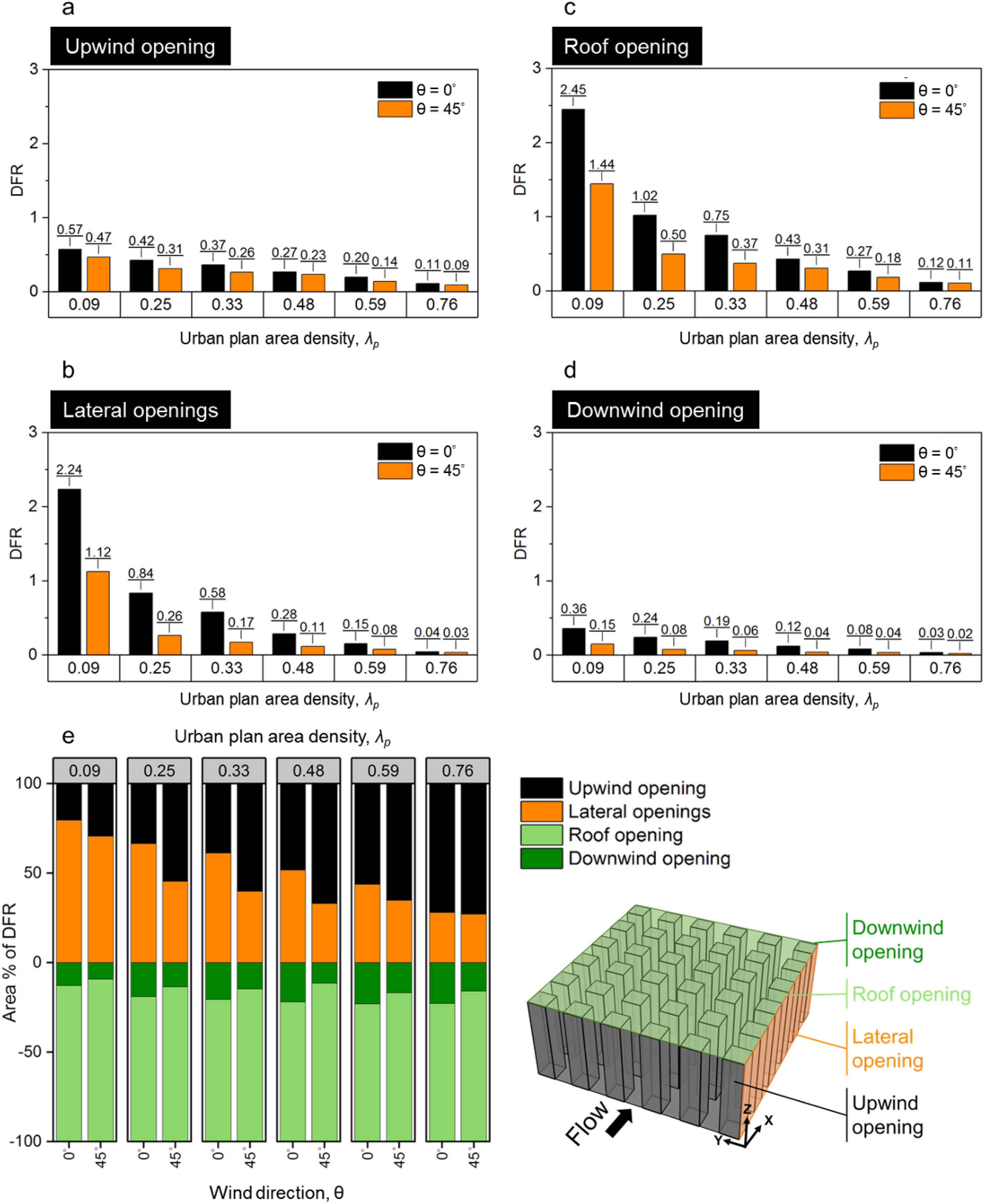
Fig. 14. DFRs through (a) upwind, (b) lateral, (c) roof and (d) downwind openings for different urban plan area densities; (e) area percentages of DFR through all openings for wind directions of 0° and 45° as Case_S1 to Case_S12 in UCL.
Technology Overview
A parametric CFD study is performed to assess city breathability of high-rise buildings. Effects of urban density and building corner shape on wind environments are evaluated. Ventilation outcomes with round corners are much better than those of sharp corners. Wind-based climate-responsive design is a sustainable solution for a compact city. Comprehensive exploration of multi-faceted impacts on wind field trends is conducted.
Applications & Benefits
Comprehensive assessments using CFD simulations are performed to explore the impacts of wind-based climate-responsive design on city breathability in a high-rise building array. The following parameters are studied: (i) the urban density, (ii) the building corner modification, and (iii) the wind direction. The analysis concentrates on the wind speeds and flow rates along the upwind, lateral, roof, and downwind openings with varied cross-sections inside the building array. The integrated trends of major conclusions are in accordance with the results of most studies mentioned in introduction. Besides, the innovative contributions of our study encompass an in-depth understanding of the effects of urban morphology, including the wind patterns, building corner modifications, and wind direction variability on the wind environments around high-rise building arrays.
Abstract:
As urban development advances, there is an increasing interest in compact cities as the most sustainable form. To suggest a pronounced connection between dense urban morphology and wind environments, this study adopts the new approach of wind-based climate-responsive design to investigate the influences of urban density, building corner modification, and wind direction on urban ventilation outcomes for the enhancement of city breathability. The airflow rates are estimated using a high-rise building array layout to optimize urban penetrability for enhancing breathability. The results of the CFD parametric study indicate that compact urban layouts with larger λp values experience good infiltration rates, ensuring wind comfort at the pedestrian level. Conversely, sparse urban forms with reduced λp values can achieve better permeation outcomes, resulting in elevated wind speeds at the middle level and near the roof of buildings, as well as higher airflow rates through the urban canyon layer. Additionally, the implementation of round corners reduces average wind speeds at the pedestrian level by 39% and increases wind speeds above the middle level of high-rise buildings by 20%, as compared to those of sharp corners. These findings offer valuable insights for high-rise building planning strategies, serving as both immediate and long-term solutions to realize the sustainable objectives of wind-based climate-responsive design in compact cities. Present research has offered the multifaceted trends of wind energy assessments on the realization of urban wind power. This paper also provides a theoretical framework that can assist urban designers in implementing the wind-based climate-responsive designs and enhancing living environments in contemporary compact cities.

Effect of wind-based climate-responsive design on city breathability of a compact high-rise city
Author:Juan Yu-Hsuan, Li Zhengtong, Lee Yee-Ting, Wen Chih-Yung, Yang An-Shik
Year:2023
Source publication:Journal of Building Engineering Volume 78, 1 November 2023
Subfield Highest percentage:99% Architecture #1 / 189
https://www.sciencedirect.com/science/article/pii/S2352710223019538