

SFA-Net: A Selective Features Absorption Network for Object Detection in Rainy Weather Conditions
In this article, we present a novel selective features absorption network (SFA-Net) to improve the performance of object detection not only in rainy weather conditions but also in favorable weather conditions.
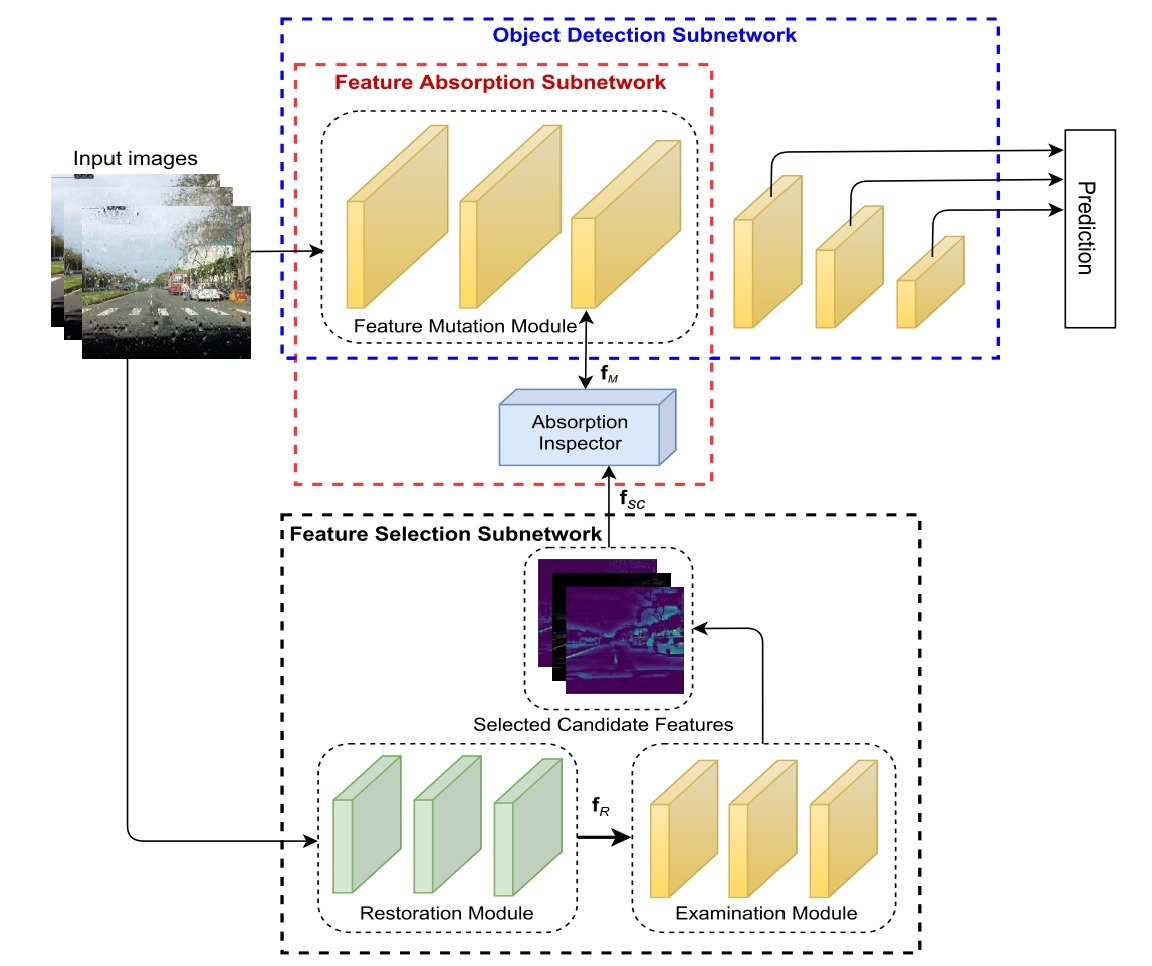
Fig. 2. Architecture of the proposed SFA-Net. Notably, in the SFA-Net, the feature selection subnetwork and feature absorption subnetwork are only activated during the training process. The object detection subnetwork is responsible for detecting objects in the inference phase. The restoration module is used to generate clean features instead of rain-free images from input rainy images. The absorption inspector transfers fSC to the FM module on the basis of the learning characteristics of fSC during training. The inspector then sends feedback to the FM module for producing samples (fM) that are indistinguishable from fSC.
Technology Overview
SFA-Net consists of three subnetworks, namely, feature selection subnetwork, feature absorption subnetwork, and object detection subnetwork. In the proposed model, the feature absorption subnetwork is employed to connect the feature selection subnetwork and object detection subnetwork for forming a unified framework.
Applications & Benefits
The extensive qualitative and quantitative results confirm the efficiency and superiority of SFA-Net over competitive models while retaining the high speed of detection.
Abstract:
In recent years, object detection approaches using deep convolutional neural networks (CNNs) have derived major advances in normal images. However, such success is hardly achieved with rainy images due to lack of visibility. Aiming to bridge this gap, in this article, we present a novel selective features absorption network (SFA-Net) to improve the performance of object detection not only in rainy weather conditions but also in favorable weather conditions. SFA-Net accomplishes this objective by utilizing three subnetworks, where the feature selection subnetwork is concatenated with the object detection subnetwork through the feature absorption subnetwork to form a unified model. To promote further advancement in object detection impaired by rain, we propose a large-scale rainy image dataset, named srRain, which contains both synthetic rainy images and real-world rainy images for training and testing purposes. srRain is comprised of 25,900 rainy images depicting diverse driving scenarios in the presence of rain with a total of 181,164 instances interpreting five common object categories. Experimental results display that our SFA-Net reaches the highest mean average precision (mAP) of 77.53% on a normal image set, 62.52% on a synthetic rainy image set, 37.34% on a collected natural rainy image set, and 32.86% on a published real rainy image set, surpassing current state-of-the-art object detectors and the combination of image deraining and object detection models while retaining a high speed.

SFA-Net: A Selective Features Absorption Network for Object Detection in Rainy Weather Conditions
Author:Huang, S., Hoang, Q., Le, T.
Year:2022
Source publication: IEEE Transactions on Neural Networks and Learning Systems ( Early Access )
Subfield Highest percentage:99% Computer Science Computer Networks and Communications #3/334