

Synergistic Effect of Cation Composition Engineering of Hybrid Cs1−xFAxPbBr3 Nanocrystals for Self-Healing Electronics Application
Herein, a two-step modified hot-injection combined with cation compositional engineering and surface treatment to synthesize high-purity cesium/formamidinium lead bromide HPNCs(Cs1-xFAxPbBr3) is presented. The optimized Cs0.5FA0.5PbBr3 light-emitting devices (LEDs) exhibit uniform luminescence of 3500 cd m−2 and a prominent current efficiency of 21.5 cd A−1. As a proof of concept, a self-healing polymer (SHP) integrated with white LED backlight and laser prototypes exhibited 4 h autonomous self-healing through the synergistic effect of weak reversible imine bonds and stronger H-bonds.
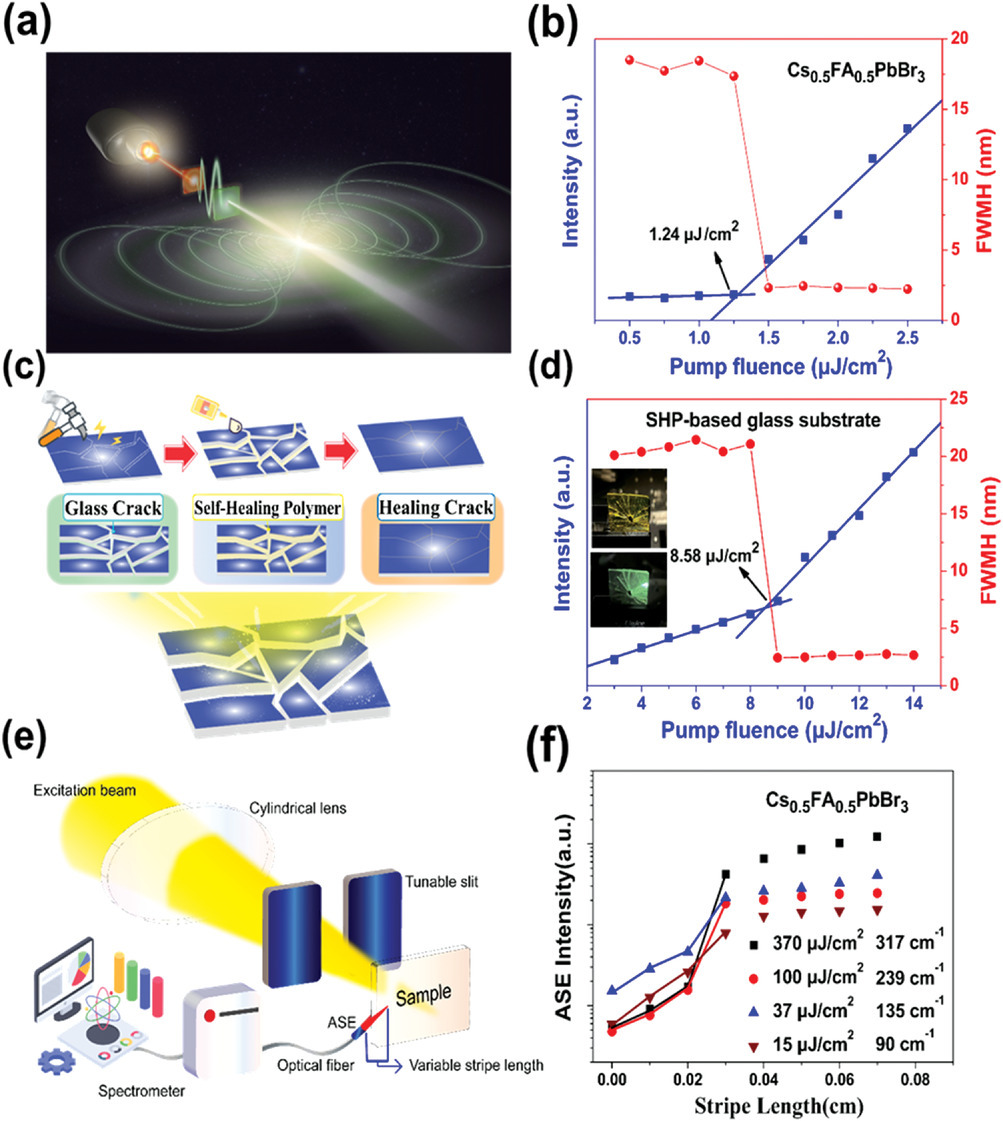
Schematic diagrams of SHP-based laser device. a) Schematic illustration of experimental setup for amplified spontaneous emission. b) The integrated intensity and FWHM of Cs0.5FA0.5PbBr3 HPNCs films as a function of pump intensity. c) Schematic diagrams of self-healing coating Cs0.5FA0.5PbBr3 HPNCs glass substrate concept. d) The integrated intensity and FWHM of SHP-based Cs0.5FA0.5PbBr3 HPNCs glass substrate as a function of pump intensity. Inset photographs display the initial state of SHP-based Cs0.5FA0.5PbBr3 HPNCs glass substrate without and with UV lamp (λ = 365 nm). e) Schematic illustration of experimental setup by variable stripe length method. f) The integrated intensity of Cs0.5FA0.5PbBr3 HPNCs films as a function of the stripe length with various pump intensities.
Technology Overview
Herein, we introduce a simple and practical alternative pathway that highlights three major aspects of our work. First, we conduct a kinetic A-site cation exchange (FA and Cs) to develop highly pure mixed-cation perovskite system based on two-step modified hot-injection (TMHI) and surface treatment (ST) process. Second, we design a backlight display through encapsulation of Cs0.5FA0.5PbBr3 PeNCs into SHP. We exploit the synergistic effect of highly mobile chain as entropic contribution with strong dynamic H-bond and weaker reversible imine bonds for efficient self-healing. Third, the Cs0.5FA0.5PbBr3 PeNCs is employed for ASE laser fabrication, and exhibit a low lasing threshold value of 1.24 µJ cm−2. The perovskite cation composition engineering with strong encapsulation by SHP polymer, highlight the universality of our SHP-PeNCs composite for versatile optoelectronic and photonics applications.
Applications & Benefits
In summary, we first demonstrated a high-efficiency colloidal Cs1-xFAxPbBr3 HPNCs through the substitution of Cs+ by FA+ cations, contributed to the modification of Pb−Br bond lengths and angles within the PbX64− octahedron. The associations between the FA dopant, surface ligand density, morphology, and LED performance were systematically investigated in the perovskite crystal structure. The ST-2-based Cs0.5FA0.5PbBr3 HPNCs PeLEDs exhibited homogeneous luminance of 3500 cd m−2, and a prominent current efficiency of 21.5 cd A−1. More importantly, we presented two entropy-driven self-healing mechanisms application in perovskite backlight and laser via self-healing material and Cs0.5FA0.5PbBr3 HPNCs combination.
Abstract:
Mixed-cation hybrid perovskite nanocrystal (HPNC) with high crystallinity, color purity, and tunable optical bandgap offers a practical pathway toward next-generation displays. Herein, a two-step modified hot-injection combined with cation compositional engineering and surface treatment to synthesize high-purity cesium/formamidinium lead bromide HPNCs(Cs1-x FAx PbBr3 ) is presented. The optimized Cs0.5 FA0.5 PbBr3 light-emitting devices (LEDs) exhibit uniform luminescence of 3500 cd m-2 and a prominent current efficiency of 21.5 cd A-1 . As a proof of concept, a self-healing polymer (SHP) integrated with white LED backlight and laser prototypes exhibited 4 h autonomous self-healing through the synergistic effect of weak reversible imine bonds and stronger H-bonds. First, the SHP-HPNCs-initial and SHP-HPNCs-cut possess high long-term stability and dramatically suppressed lead leakage as low as 0.6 ppm along with a low leakage rate of 1.11 × 10⁻⁵ cm2 and 3.36 × 10⁻⁵ cm2 even over 6 months in water. Second, the Cs0.5 FA0.5 PbBr3 HPNCs and SHP-induced shattered-repaired perovskite glass substrate show the lowest lasing threshold values of 1.24 and 8.58 µJ cm-2 , respectively. This work provides an integrative and in-depth approach to exploiting SHP with intrinsic and entropic self-healing capabilities combined with HPNCs to develop robust and reliable soft-electronic backlight and laser applications.
Synergistic Effect of Cation Composition Engineering of Hybrid Cs1−xFAxPbBr3 Nanocrystals for Self-Healing Electronics Application
Author:Fang-Cheng Liang, Fu-Cheng Jhuang, Yu-Han Fang, Jean-Sebastien Benas, Wei-Cheng Chen, Zhen-Li Yan, Wei-Chun Lin, Chun-Jen Su, Yuki Sato, Takayuki Chiba, Junji Kido, Chi-Ching Kuo
Year:2023
Source publication:Advanced Materials Volume35, Issue9 March 2, 2023, 2207617
Subfield Highest percentage:99% Mechanical Engineering #3/631
https://advanced.onlinelibrary.wiley.com/doi/full/10.1002/adma.202207617