

Tuning Ambipolarity of the Conjugated Polymer Channel Layers of Floating-Gate Free Transistors: From Volatile Memories to Artificial Synapses
In this study, we synthesize five dual-acceptor conjugated polymers (F0, F10, F25, F40, and F50) through the random copolymerization of the DPP unit and the benzotriazole unit at varied molar ratios.
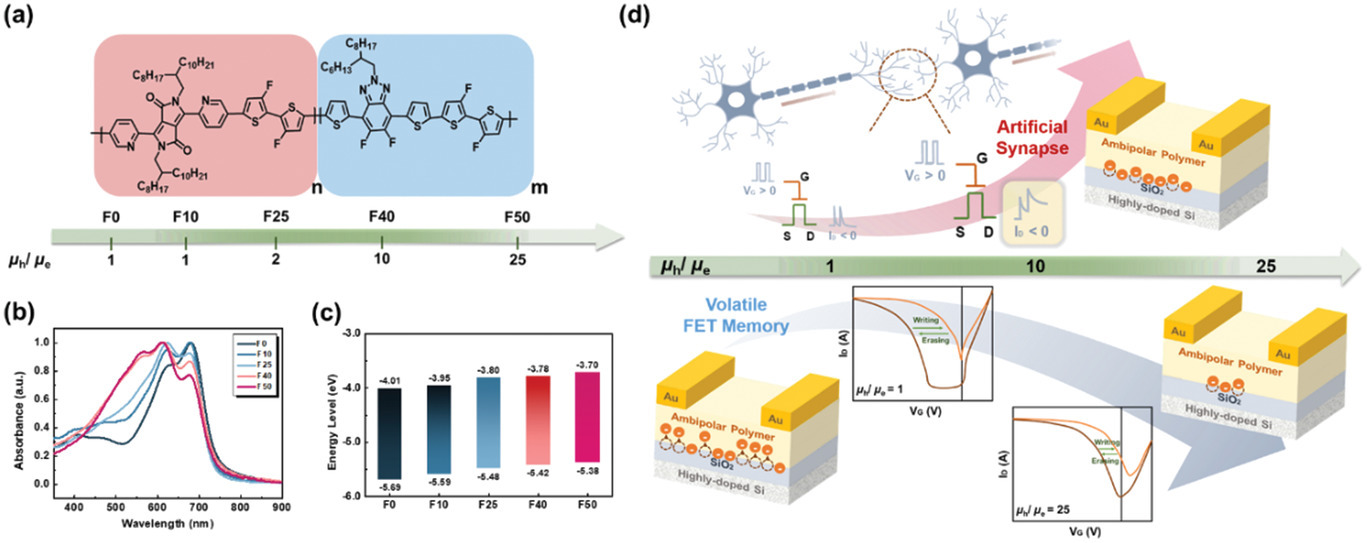
a) Chemical structures, b) UV–vis absorption spectra, and c) energy levels of the target DPP-based dual-acceptor random polymers, where n:m = 100:0 (F0), 90:10 (F10), 75:25 (F25), 60:40 (F40), and 50:50 (F50). d) The correlation between the hole/electron mobility ratio of the polymer channel and the resultant memory, synaptic characteristics.
Technology Overview
This study reveals an unexpected compromise between the volatile memory characteristics and the artificial synaptic characteristics for a floating-gate free transistor memory. This dependence on polymer's ambipolarity provides a clear design principle for the organic floating-gate free synaptic transistors.
Applications & Benefits
We describe a clear correlation among the µh/µe ratio, the memory retention characteristic, and the synaptic behavior for the polymer channel layer in a floating-gate free transistor by studying five DPP–benzotriazole dual-acceptor random conjugated polymers. Our results demonstrate the influence of the energy levels and the µh/µe ratios of ambipolar polymers on the volatile memories and artificial synapses for floating-gate free transistors.
Abstract:
Three-terminal synaptic transistor has drawn significant research interests for neuromorphic computation due to its advantage of facile device integrability. Lately, bulk-heterojunction-based synaptic transistors with bipolar modulation are proposed to exempt the use of an additional floating gate. However, the actual correlation between the channel's ambipolarity, memory characteristic, and synaptic behavior for a floating-gate free transistor has not been investigated yet. Herein, by studying five diketopyrrolopyrrole–benzotriazole dual-acceptor random conjugated polymers, a clear correlation among the hole/electron ratio, the memory retention characteristic, and the synaptic behavior for the polymer channel layer in a floating-gate free transistor is described. It reveals that the polymers with balanced ambipolarity possess better charge trapping capabilities and larger memory windows; however, the high ambipolarity results in higher volatility of the memory characteristics, namely poor memory retention capability. In contrast, the polymer with a reduced ambipolarity possesses an enhanced memory retention capability despite showing a reduced memory window. It is further manifested that this enhanced charge retention capability enables the device to present artificial synaptic characteristics. The results highlight the importance of the channel's ambipolarity of floating-gate free transistors on the resultant volatile memory characteristics and synaptic behaviors.
Tuning Ambipolarity of the Conjugated Polymer Channel Layers of Floating-Gate Free Transistors: From Volatile Memories to Artificial Synapses
Author:Yu-Ting Yang, Ying-Sheng Wu, Waner He, Hsin-Chiao Tien, Wei-Chen Yang, Tsuyoshi Michinobu, Wen-Chang Chen, Wen-Ya Lee, Chu-Chen Chueh
Year:2022
Source publication:Advanced Science Volume 9, Issue 313, November 2022 Article number 2203025
Subfield Highest percentage:99% General Engineering #2/300
https://onlinelibrary.wiley.com/doi/full/10.1002/advs.202203025