

In-situ construction of ternary metal oxide heterostructures Mn@LaZrO: A novel multi-functional nanocatalyst for detecting environmental hazardous 4-nitroaniline
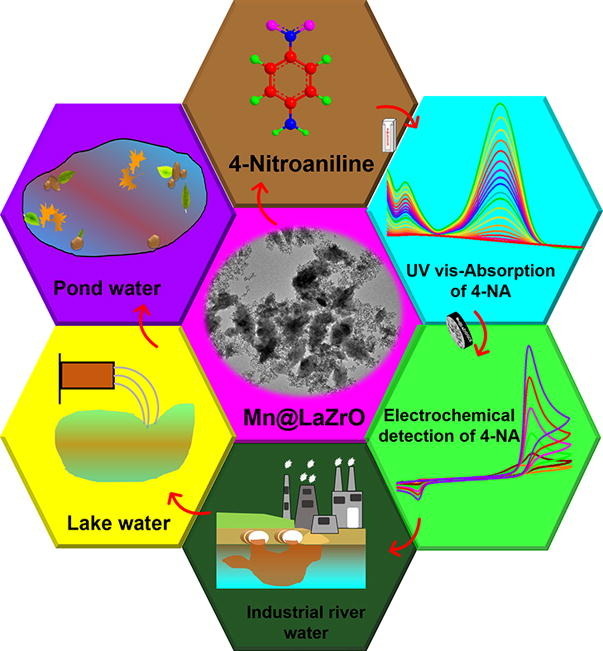
The detection of 4-NA in the pretreated real samples as lake water, pond water, and industrial river water was executed. DPV analysis were established followed by the addition of 4-NA at Mn@LaZrO/GCE in the pretreated real sample environment.
Technology Overview
The Mn@LaZrO was prepared via in-situ hydrothermal synthesis. Electrochemical and UV–vis sensing analysis for 4-NA detection was executed. Both the analytical techniques exhibited excellent response for 4-NA at Mn@LaZrO. Lower LOD for both the studies were obtained to be about 3 nM and 41 nM. The real sample analysis in environmental samples showed good results.
Applications & Benefits
The Mn@LaZrO electrode material possessed high crystallinity with nanosized particles with unique chemical and physical properties. The elemental presence of Mn@LaZrO was agreed with the studies as XPS, EDAX, and mapping analysis. The Mn@LaZrO was significant with a bifunctional property of detecting 4-NA in environmental samples.
Abstract:
The level of environmental pollutants is kept increasing as the continued sources of waste discharges into the ecosystem. The improper discharge of industrial waste products, widely used pesticides in agriculture, and pharmaceutical discharges are the major source of this uplift. Nitro aromatics are one among the major intermediates for producing dyes, pesticides, and fungicides. Monitoring and assessing these environmental pollutants is more important to reduce the consequences experienced by human and aquatic life. Thus, the dual-sensing platform was developed for analyzing the 4-nitroaniline (4-NA) derivative via electrochemical and UV–vis sensing analysis. Inspired by the unique properties of nanomaterials trimetallic oxides as manganese with lanthanum zirconium oxide (Mn@LaZrO) were synthesized. The physicochemical features were determined with different analytical techniques. The Mn@LaZrO was found with pure crystalline nature and nanospheres at nanoplates were identified. The fabricated electrode with Mn@LaZrO was exposed to both the sensing analysis (UV and electrochemical) with 0.049 µM −1443.78 µM and 0.49 µM-159.61 µM linear ranges of 4-NA addition. The higher surface area with more reactive active sites triggered the faster electron transfer rate in 4-NA sensing. The Mn@LaZrO/GCE showed lowered resistance with the Rct value of 117.75 Ω determining the higher electrocatalytic activity of the composite. The LOD was obtained to be 0.003 µM and 0.041 µM. The highly influential factors such as selectivity, repeatability, reproducibility, and stability parameters depicted excellent performances. Thus, the dual-functional Mn@LaZrO executes excellent performances with its unique features.

In-situ construction of ternary metal oxide heterostructures Mn@LaZrO: A novel multi-functional nanocatalyst for detecting environmental hazardous 4-nitroaniline
Author:Nandini Nataraj, Tse-Wei Chen, Muthumariappan Akilarasan, Shen-Ming Chen, Bih-Show Lou, Wedad A. Al-onazi, M. Ajmal Ali, Mohamed S Elshikh
Year:2022
Source publication:Chemical Engineering Journal Volume 446, Part 3, 15 October 2022, 137025
Subfield Highest percentage:99% Industrial and Manufacturing Engineering #3/338
https://www.sciencedirect.com/science/article/pii/S1385894722025177