

CFD assessment of wind energy potential for generic high-rise buildings in close proximity: Impact of building arrangement and height
We presents the 14 test cases used to study the influence of the following three parameters:
(1)The passage width between the two upstream buildings (w): w varies from 0.15B to 0.75B.
(2)The streamwise distance between the upstream and downstream buildings (d): d varies from 0.3B to 0.6B.
(3)The height difference between the upstream and downstream buildings (ΔH = Hu – Hd): ΔH varies from −0.3H to 0.3H, while w and d are the same as the reference case.
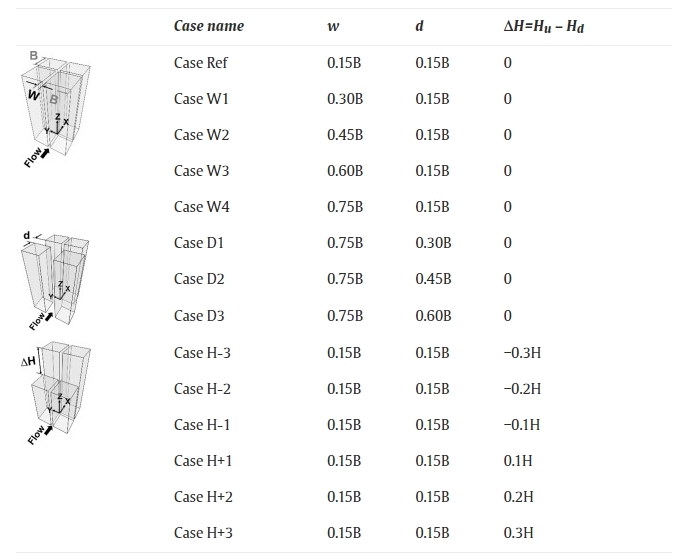
For these cases only the arrangement and height of the upstream buildings are varied while the passage width between the two downstream buildings remains unchanged at 0.15B.
Technology Overview
Comprehensive analysis of wind energy potential for a generic compact urban areas.Insights on impact of building arrangement and height on wind energy potential.Analysis of impact of WT type: HAWT, typical and horizontally-mounted Darrieus VAWT.The distance between buildings can lead to a 65% variation in wind power density.
Applications & Benefits
The power densities calculated for a horizontally-mounted VAWT are higher than those of a HAWT and a typical VAWT by approximately 11% – 37% at z/Hd = 0.97 for the normal wind direction of 0°. This proposes a significant contribution of the vertical velocity component, concluding that the horizontally-mounted VAWT is the best option for wind energy harvesting in the passage between the buildings and along the rooftop.
Abstract:
High-rise building complexes are of great importance for enabling sustainable urban development in large parts of the world. Earlier studies have indicated that high wind speed regions can be present along the passage between two high-rise buildings as well as above the roofs. At such locations, urban wind energy could be harvested by installing wind turbines between and/or above the roof of the buildings. However, the available wind energy potential around an array of generic high-rise buildings in close proximity has not yet been assessed for different building configurations. This paper conducts a detailed evaluation of the impacts of the building arrangement and height for a 2 × 2 array with a building height-to-street width ratio of 30 on the mean wind velocity and the wind energy potential along the passages between both upstream and downstream buildings as well as on their roofs. The following parameters are analyzed: (i) the passage width between the two upstream buildings (w), (ii) the streamwise distance between the upstream and downstream buildings (d), and (iii) the height difference between the upstream and downstream buildings (ΔH). The 3D steady Reynolds-averaged Navier-Stokes (RANS) equations are solved using the Reynolds stress model (RSM) turbulence model for closure. The CFD results are validated using wind-tunnel measurements of mean wind speed and turbulence intensity performed for the same building array. The results show elevated wind power density along the upstream passages for small w (=0.15B), high d (=0.6B), and equal building height (ΔH = 0). In contrast, comparatively high values of w, small d, and ΔH < 0 yield high wind power densities between the downstream buildings. Among the different wind turbine types considered, horizontally-mounted vertical axis wind turbines seem the most promising option for wind energy harvesting between the buildings.

CFD assessment of wind energy potential for generic high-rise buildings in close proximity: Impact of building arrangement and height
Author:Yu-Hsuan Juan, Abdolrahim Rezaeiha, Hamid Montazeri, Bert Blocken, Chih-Yung Wen, An-Shik Yang
Year:2022
Source publication:Applied Energy Volume 321, 1 September 2022, 119328
Subfield Highest percentage:99% Building and Construction #1/211
https://www.sciencedirect.com/science/article/pii/S030626192200678X