

Optimization of the carrier recombination and transmission properties in perovskite LEDs by doping poly (4-vinylpyridine) and graphene quantum dots made of chitin
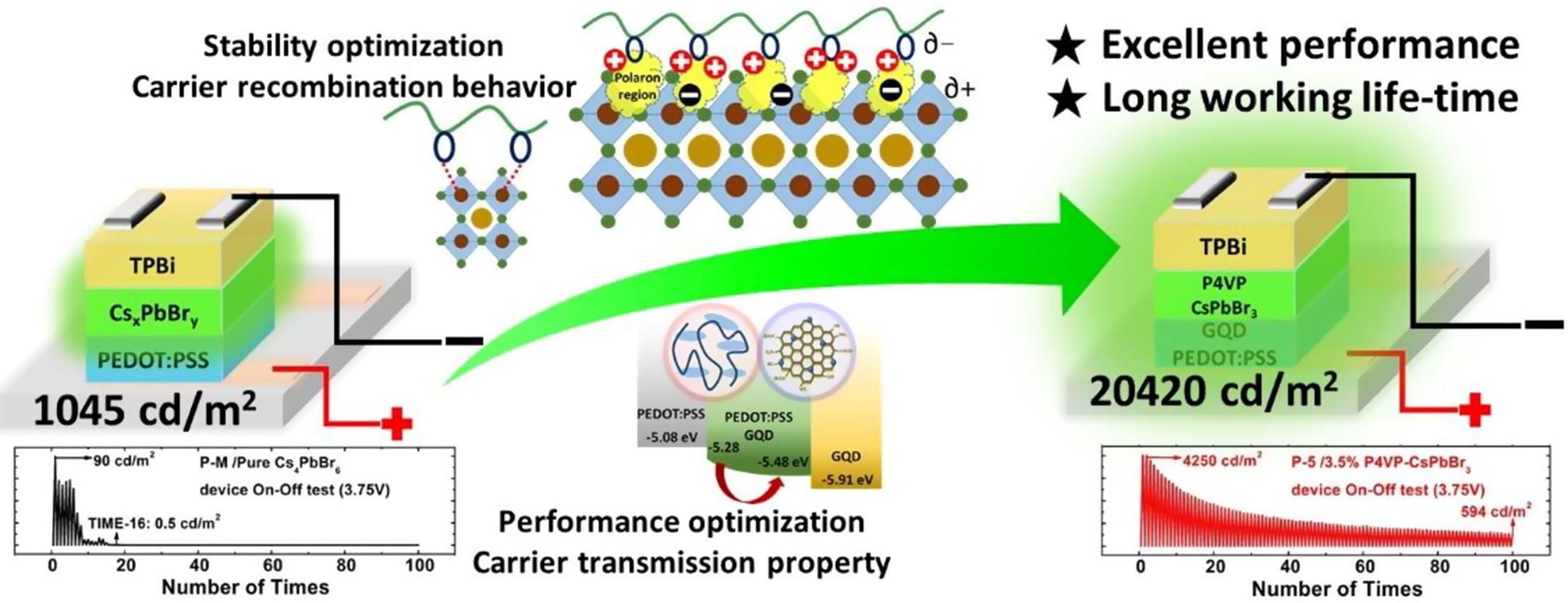
We optimized the perovskite-emitting layer (EML) and hole transport layer (HTL) of perovskite light-emitting diodes (PeLEDs) by poly-4-vinylpyridine (P4VP) and graphene quantum dots (GQDs) to investigate the effects of carrier recombination and transport properties on the lifetime and performance of the devices. Finally, we successfully produced PeLEDs with a peak brightness of 20,420cd m-2, and the cycle lifetimes increased from 16 cycles to 100 cycles.
Technology Overview
P4VP-controlled CsPbBr3 perovskite unitary orthorhombic structure crystallization. P4VP- CsPbBr3 polaron region induces free carriers polarization to protect EML. Efficient carriers transmission is achieved by using GQDs-HTL to align EML’s HOMO. PeLEDs’ luminance reaches 20420 cd.m-2 with stability beyond 100 cycles lifetimes.
Applications & Benefits
We successfully produced PeLEDs with a peak brightness of 20420 cd m-2 that are able to sustain brightness up to 594 cd m-2 after 100 uses. The long-life, high-performance PeLEDs of this study can be used to improve commercial PeLEDs products.
Abstract:
Light emission intensity and a lifetime of perovskite light-emitting diodes (PeLEDs) have improved considerably through fine-tuning the regulation of carriers’ recombination and transport. This study found that adding poly (4-vinylpyridine) within a CsxPbBry system leads to a dipole–dipole interaction of pyridine-N and Pb2+. This interaction increases the solubility of the CsxPbBry precursor solution, which stabilizes the CsxPbBry crystal structure and induces a CsPbBr3 unitary state. The interaction further generates a polaron region and causes the orderly distribution of excess carriers in the electric field, thus preventing disordered surface charges from structurally damaging the crystal. The PEDOT:PSS hole transport layer mixed with a graphene quantum dot made of chitin tunes the highest occupied molecular orbital to improve carrier transmission efficiency. We fabricated PeLEDs with a peak luminance of 20420 cd m-2 and a fatigue half-life four times higher than original PeLEDs. This stable performance of the device can hasten the commercial development of PeLEDs.
Optimization of the carrier recombination and transmission properties in perovskite LEDs by doping poly (4-vinylpyridine) and graphene quantum dots made of chitin
Author:Zhen-Li Yan, Fang-Cheng Liang, Chia-Yu Yeh, Darwin Kurniawan, Jean-Sebastien Benas, Wei-Cheng Chen, Chia‐Jung Cho, Wei-Hung Chiang, Ru-Jong Jeng, Chi-Ching Kuo
Year:2022
Source publication:Chemical Engineering Journal Volume 444, 15 September 2022, 136518
Subfield Highest percentage:99% Industrial and Manufacturing Engineering #3/338
https://www.sciencedirect.com/science/article/pii/S1385894722020137