

A portable Ru-decorated cobalt phosphide on graphitic carbon nitride sensor: An effective electrochemical evaluation method for vitamin B2 in the environment and biological samples
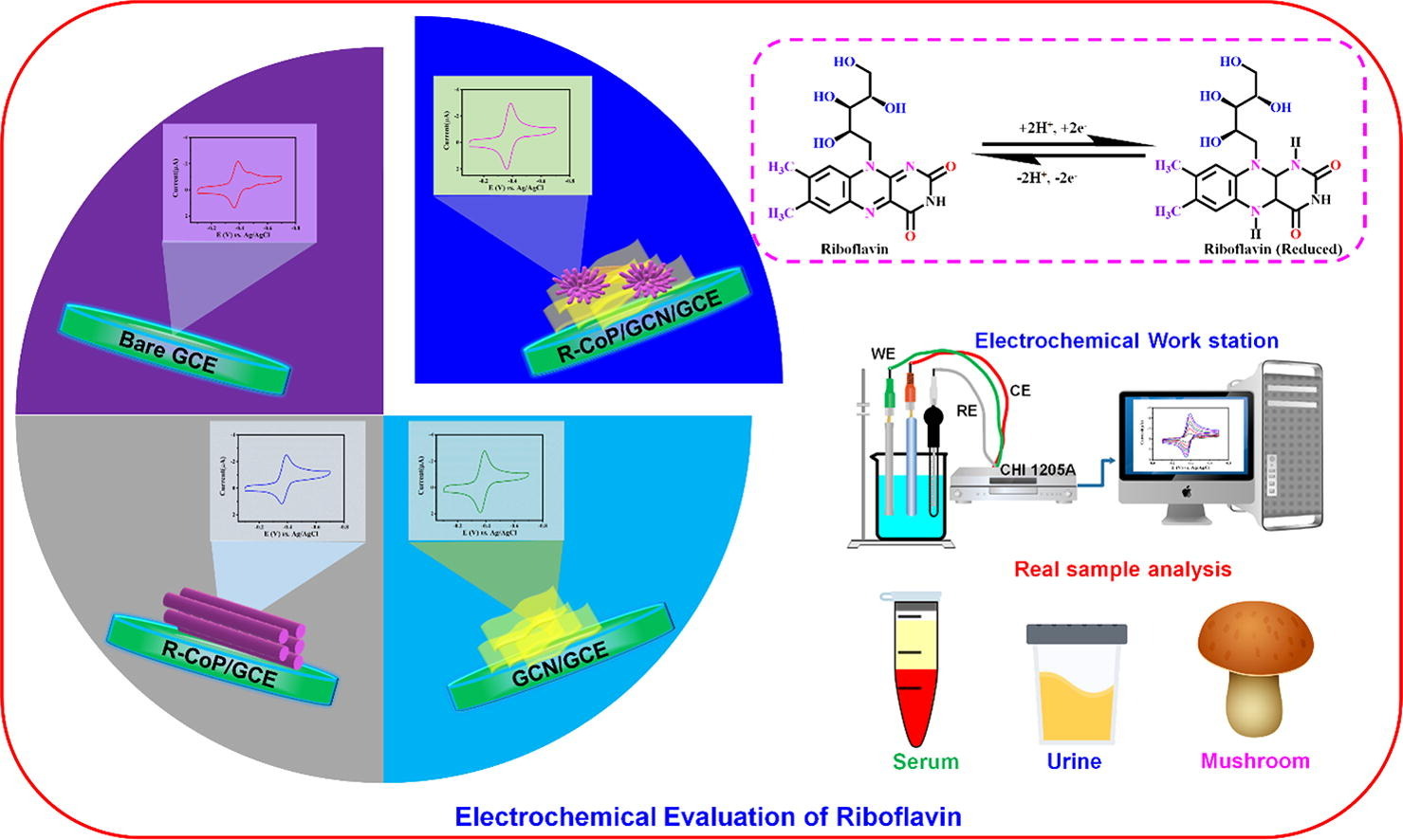
Electrochemical evaluation of Riboflavin (RF) through R-CoP/GCN/GCE in biological and environmental samples.
Technology Overview
R-CoP prepared through thermal treatment with sodium phosphate as phosphorus source.R-CoP/GCN has been synthesized through ultrasonication method.R-CoP/GCN/GCE is effectively implemented in the electrochemical evaluation of Riboflavin (RF).A promising candidate for day-to-day evaluation of toxic substances in the environment.
Applications & Benefits
The proposed R-CoP/GCN sensor shows exquisite electrochemical features including a wide linear range (0.062 – 3468.75 μM), Nanomolar detection limit (1.09 nM), and encouraging sensitivity (1.277 µA µM−1 cm−2).
Abstract:
With the significant importance of riboflavin (RF) in food, biological, and pharmaceutical areas, precisely determining its level is critical for regulating health and nutrition, diagnosis/treatment of related diseases, pharmacological research, and food/drug quality monitoring. Thus, the sensitive and accurate determination of RF is necessary. Herein, we construct facile and low-cost ruthenium (Ru) doped cobalt phosphide (R-CoP) embedded graphitic carbon nitride as an electrode modifier via a two-step synthesis method. By the virtue of its unique physiochemical properties such as high active surface area (69.43 m2/g) compares to similar electrocatalyst and high electron transfer kinetics with low charge transfer resistance (Rct = 367.89 Ω), it has been successfully employed in the electrochemical evaluation of RF. In this regard, it has been effectively employed in the electrochemical evaluation of RF through cyclic voltammetry (CV) and amperometric (i − t) techniques. The proposed R-CoP/GCN/GCE sensor shows exquisite electrochemical characteristics including a wide linear range (0.062 – 3468.75 μM), Nanomolar detection limit (1.09 nM), and encouraging sensitivity (1.277 µA µM-1 cm-2). Moreover, it also exemplifies exquisite selectivity, repeatability, reproducibility, and storage stability therefore it has been employed in the practical feasibility analysis in various real samples which shows excellent recovery results. On comparing, it exemplifies excellent electrochemical performance than the similar electrocatalyst in the electrochemical sensing of biological compounds in various real samples.
A portable Ru-decorated cobalt phosphide on graphitic carbon nitride sensor: An effective electrochemical evaluation method for vitamin B2 in the environment and biological samples
Author:Ragurethinam Shanmugam, Chelliah Koventhan, Shen-Ming Chen, Weisen Hung
Year:2022
Source publication:Chemical Engineering Journal Volume 446, Part 1, 15 October 2022, 136909
Subfield Highest percentage:99% Industrial and Manufacturing Engineering #3/338
https://www.sciencedirect.com/science/article/pii/S1385894722024032