

Phosphorous-doped molybdenum disulfide anchored on silicon as an efficient catalyst for photoelectrochemical hydrogen generation
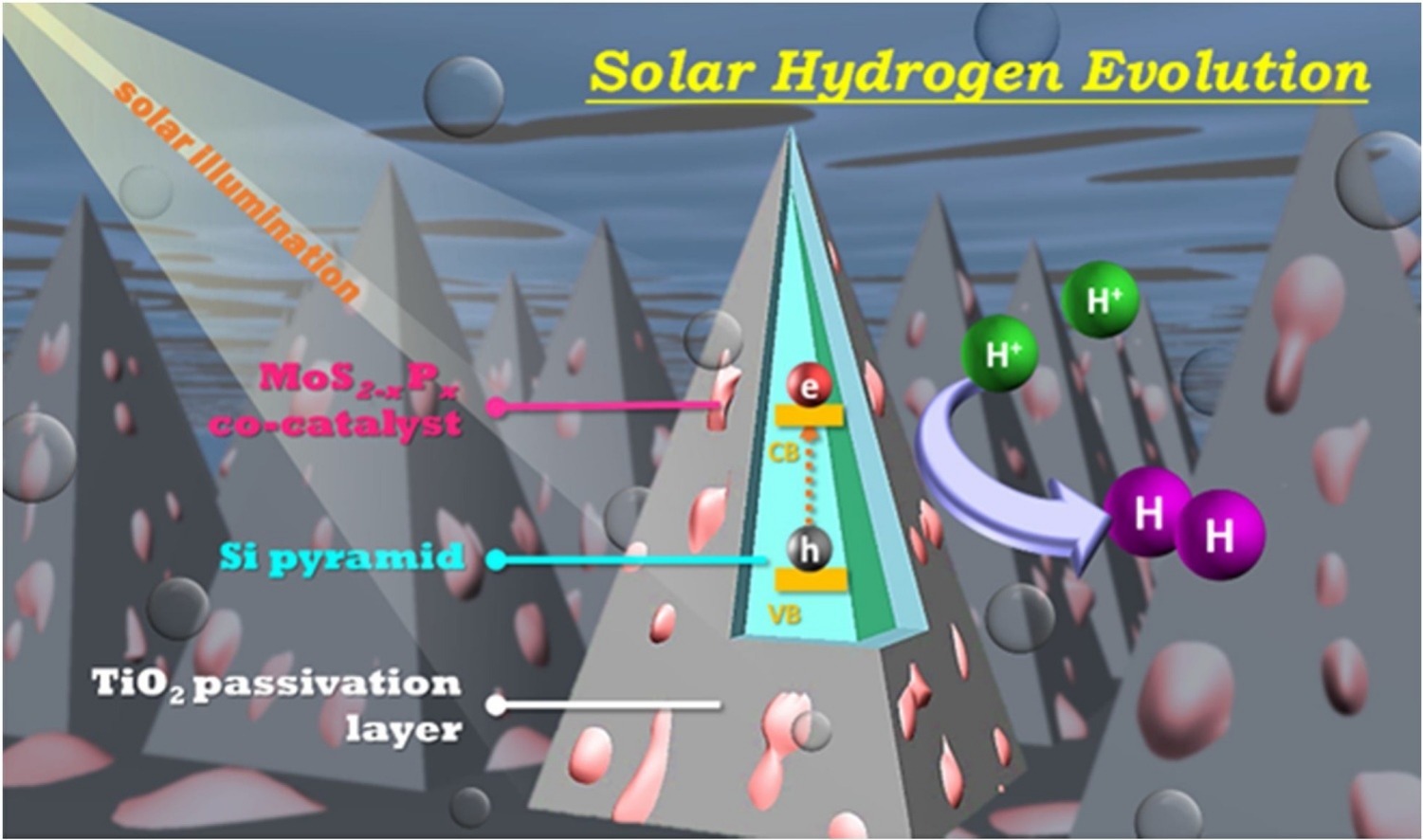
Herein, Si pyramids that were prepared through chemical wet etching were used as the photocathodes for solar hydrogen production.
Technology Overview
P-doped MoS2 was integrated on Si pyramids as photocathode for hydrogen evolution. The Efficiency was enhanced by exposing edges and activating basal planes of MoS2. MoS1.75P0.25/Si pyramids showed the optimal current density of −23.8 mA cm−2. MoS1.75P0.25/2 nm TiO2/Si electrode presented the current retention of 84.0%.
Applications & Benefits
The PEC durability of photocathodes were enhanced through decoration with a TiO2 passivation layer prepared through ALD. The current density retention of MoS1.75P0.25/10 nm TiO2/Si pyramids was 84.0% after 2 h of chronoamperometric measurement.
Abstract:
Herein, molybdenum disulfide (MoS2) integrated on Si pyramids was used as a co-catalyst to improve charge separation efficiency. Various quantities of phosphorus (P) heteroatoms were doped into MoS2 materials to boost catalytic performance. Raman and extended X-ray absorption fine structure spectra showed that the introduction of P dopants increased the number of exposed edges and sulfur vacancies that acted as hydrogen evolution reaction (HER) active sites on MoS2 and enhanced photoelectrochemical activity. Density functional theory calculations revealed that the HER inert basal plane of MoS2 became catalytically active after P atoms doping. MoS1.75P0.25/Si pyramids presented the optimal onset potential of +0.29 V (vs. RHE) and current density −23.8 mA cm−2. A titanium dioxide (TiO2) layer was prepared through atomic layer deposition and served as a passivation layer that improved photocathode stability. The photocurrent retention of MoS1.75P0.25/10 nm TiO2/Si pyramids was 84.0% after 2 h of chronoamperometric measurement.
Phosphorous-doped molybdenum disulfide anchored on silicon as an efficient catalyst for photoelectrochemical hydrogen generation
Author:Chen C.-J., Veeramani V., Wu Y.-H., Jena A., Yin L.-C.,Chang H.,Hu S.-F., Liu R.-S.
Year:2020
Source publication:Applied Catalysis B: Environmental Volume 263, April 2020, 118259
Subfield Highest percentage:99% General Environmental Science #1/220
https://www.sciencedirect.com/science/article/pii/S0926337319310069