

Optimization design by evolutionary computation for minimizing thermal stress of a thermoelectric generator with varied numbers of square pin fins
This study analyzes the thermoelectric performance and thermal stress of a thermoelectric module in a waste heat recovery system.
Technology Overview
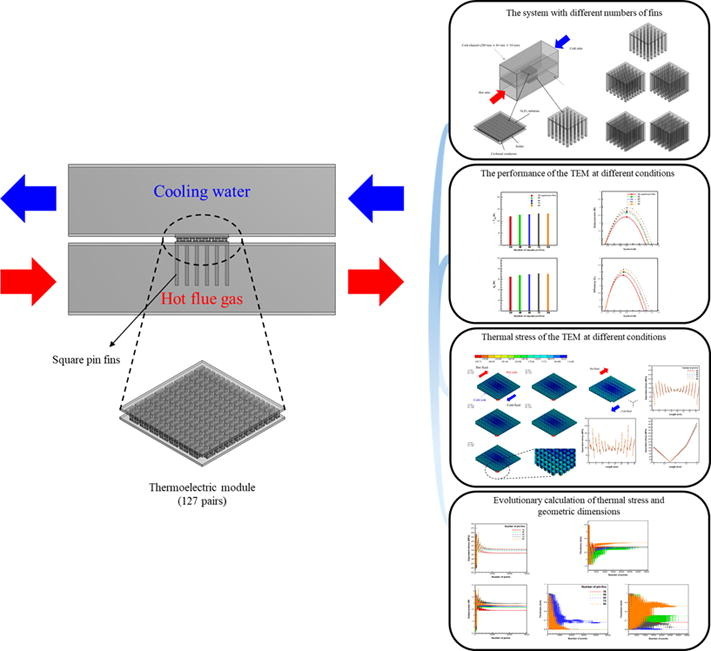
Thermoelectric performance and thermal stress of a TEM with square pin fins are examined. The temperature distribution in a TEM is uneven due to differences in heat transfer. The maximum thermal stress occurs at the corners of the TEM’s leg. The optimization method can effectively minimize thermal stress without losing power. The maximum thermal stress is reduced by approximately 11.78%.
Applications & Benefits
The results indicate that for different numbers of square pin fins, the heat transfer rate of the module’s hot side increases as the number of fins increases. The maximum thermal stress is reduced by approximately 11.78%, and thermal stress is reduced under a ceramic plate thickness smaller than 0.8 mm and a TE leg thickness greater than 2 mm.
Abstract:
Thermal stress plays an important role in the lifetime of thermoelectric generators, and its minimization can prolong the usage of the generators. To figure out and efficiently lower the thermal stress, this study analyzes the thermoelectric performance and thermal stress of a thermoelectric module in a waste heat recovery system. The performance of the TEM with varied numbers of square pin fins in a flow channel is examined by computational fluid dynamics. The results indicate that for different numbers of square pin fins, the heat transfer rate of the module’s hot side increases as the number of fins increases. When the number of fins increases from 36 to 84, the heat transfer rate improves by 8.57%. In addition, the temperature distribution in the module in a waste heat recovery system is uneven due to differences in heat transfer. Therefore, the thermal stress of the module is uneven, and the maximum thermal stress occurs in the TE legs, which are located at the corners of the module. To reduce the maximum thermal stress, the thicknesses of the ceramic plate and the thermoelectric legs are optimized using the multi-objective genetic algorithm. The optimization results indicate that the maximum thermal stress of the module is proportional to its output power, meaning that as the maximum thermal stress in the module is minimized, its output power will approach the minimum value. Instead, the same method is employed to minimize the maximum thermal stress on the module while maintaining its output power. As a result, the maximum thermal stress is reduced by approximately 11.78%, and thermal stress is reduced under a ceramic plate thickness smaller than 0.8 mm and a TE leg thickness greater than 2 mm.
Optimization design by evolutionary computation for minimizing thermal stress of a thermoelectric generator with varied numbers of square pin fins
Author:Wei-Hsin Chen, Chi-Ming Wang, Da-Sheng Lee, Eilhann E. Kwon, Veeramuthu Ashokkumar, Alvin B. Culaba
Year:2022
Source publication:Applied Energy Volume 314, May 2022, 118995
Subfield Highest percentage:99% Building and Construction #1/185
https://www.sciencedirect.com/science/article/pii/S0306261922004044