

Photochemical synthesis of Au nanostars on PMMA films by ethanol action as flexible SERS substrates for in-situ detection of antibiotics on curved surfaces
In this work, we present a facile production process of Au NSs through the photoreduction only using ethanol and Au precursor (HAuCl4) by the optimization of the precursor concentration and the photoreduction time.
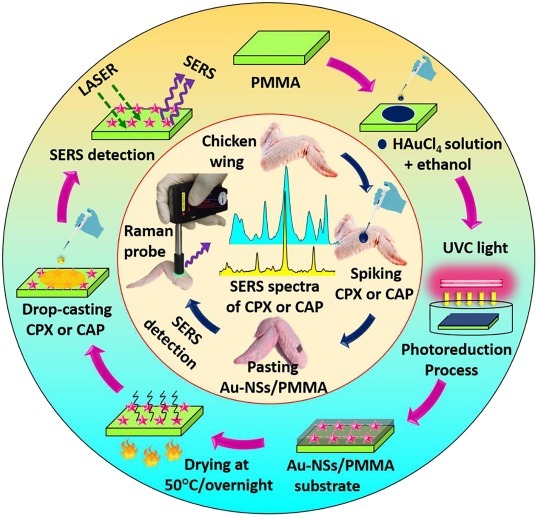
Scheme 1. Schematic illustration of the fabrication process of Au-NSs/PMMA SERS substrate, the SERS sensing and the in-situ detection on chicken wings.
Technology Overview
Photochemical fabrication of Au NSs by the action of ethanol has been demonstrated. Au NSs are employed directly on the flexible PMMA substrate for SERS application. High enhancement factors about 109 are achieved for the antibiotics. Effective multiplex SERS detection towards CPX and CAP is presented. In-situ detection of antibiotics in chicken-wing samples was performed.
Applications & Benefits
The transparent and flexible nature of the Au-NSs/PMMA SERS substrate enables the in-situ, real-time detection of CPX and CAP in chicken-wing samples by using the fiber-coupled Raman probe with the low LODs. The reported flexible SERS substrate opens the way to improve the practical detection of various antibiotics for the worldwide food safety issues.
Abstract:
Enormous Raman signal enhancement using gold nanostars (Au NSs) has attracted great attention due to the excitation of strong electric field on the nanostar tips. The synthetic methods of Au NSs mainly utilize specialized shape-directing agents, such as surfactants or polymers, to assist the tip formation. However, these agents passivate nanostar surfaces and weaken the interaction between Au NSs and analyte molecules. Herein, we report the synthesis of Au NSs with clean surface by the action of ethanol through a facile photoreduction process. The growth mechanism of Au NSs is elucidated and discussed with the action of ethanol as a polar protic solvent. The synthesis process of Au NSs is employed directly on poly(methyl methacrylate) (PMMA) films for the application of surface-enhanced Raman spectroscopy (SERS). The proposed flexible Au-NSs/PMMA SERS substrate is characterized by the SERS detection of two antibiotics, ciprofloxacin (CPX) and chloramphenicol (CAP). The superior detection performance includes high sensitivity, high enhancement factor (2.03 × 10⁹), low limit of detection (3.41 × 10⁻¹¹ M), superior multiplex detection ability, good mechanical stability, excellent uniformity and reproducibility (<7.32 %). These superior sensing properties can be attributed to a large number of hotspots formed by diverse nanostructures at different positions of Au NSs on the Au-NSs/PMMA SERS substrate. The multiplex SERS detection ability is also explored for the simultaneous detection of multiple analytes. The transparent and flexible nature of the Au-NSs/PMMA SERS substrate enables the in-situ, real-time detection of CPX and CAP in chicken-wing samples by using the fiber-coupled Raman probe with the low LODs. The reported flexible SERS substrate opens the way to improve the practical detection of various antibiotics for the worldwide food safety issues.

Photochemical synthesis of Au nanostars on PMMA films by ethanol action as flexible SERS substrates for in-situ detection of antibiotics on curved surfaces
Author:Riswana Barveen, N., Wang, T.-J., Chang, Y.-H.
Year:2022
Source publication:Chemical Engineering Journal Volume 431, Part 2, 1 March 2022, 134240
Subfield Highest percentage:99% Industrial and Manufacturing Engineering #3/336
https://www.sciencedirect.com/science/article/pii/S1385894721058137