

Synergetic combination of nano hexagons SnS2/Sulfur substituted graphitic carbon nitride: Evaluation of electrochemical sensor for the agricultural pollutant in environmental samples
This study discusses nano hexagon-shaped tin sulfide (SnS2) incorporated on the high defective sites of sulfur-doped graphitic carbon nitride (SGCN), a nanocomposite network prepared via ultrasonic dispersion.
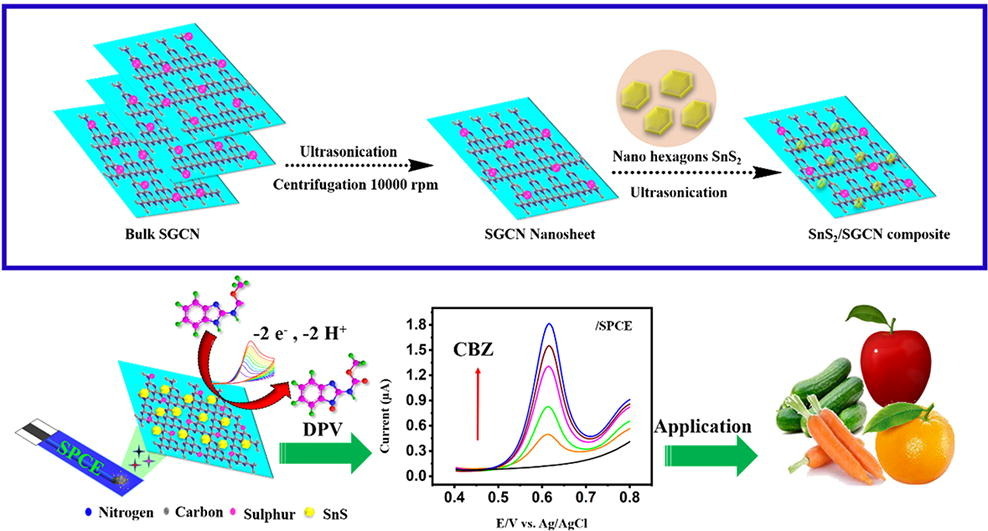
Technology Overview
SnS2 incorporated on the high defective sites of SGCN via ultrasonic dispersion. This nanocomposite an displays excellent electroanalytical performance. It is successfully implemented in the determination of agricultural pollutant CBZ. An excellent candidate for the real-time applications in environmental samples.
Applications & Benefits
Herein, we reported a cost-effective approach to preparing S-doped GCN incorporated with nano hexagons SnS2 via ultrasonic dispersion method. As synthesized SnS2/SGCN were scrutinized by various spectroscopic techniques (PXRD, FT-IR, XPS, FESEM, HR-TEM, and EIS) and it proves to have a more synergistic effect which creates higher active sites for electrocatalytic activity. Analytical methods such as cyclic voltammetry (CV) and differential pulse voltammetry (DPV) demonstrate the excellent performance of SnS2/SGCN nanocomposite modified SPCE over the electrochemical detection of CBZ. Thus, the SnS2/S-GCN/SPCE sensor delivers an excellent linear range and provides a predominant nanomolar level limit of detection, high selectivity, and sensitivity towards CBZ. Besides, the proposed sensor discloses excellent storage stability, repeatability, and reproducibility.
Abstract:
In the modern era, pesticide is highly formulated for huge harvest yield in agriculture. Nevertheless, improper disposal of pesticide residues from the industries has severely impacted living beings and poses a serious threat. Thus, researchers are keen to evaluate carbendazim’s complex chemical constituents in food samples through sensitive and selective detection. This study discusses nano hexagon-shaped tin sulfide (SnS2) incorporated on the high defective sites of sulfur-doped graphitic carbon nitride (SGCN), a nanocomposite network prepared via ultrasonic dispersion. It displays low electron transfer resistance, high effective surface area, and excellent film electrode stability. A modified screen-printed carbon electrode (SPCE) was implemented to sense the carbendazim (CBZ) residues in environmental samples. Under the optimized conditions, the sensor presents a differential pulse voltammetry current response for CBZ concentration from 0.002 to 416 µmol. L-1 with a nanomolar detection (3 × 10⁻⁸ mol. L-1). It also exemplifies high sensitivity (0.1366 µA µM−1 cm−2), selectivity, reproducibility, and long-term storage stability. Further, the proposed sensor was implemented to determine CBZ in apple, orange, cucumber, and carrot samples. Good recovery was found using the standard addition method that substantiates the excellent analytical performance of the proposed electrochemical sensor.

Synergetic combination of nano hexagons SnS2/Sulfur substituted graphitic carbon nitride: Evaluation of electrochemical sensor for the agricultural pollutant in environmental samples
Author:Shanmugam, R., Ganesamurthi, J., Chen, T.-W., Chen, S.-M., Alagumalai, K., Alkahtani, J., Alwahibi, M.S., Ajmal Ali, M.
Year:2022
Source publication:Chemical Engineering Journal Volume 431, Part 2, 1 March 2022, 134174
Subfield Highest percentage:99% Industrial and Manufacturing Engineering #3/336
https://www.sciencedirect.com/science/article/pii/S1385894721057478