

Mobility Predictions for IoT Devices Using Gated Recurrent Unit Network
In this article, we presented a tracking and trajectory prediction for UAV-BSs in wireless and cellular networking environments.
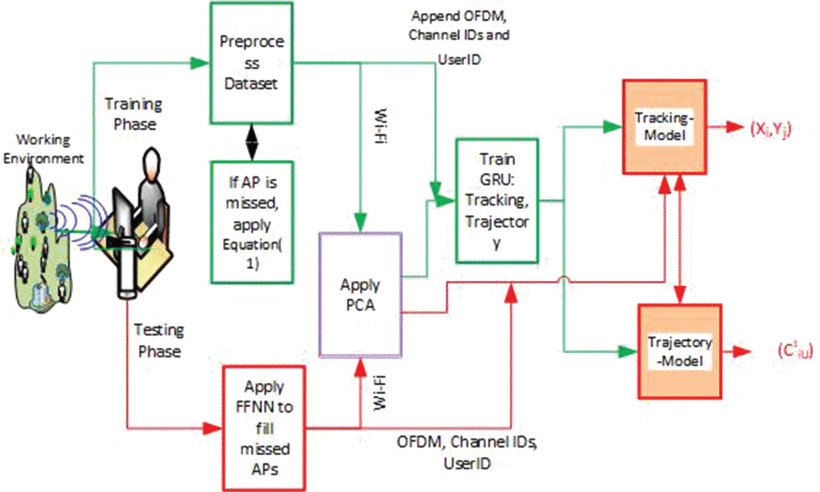
Fig. 1.Proposed system architecture.
Technology Overview
We integrate Wi-Fi signals, channel IDs, and cellular data to fill in the gaps when there are signal alterations or fluctuations. We use the deep learning algorithm to develop a scalable and accurate mobility prediction models for massive IoT devices in cost-effective techniques and technologies. We design a novel positioning model to provide state-of-the-art positioning performances of the IoT devices through integrations of various algorithms, such as feedforward neural network (FFNN), PCA, and GRU network. We adapt the deep learning algorithm for mobile big data (MBD) collected from a real environment, experimentally.
Applications & Benefits
The GRU algorithms can adapt to occlusions in wireless signals, and as a result, the PCA-GRU model provides better state-of-the-art performance than the PCA-MLP and PCA-LSTM models. As a future study, we aim to apply a DNN algorithm for UAV-BSs deployment in urban and suburban areas, and channel modeling based on CSI and radio signals values.
Abstract:
Wireless and mobile technologies, as well as their users, are growing rapidly as the Internet of Things (IoT) products, such as sensor-network technologies, mobile devices, and supporting applications, become widely dispersed. Owing to the dynamic changes in the wireless networks and the exponential growth of the IoT products, which make it difficult to locate large quantities of users and devices, providing accurate tracking and trajectory predictions in open and highly condensed wireless networks is extremely difficult. An adaptive and scalable system is required to offer accurate location-based services (LBSs) for the success of IoT. To enhance the attainment of IoT, we propose a hybrid of principal component analysis (PCA) and gated recurrent unit (GRU) algorithms for mobility predictions in a wireless urban area. During the system development processes, we first collect an LTE signal from three unmanned aerial vehicle base stations (UAV-BSs), the Wi-Fi signal strength from each reachable Wi-Fi access points (APs), and channel information from the Wi-Fi signal media. We then apply PCA to reduce the number of Wi-Fi features and to decrease signal noise. Next, we train the GRU algorithm to develop models that can predict the mobility of IoT device users. Finally, we evaluate the tracking and trajectory models. To evaluate the proposed techniques, we compare the common parameters of the GRU with those of other deep learning types. The proposed technique provides plausible and state-of-the-art results for mobility predictions of IoT devices in a wireless environment.
Mobility Predictions for IoT Devices Using Gated Recurrent Unit Network
Author:Adege A.B., Lin H.-P., Wang L.-C.
Year:2020
Source publication:IEEE Internet of Things Journal Volume: 7, Issue: 1, Jan. 2020
Subfield Highest percentage:99% Hardware and Architecture #2/157