

Modelling liner forces response to very close-proximity tunnelling in soft alluvial deposits
This study analysed the response of liner forces to the effect of aligned-inclined tunnelling in the very close-proximity of the existing tunnel.
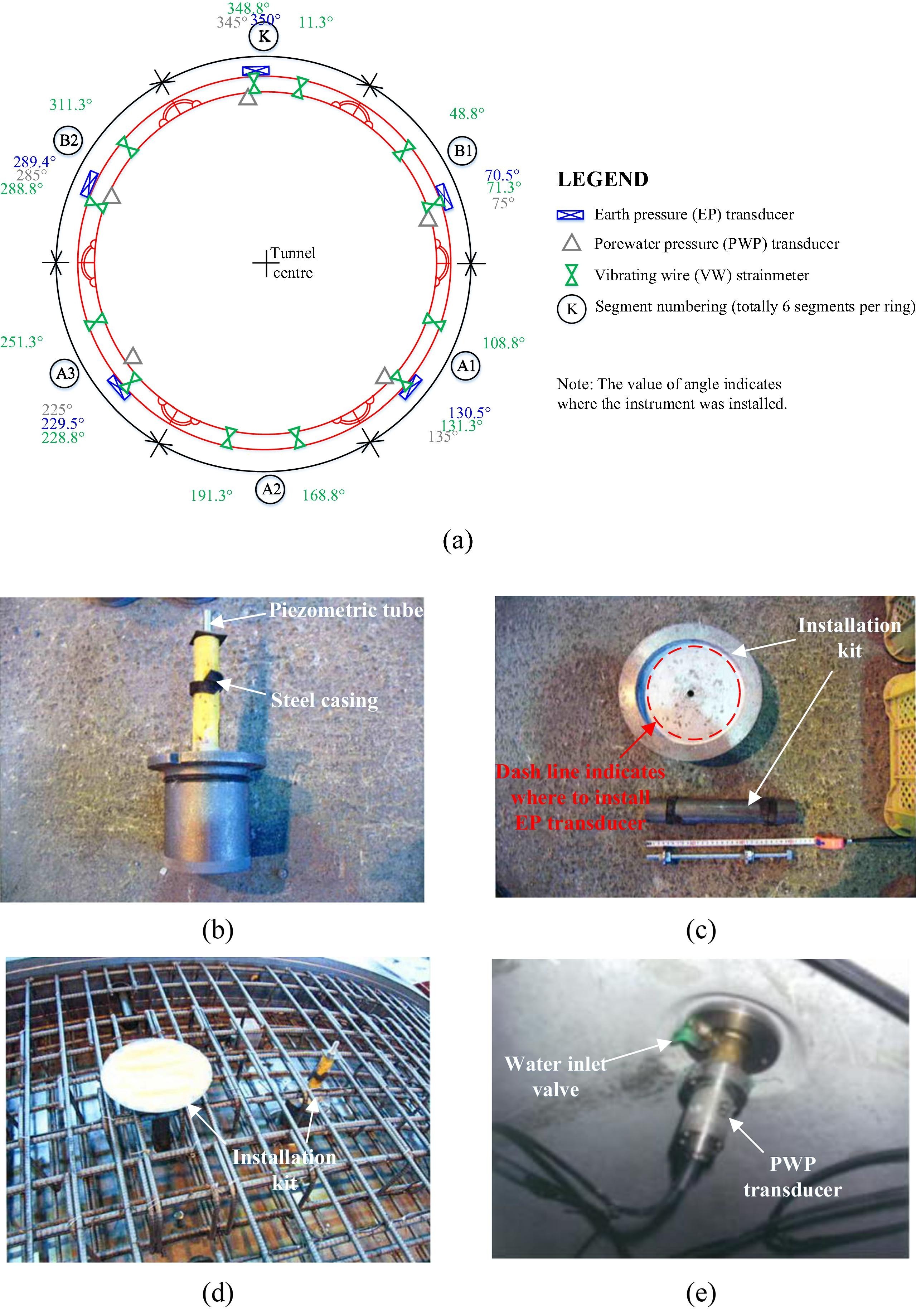
Fig. 2. Instrumented tunnel ring: (a) configuration, (b) porewater pressure (PWP) transducer installation kit, (c) earth pressure (EP) transducer installation kit, (d) completion of kit deployment, and (e) installation of PWP transducer.
Technology Overview
Liner forces response to the very close-proximity tunnelling is investigated. Instrumented rings are used for measuring not only liner forces but earth pressure. Simulation mimics the tunnel advance effect and optimises the joint configuration.
Applications & Benefits
When passing through the existing tunnel, the rotation of the principal stress worked the other way around when compared to reaching the existing tunnel. The joint design should be aware of the distribution of odd number joint when aligned-inclined tunnelling in the very close proximity of the existing tunnel. The influence of the Young’s ground modulus Es on the relationship between the liner forces and the rotational stiffness ratio λ was deemed to be minimal. The above results should be useful in understanding the response of tunnel liner forces to the effect of very close-proximity tunnelling and optimising the joint number and angle.
Abstract:
The response of tunnel liner forces to the construction of very close-proximity tunnels is rather complex and depends upon ground deformability, liner joint configuration, intersection angle of new tunnel construction. A consensus with respect to securing the safety of very close-proximity tunnelling has not yet reached. This study characterised the response of tunnel liner forces to the excavation of very close-proximity tunnels, with reference to the field measurements and 2D numerical simulations. The very close-proximity tunnelling was conducted in the soft alluvial deposits at Taipei, Taiwan where two 6.1-m diameter shield tunnels ran in parallel and then stacked each other while entering the reception shaft. The ‘belta’ and the ‘volume loss’ methods were to distribute the earth load to the liner and capture the effect of ground loss respectively and the ‘local strain’ method was to reproduce both the effect of very close-proximity tunnelling and the effect of pass-through by applying a given volumetric strain to soil clusters. The predictions against the three different phases of shield approaching to (66D distance from the Ring H), reaching (1D distance from the Ring H) and passing through (57D distance from the Ring H) the existing tunnel were compared with the field measurements respectively. The principle stress change and rotation were analysed. Parametric studies with respect to the joint number and angle, ground deformability, and rotational stiffness of joint were conducted. The critical angles for the distribution of odd number joint while aligned-inclined tunnelling in the very close proximity of the existing tunnel were suggested. The results are useful in understanding the response of tunnel liner forces to the effect of very close-proximity tunnelling and optimising the joint number and angle towards securing the safety of very close-proximity tunnelling in soft soils.

Modelling liner forces response to very close-proximity tunnelling in soft alluvial deposits
Author:heng W.-C., Li G., Ong D.E.L., Chen S.-L., Ni J.C.
Year:2020
Source publication:Tunnelling and Underground Space Technology
Volume 103, September 2020, 103455
Subfield Highest percentage:99% Geotechnical Engineering and Engineering Geology #2/195
https://www.sciencedirect.com/science/article/pii/S0886779820304090?via%3Dihub