

High-performance catalytic strips assembled with BiOBr Nano-rose architectures for electrochemical and SERS detection of theophylline
This research investigation presents a preparation, characterization and fabrication of BiOBr nanomaterial modified electrodes towards the sensing of hazardous theophylline drug in the real-world environment.
Technology Overview
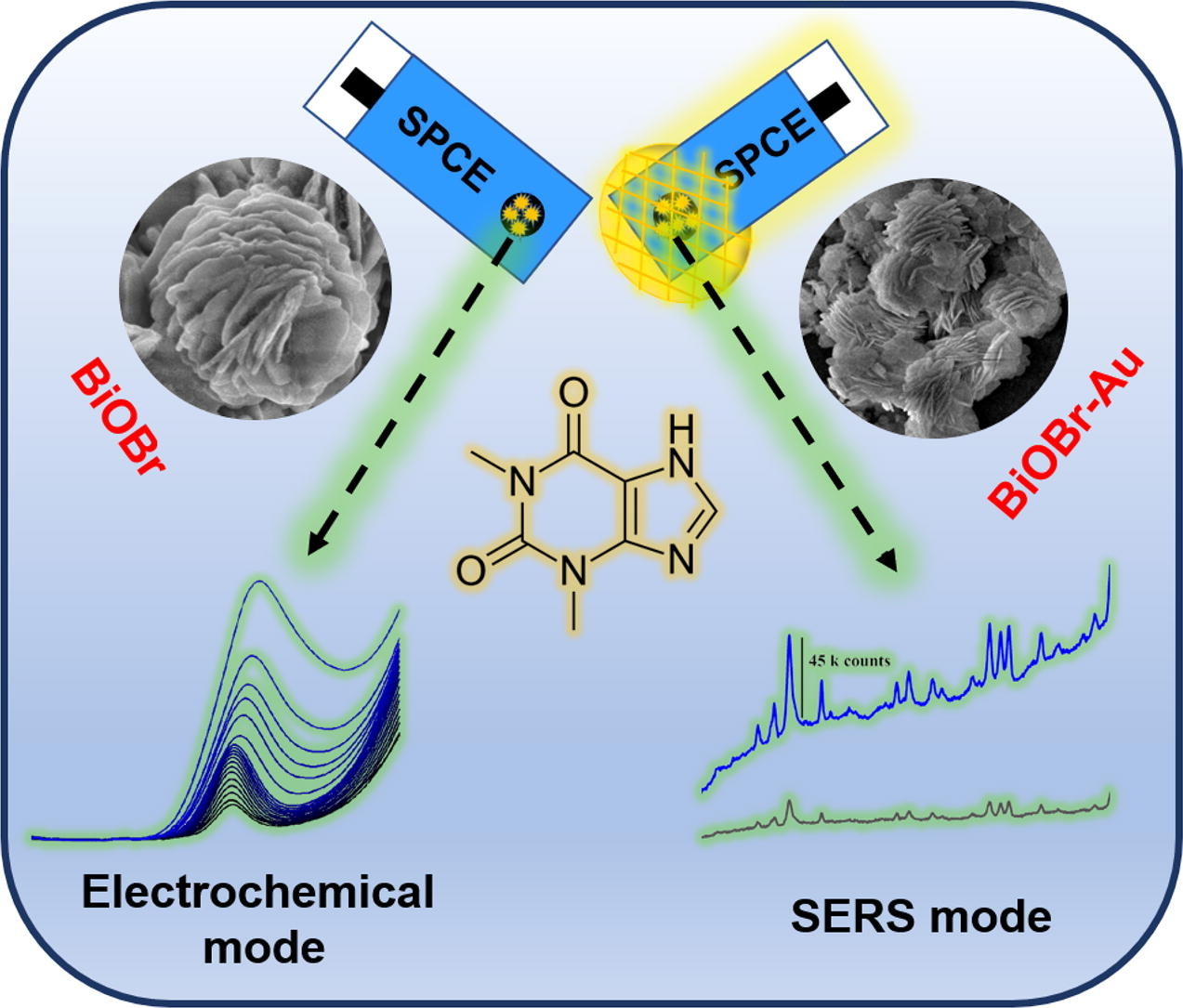
BiOBr nano-rose like architectures are constructed through hydrothermal method. Dual mode theophylline sensor based on BiOBr nano-rose is successfully fabricated. BiOBr sensor exhibited a limit of detection of 0.721 nM for electrochemical mode. BiOBr sensor displayed a limit of detection of 0.01 nM for SERS mode. Dual mode theophylline sensor is also investigated on real-world samples.
Applications & Benefits
In this work, we successfully presented a dual mode SPCE based catalytic strips based on BiOBr nanostructures for electrochemical and SERS detection of theophylline (TP). This research investigation evidently provides a compelling case that our fabricated low cost and high-performance BiOBr nano-roses based catalytic strips can be advocated for real-world environmental monitoring and remediation applications.
Abstract:
The recent developments in the healthcare sector and administration of various drugs into human systems demands for ultra-sensitive detection of drugs. Theophylline (TP) is one such drug extensively consumed for numerous respiratory disorders. In order to avoid the side effects caused by TP, consistent monitoring of it is of prime importance. Here, we developed a multifunctional screen-printed carbon electrode (SPCE) based catalytic strips loaded with BiOBr nano rose (BOB-NR) like architectures. The SPCE catalytic strips are exploited for dual mode (electrochemical and surface enhanced Raman spectroscopy (SERS)) detection of toxic drug TP. The hydrothermally prepared BiOBr nanostructures are thoroughly characterized for its physical properties and attached to SPCE through a unique gravity offered drying (GOD) strategy. The BOB-NR offered less charge transfer resistance and diffusion resistance upon the electrochemical investigation indicating its superior electrocatalytic capabilities. It reflected on projecting a wide linear range and excellent limit of detection (LOD) for electrochemical detection of TP. On the other side, the plasmonic Au layer deposited on the BOB-NR loaded SPCE strips (BiOBr/Au@SPCE) are employed for rapid SERS detection of TP. The higher enhancement factor of 107 is obtained for BiOBr/Au@SPCE strips for TP detection owing to its catalytic activity between Au layer and BiOBr nanostructures. The Au layer aids in developing a localized electromagnetic hotspot and the charge transfer process arising from BiOBr to Au all together plays a critical role in achieving a superior SERS performance. The fabricated multifunctional catalytic strips are also tested for its stability, repeatability and real-world analysis. Our established platform for detection of toxic drugs promises to be greater prospect for portable, rapid and on the spot analysis.
High-performance catalytic strips assembled with BiOBr Nano-rose architectures for electrochemical and SERS detection of theophylline
Author:Balaji R., Maheshwaran S., Chen S.-M., Chandrasekar N., Ethiraj S., Samuel M.S., Renganathan V.
Year:2021
Source publication:Chemical Engineering Journal Volume 425 130616
Subfield Highest percentage:99% Industrial and Manufacturing Engineering #3/336
https://www.sciencedirect.com/science/article/pii/S1385894721022026