

A Novel Path-Following-Method-Based Polynomial Fuzzy Control Design
This article has presented a novel path-following-method-based design methodology for the stabilization of the polynomial fuzzy model with a systematic ROA analysis.
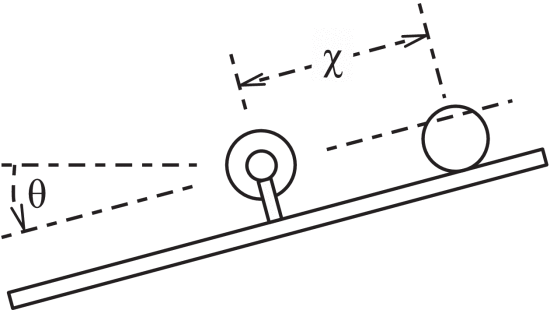
Fig. 4.Ball-and-beam system.
Technology Overview
The new feature of this article is to propose the nonconvex stabilization criterion for polynomial fuzzy control systems to prevent the conservativeness induced by the convex transformation in the SOS-based studies. Moreover, the polynomial S -procedure is applied to systematically analyze the ROA and the copositive relaxation is utilized to deal with the double fuzzy summation problem.In addition, the common restriction for the Lyapunov function is removed in this article.
Applications & Benefits
Four examples have been given to show the viability and effectiveness of the proposed path-following-method-based polynomial fuzzy control design methodology. Moreover, the comparison results show that the proposed nonconvex stabilization criterion indeed can complement the existing convex stabilization criteria.
Abstract:
This article presents a novel path-following-method-based polynomial fuzzy control design. By examining the stabilization problem, the nonconvex stabilization criterion represented in terms of bilinear sum-of-squares (SOS) constraints is proposed to complement the existing convex stabilization criteria. Based on the polynomial Lyapunov function and considering the operation domain, the stabilization control is designed with a systematic region of attraction (ROA) analysis method. Since the proposed stabilization criterion remains in nonconvex form, the conservativeness caused by the transformation from nonconvex (bilinear SOS) constraints into convex (SOS) constraints can be avoided. Moreover, the restriction on the Lyapunov function candidates for the convex transformation in the literature does not exist in the proposed nonconvex stabilization criterion. The stabilization analysis for polynomial fuzzy control systems is concerned with the double fuzzy summation problem that can be treated as the copositivity problem. Therefore, the SOS-based copositive relaxation technique is applied for the proposed stabilization criterion. Since the proposed nonconvex stabilization criterion is represented in terms of bilinear SOS constraints, the path-following method is employed for solving the bilinear SOS problem. Finally, design examples are provided to demonstrate that the proposed nonconvex stabilization criterion complements the existing convex stabilization criteria.

A Novel Path-Following-Method-Based Polynomial Fuzzy Control Design
Author:Chen Y.-J., Tanaka K., Tanaka M., Tsai S.-H., Wang H.O.
Year:2021
Source publication: IEEE Transactions on Cybernetics Volume: 51 Issue: 6
Subfield Highest percentage:99% Control and Systems Engineering #1/260