

Superior thermally-stable narrow-band green emitter from Mn2+-doped zero thermal expansion (ZTE) material
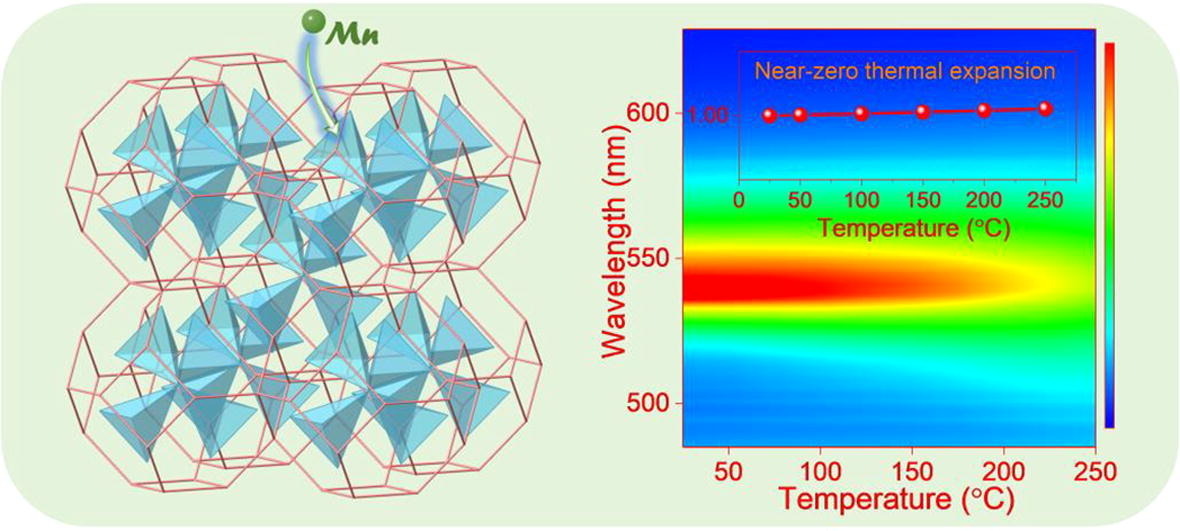
This work focuses on an near zero thermal quenching (zero-TQ) luminescence performance of Mn2+ ions in Zn4B6O13:Mn2+ phosphor with 3D isotropic cage structure. The effective strategy to design zero-TQ and high self-reductive phosphors provides inspiration to develop high-quality and low-cost luminescent materials.
Technology Overview
Zn4B6O13:Mn2+ phosphor maintains 103% initial intensity at 150 °C and 98% at 250 °C. Zn4B6O13:Mn2+ exhibits an ultra-narrow emission (fwhm = 33 nm). An efficient self-reduction of Mn4+/Mn7+ to Mn2+ occurs under air atmosphere.
Applications & Benefits
By employing 440 nm blue chip, the as-fabricated pc-WLED using Zn4B6O13:Mn2+ green phosphor presents warm white light (0.3714, 0.3386) with CCT = 3960 K, CRI = 76.2, demonstrating that Zn4B6O13:Mn2+ phosphor could be a potential candidate for practical optical application. The 3D isotropic cage-structure model could guide to develop more excellent phosphors with high thermal stability and luminescence efficiency.
Abstract:
Thermal quenching is still a pivotal challenge for phosphor materials in white light emitting diodes lighting applications. Herein, we propose an effective strategy to design a near zero-thermal-quenching green emission in zero-thermal-expanding Zn4B6O13 host based on unique 3D isotropic cage structure. The integrated emission intensity of Zn4B6O13:Mn2+ could maintain 103% of initial intensity at 150 °C and 98% at 250 °C under blue light excitation. During the low-frequency vibrations, the unchanged bonds and angles induce the zero thermal expansion, and the unaffected lattice and coordination environment contribute the nearly unchanged emission intensity during the heating process. In addition, an efficient self-reduction of activators in the studied system is ascribed to vacancy and interstitial oxygen defects act as donors to provide electrons. This work initiates a novel strategy to construct thermally-stable and self-reductive phosphors for multiple optical applications.
Superior thermally-stable narrow-band green emitter from Mn2+-doped zero thermal expansion (ZTE) material
Author:Wang W., Yang H., Fu M., Zhang X., Guan M., Wei Y., Lin C.C., Li G.
Year:2021
Source publication:Chemical Engineering Journal Volume 415 128979
Subfield Highest percentage:99% Industrial and Manufacturing Engineering #3/336
https://www.sciencedirect.com/science/article/pii/S1385894721005726?via%3Dihub