

Stable blue perovskite light-emitting diodes achieved by optimization of crystal dimension through zinc bromide addition
The controlled addition of zinc bromide effectively allows a precise regulation of the phenethylammonium-mixed halides (Br−/Cl−) perovskite structure as well as its crystal dimensionality, optimized parameters exhibit excellent properties, allowing the fabrication of an efficient blue perovskite light-emitting diodes (PeLEDs).
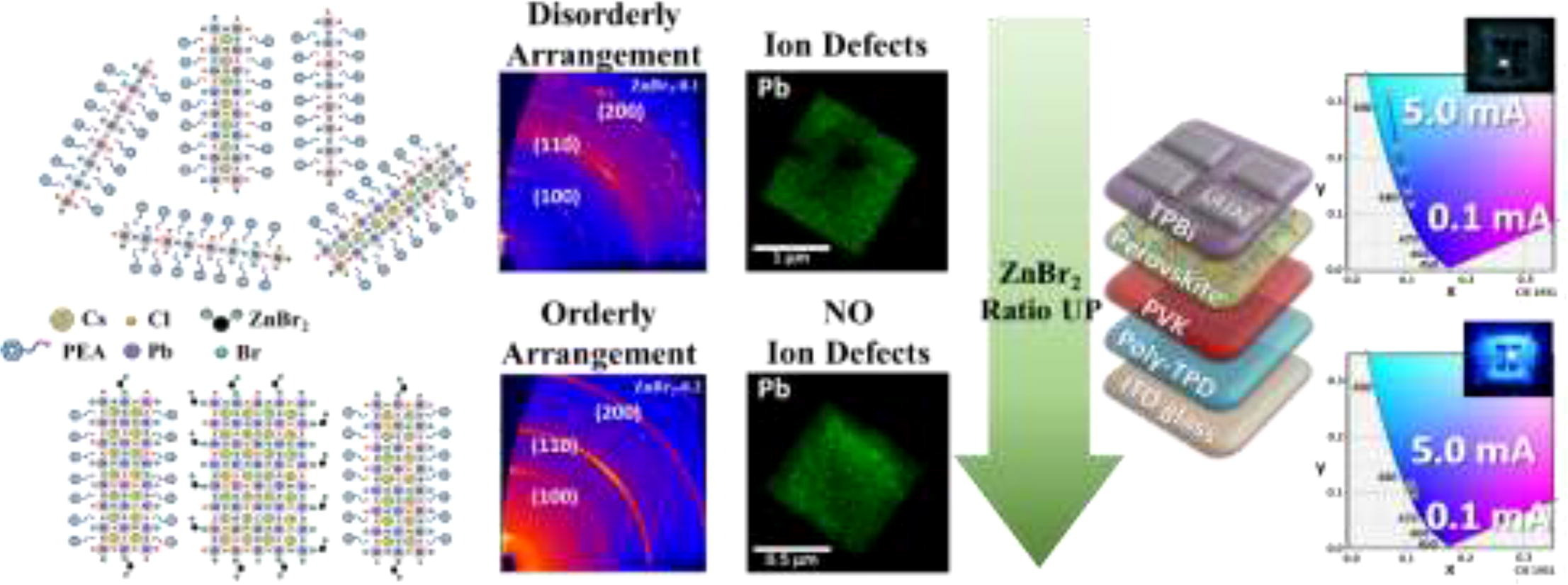
Technology Overview
The perovskite crystal are regulated to better arrangement by addition of ZnBr2. PeLEDs efficiency was improved through energy level alignment. The blue PeLEDs exhibit excellent performance (luminance: 1245Cd/m2, EQE: 1.3%). The EL of PeLEDs only 3-nm red shift under the 0.1 to 5 mA current excitation.
Applications & Benefits
Hybrid perovskite materials have been widely studied in recent years because of their promising optical properties and structural and bandgap tenability. It is still challenging to achieve high luminescence blue PeLEDs with respectable stability. We finally show the fabricated ZnBr2-assisted blue PeLED can possess improved luminescence and stability and show mitigated red-shift in the EL spectrum, demonstrating an effective strategy to realize efficient and stable blue PeLEDs.
Abstract:
Low-dimensional perovskites have been widely studied as a promising candidate for realizing stable light-emitting diodes (LEDs). However, blue-light-emitting devices generally possess low stability associated with gradually red-shifted emission. To overcome this issue, the effect of zinc bromide (ZnBr2) addition on the regulation of the crystal structures of phenethylammonium and bromine-chlorine mixed inorganic perovskites (PEA-CsPbBrxCl3-x) is investigated. With the ZnBr2 addition, low-dimensional perovskite structures undergo morphological changes, such as thickening of their crystal structures and higher degree of crystal arrangement. Stoichiometric selective characterization reveals that perovskite bonding forces changed from Van der Waals with PEA to ionic with ZnBr2. Meanwhile, ZnBr2 can effectively address the ion defect filling and dimensional structure property switching. Consequently, the optimized ZnBr2-assisted PEA-CsPbBrxCl3-x LED is shown to deliver a high luminance of 1245 cd/m2 along with a high external quantum efficiency of 1.30%. Furthermore, this blue LED exhibits excellent spectral stability, for which only 3-nm red-shift on external excitation (0.1 to 5.0 mA) is observed. Our result clearly shows that ZnBr2 addition effectively improves the stability of blue light-emitting perovskites.
Stable blue perovskite light-emitting diodes achieved by optimization of crystal dimension through zinc bromide addition
Author:Yan Z.-L., Benas J.-S., Chueh C.-C., Chen W.-C., Liang F.-C., Zhang Z.-X., Lin B.-H., Su C.-J., Chiba T., Kido J., Kuo C.-C.
Year:2021
Source publication:Chemical Engineering Journal Volume 414 128774
Subfield Highest percentage:99%
Industrial and Manufacturing Engineering (2020) #3/336
https://www.sciencedirect.com/science/article/pii/S1385894721003715