Alternative strengthening strategies to improve the seismic resilience of RC frame structures
This study experimentally evaluates five seismic strengthening strategies for reinforced concrete (RC) frames through cyclic lateral loading tests. Focusing on comparative performance and practical engineering applicability, the researchers investigate a shear panel damper, two steel-braced frame systems, and two shear wall configurations. High-strength polymer-cement mortar is strategically applied at critical connection interfaces to ensure superior bonding and efficient load transfer. The experimental results reveal that all retrofitted configurations substantially improve lateral strength by up to 655%, as well as stiffness, energy dissipation, and overall structural damage control, compared with the unstrengthened reference frame.
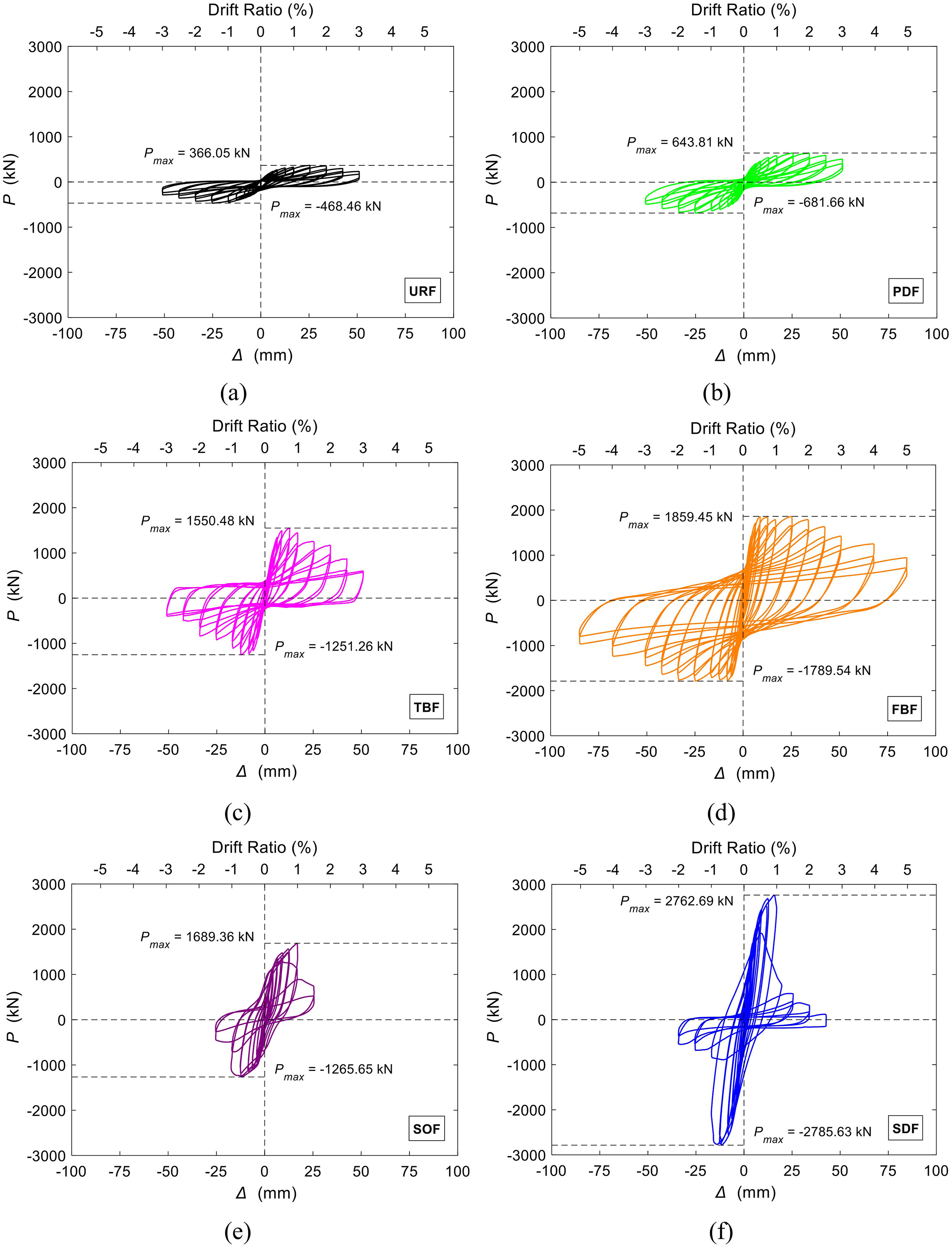
Fig. 18. Hysteresis curves for specimens: (a) URF; (b) PDF; (c) TBF; (d) FBF; (e) SOF; (f) SDF.
Technology Overview
The technology utilizes quasi-static cyclic lateral loading protocols to test half-scale, single-story RC frame specimens. The system integrates a high-strength polymer-cement mortar (60 MPa) at critical interfaces. It systematically quantifies seismic resilience metrics, including lateral capacity envelopes, secant stiffness degradation, hysteretic loop pinching, viscous damping ratios, and modified Park–Ang damage indices.
Applications & Benefits
This framework applies directly to performance-based seismic upgrading and retrofitting of existing RC buildings. Beneficially, it guides structural design by identifying that four-sided braced frames optimize strength and ductility, while shear panel dampers maximize post-earthquake maintainability for essential facilities. Ultimately, it minimizes structural collapse risks, economic losses, and repair times.
Abstract:
The goal of this paper is to propose an optimization scheme for enhancing power dispatch and load scheduling for residential fuel cell-based combined heat and power systems (FC-CHPS) using mixed integer linear programming (MILP), considering the lifetime degradation of both the fuel cell system (FCS) and battery energy storage systems (BESS). The scheme is applied in the home energy management system that oversees the electric and thermal power of residential FC-CHPS. First, the nonlinearity in the relationship between the natural gas consumption and output electric power, and between the residual thermal power and output electric power of the fuel cell system (FCS) in the FC-CHPS is approximated using piecewise linearization. Then, the piecewise linearization is integrated with MILP to derive optimal power dispatch and load scheduling solutions, while accounting for the nonlinearity of the FCS. Next, cost functions representing the lifetime degradation of FCS and BESS are formulated. These cost functions result in nonlinear optimization constraints. Therefore, innovative methods are proposed to linearize these constraints, allowing the continued use of MILP as the optimization method and factoring in the lifetime degradation of FCS and BESS. Compared to the mixed-integer non-linear programming (MINLP) method that does not linearize the non-linearity in the FCS or the lifetime degradation of the FCS and BESS, the proposed MILP scheme achieves the identical objective function value. Furthermore, the computation time for the proposed MILP scheme is 99.94 % lower than that required by the MINLP method. The proposed scheme provides accurate results in short computation times.

Alternative strengthening strategies to improve the seismic resilience of RC frame structures
Author:Hsiao Fu-Pei, Lin Chia-Chen, Weng Pu-Wen, Haryanto Yanuar, Nugroho Laurencius, Huang Chao-Hsun
Year:2026
Source publication: Journal of Building Engineering, February 2026, Volume 119, 115078
Subfield Highest percentage: 99% Architecture #2/210