Advancements in waste-to-hydrogen technologies across Asia: A critical review of thermal conversion process on hydrogen
Asia's rapid population growth, industrialization, and urbanization have simultaneously accelerated regional energy demands and waste generation. This critical dual challenge has drawn extensive focus toward sustainable waste-to-hydrogen (WtH) systems. These systems systematically process heterogeneous municipal solid waste, agricultural residues, and industrial byproducts into high-value clean energy. Because hydrogen delivers an exceptionally high energy density alongside completely zero-emission capabilities, it serves as an ideal carrier. This comprehensive review bridges existing literature gaps by evaluating thermochemical conversion processes, process performance, techno-economic feasibility, and changing national policies across Asian economies to facilitate a clean transition.
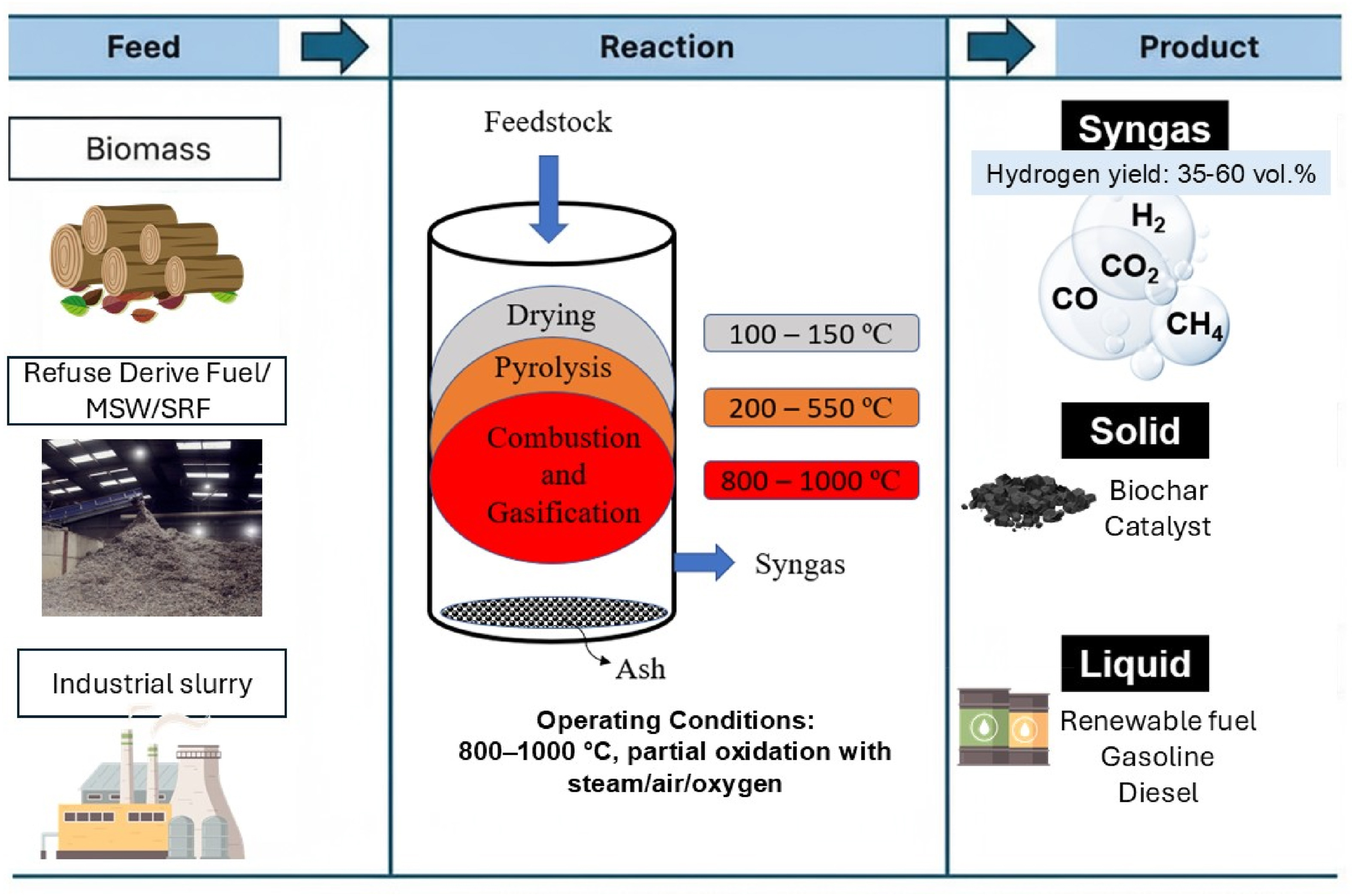
Fig. 12. Simplified schematic of the gasification process for hydrogen production.
Technology Overview
Thermochemical WtH systems utilize specific conversion pathways: gasification, pyrolysis, and plasma-assisted gasification. Gasification breaks down feedstock via controlled partial oxidation to generate high-quality hydrogen-rich syngas. Pyrolysis thermally decomposes organic waste in oxygen-free environments to yield bio-oil and syngas. Advanced plasma gasification employs ultra-high temperatures to treat diverse waste streams, delivering superior hydrogen yields while minimizing greenhouse gas emissions.
Applications & Benefits
WtH technologies offer profound benefits by solving urban waste disposal crises and delivering clean, low-carbon hydrogen carriers. They bolster circular economy targets by converting environmental residues like slag and char into industrial materials. Finally, this hydrogen supplies vital sectors, integrating into natural gas blending, power plant co-firing, transport fuel cells, and chemical synthesis to drive regional net-zero transitions.
Abstract:
The increasing energy demand and escalating waste generation in Asia have driven the exploration of sustainable waste-to-hydrogen (WtH) technologies. Hydrogen production via thermochemical waste treatment-particularly gasification, pyrolysis, and plasma-assisted process, offers a promising pathway to convert municipal solid waste, agricultural residues, and industrial waste byproducts into a clean energy carrier. Despite numerous studies on WtH, a comprehensive assessment linking process performance, techno-economic feasibility, and policy frameworks across Asian countries remains limited. This review bridges the gap by systematically examining over 200 recent publications to evaluate advancements, challenges, and prospects of hydrogen production through thermal treatment in the Asian context. Findings reveal substantial variations in feedstock composition, process efficiencies, hydrogen yields (30–65 %), and national policy frameworks. Plasma-assisted gasification demonstrates superior performance, with hydrogen contents reaching up to 50 vol% in syngas and notable reductions in CO2 emissions, though high capital intensity remains a barrier. Economic assessments indicate a levelized cost of hydrogen between 2 and 6 USD/kg H2, while environmental evaluations suggest reductions of 2–30 kg CO2-eq per kg H2 produced. Policy analysis highlights both enabling drivers, such as feed-in tariffs and renewable portfolio standards in Japan, Korea, and China, and persisting barriers related to financing, infrastructure, and regulatory inconsistencies. Overall, this review underscores that advancing WtH technologies in Asia requires coordinated efforts in pilot-scale validation, demonstration projects, and cross-sectoral collaboration. By overcoming technical and policy challenges, WtH can play a critical role in achieving Asia's net-zero and circular economy targets.
Advancements in waste-to-hydrogen technologies across Asia: A critical review of thermal conversion process on hydrogen
Author:Aji Nugroho Rusdan Aditya, Aspriyanti Vita Ayu, Cahyono Agung, Sopandi Talitha, Wang Wei-Cheng, Kuo Jenn-Kun, Huang Chung-Neng, Hsu Hsin-Wei
Year:2026
Source publication: Energy, Volume 344, 1 February 2026, 139810
Subfield Highest percentage: 99% Modeling and Simulation #4/397