Industrial upgrading policies and export resilience: An empirical assessment of technology investment in Taiwan's manufacturing sector
This study examines the structural effects of policy-driven technology investment on export performance in Taiwan's manufacturing sector from 2016 to 2023. Utilizing industry-level panel data, the paper evaluates how investment penetration influences export growth, orientation, and resilience. The empirical results demonstrate that technology-intensive capital investment significantly enhances export orientation and bolsters industrial resilience against external shocks. However, the findings also reveal transitional friction, characterized by temporary short-term volatility and lagged effects before long-term stabilization occurs. Ultimately, the study highlights how scale concentration moderates these industrial policy outcomes.
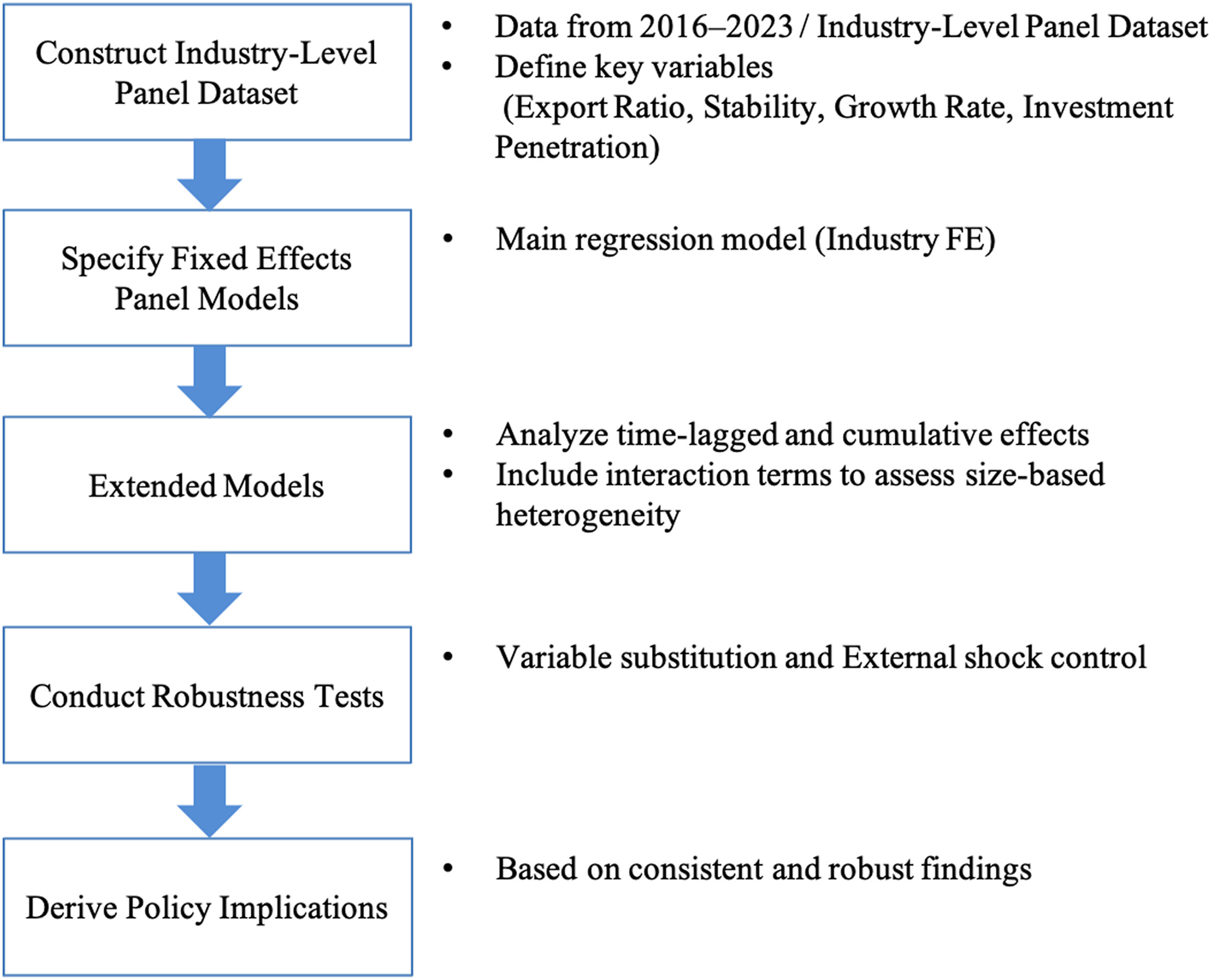
Fig. 1. Research flowchart.
Technology Overview
The research employs a fixed-effects panel regression model as its core empirical strategy to control for unobserved industry-level heterogeneity. It introduces an innovative "Investment Penetration Rate" proxy, measuring policy-eligible technology expenditures. The model evaluates three dependent structural metrics—export growth rate, export ratio, and a three-year moving coefficient of variation for export stability.
Applications & Benefits
This framework applies directly to macro-level industrial policy design and strategic evaluation for export-dependent economies. Beneficially, it equips policymakers with quantitative insights to optimize tax credit distribution and mitigate resource misallocation. It effectively guides manufacturing sectors to navigate digital transitions, fostering long-term export absorption capacity and sustainable value-chain upgrading.
Abstract:
Amid global digital transformation and the restructuring of manufacturing supply chains, enhancing export resilience has become a central focus of industrial policy. Although many countries have promoted technology upgrading and capital incentives, empirical evaluations of their industry-level structural effects remain limited. This study examines Taiwan's manufacturing sector from 2016 to 2023, employing a fixed-effects panel model to assess the impact of technology investment penetration (a proxy for policy-driven investment) on export structure performance. The results show that technology investment significantly enhances export orientation and maintains positive effects during external shocks. However, early transformation stages exhibit increased volatility and lagged effects, reflecting a dynamic pattern where short-term instability coexists with long-term upgrading. The effects of policy incentives are moderated by industrial scale; outcomes in sectors with a higher proportion of large enterprises tend to be more pronounced but exhibit greater short-term fluctuations. By proposing an integrated structural-dynamic framework, this study shows that technology-oriented investment not only drives upgrading and technology absorption but also reinforces export stability and industrial resilience. These findings offer timely policy insights for export-oriented economies undergoing similar transitions.
Industrial upgrading policies and export resilience: An empirical assessment of technology investment in Taiwan's manufacturing sector
Author:Chen Chiu-Chia, Huang Chien-Yi
Year:2026
Source publication: Technology in Society, Volume 85, April 2026, 103204
Subfield Highest percentage: 99% Sociology and Political Science #1/1530