Measurement of reactor neutrino oscillation with the first JUNO data
This paper reports the first simultaneous high-precision measurement of solar neutrino oscillation parameters using the initial 59.1 days of data from the Jiangmen Underground Neutrino Observatory (JUNO). Located 52.5 km from multiple reactor cores, JUNO utilizes a 20-ktonne liquid-scintillator detector to capture reactor antineutrinos via inverse beta decay. These results improve the precision of solar oscillation parameters by a factor of 1.6 over previous combined global measurements, validating the detector's design and establishing its readiness to resolve the neutrino mass ordering.
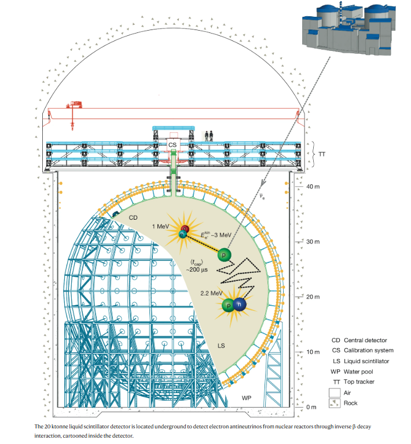
Fig. 1 JUNO experimental layout.
Technology Overview
JUNO employs a 20-ktonne liquid-scintillator central detector shielded underground by 650 m of rock overburden. It uses 17,596 20-inch and 25,587 3-inch PMTs to achieve 78% geometric coverage, backed by a water Cherenkov pool and top tracker for cosmic muon veto. Advanced calibrations maintain energy scale non-linearity within 0.6%, yielding an unprecedented 3% energy resolution at 1 MeV.
Applications & Benefits
Applications span fundamental particle physics, astrophysics, and geophysics. JUNO’s sub-percent precision capabilities validate the three-flavour neutrino mixing framework, constrain leptonic CP violation, and pave the way to determine the neutrino mass ordering. Additionally, the platform enables real-time core-collapse supernova monitoring, solar and atmospheric neutrino studies, geoneutrino measurement, and searches for physics beyond the Standard Model.
Abstract:
Neutrino oscillations (see refs. 1,2 and references therein), a quantum effect manifesting at macroscopic scales, are governed by lepton flavour mixing angles and neutrino mass-squared differences3 that are fundamental parameters of particle physics, representing phenomena beyond the Standard Model. Precision measurements of these parameters are essential for testing the completeness of the three-flavour framework, determining the mass ordering of neutrinos and probing possible new physics. The Jiangmen Underground Neutrino Observatory (JUNO)4 is a 20-ktonne liquid-scintillator detector located 52.5 km from multiple reactor cores, designed to resolve the interference pattern of reactor neutrinos with sub-percent precision5,6. Here we report, using the first 59.1 days of data collected since detector completion in August 2025, the first simultaneous high-precision determination of two neutrino oscillation parameters, sin2θ12=0.3092±0.0087 and Δm212=(7.50±0.12)×10-5eV2 for the normal mass ordering scenario, improving the precision by a factor of 1.6 relative to the combination of all previous measurements. These results advance the basic understanding of neutrinos, validate the design of the detector and indicate the readiness of JUNO for resolving the neutrino mass ordering with a larger dataset. The rapid achievement with a short exposure highlights the potential of JUNO to push the frontiers of precision neutrino physics and paves the way for its broad scientific programme.

Measurement of reactor neutrino oscillation with the first JUNO data
Author:The JUNO Collaboration
Year:2026
Source publication: Nature, volume 654, pages343–348 (2026)
Subfield Highest percentage: 99% Multidisciplinary #1/223