Optimizing mentor-mentee matching: a framework for AI-MC as a UX approach in online learning
Effective mentorship is crucial for individual development, yet traditional digital mentoring platforms often suffer from communication gaps, miscommunication, and challenges in establishing initial rapport between compatible pairs. To bridge this gap, this study introduces an innovative AI-Mediated Communication (AI-MC) framework designed to optimize the mentor-mentee matching phase within online learning environments. Developed through a user-centered Design Thinking lens and evaluated via Self-Determination Theory, this approach addresses the critical research gap of interactive friction. The framework empowers mentees to overcome initial communication barriers, establish clear expectations, and successfully cultivate productive, highly autonomous digital mentorship connections for long-term positive user learning experiences.
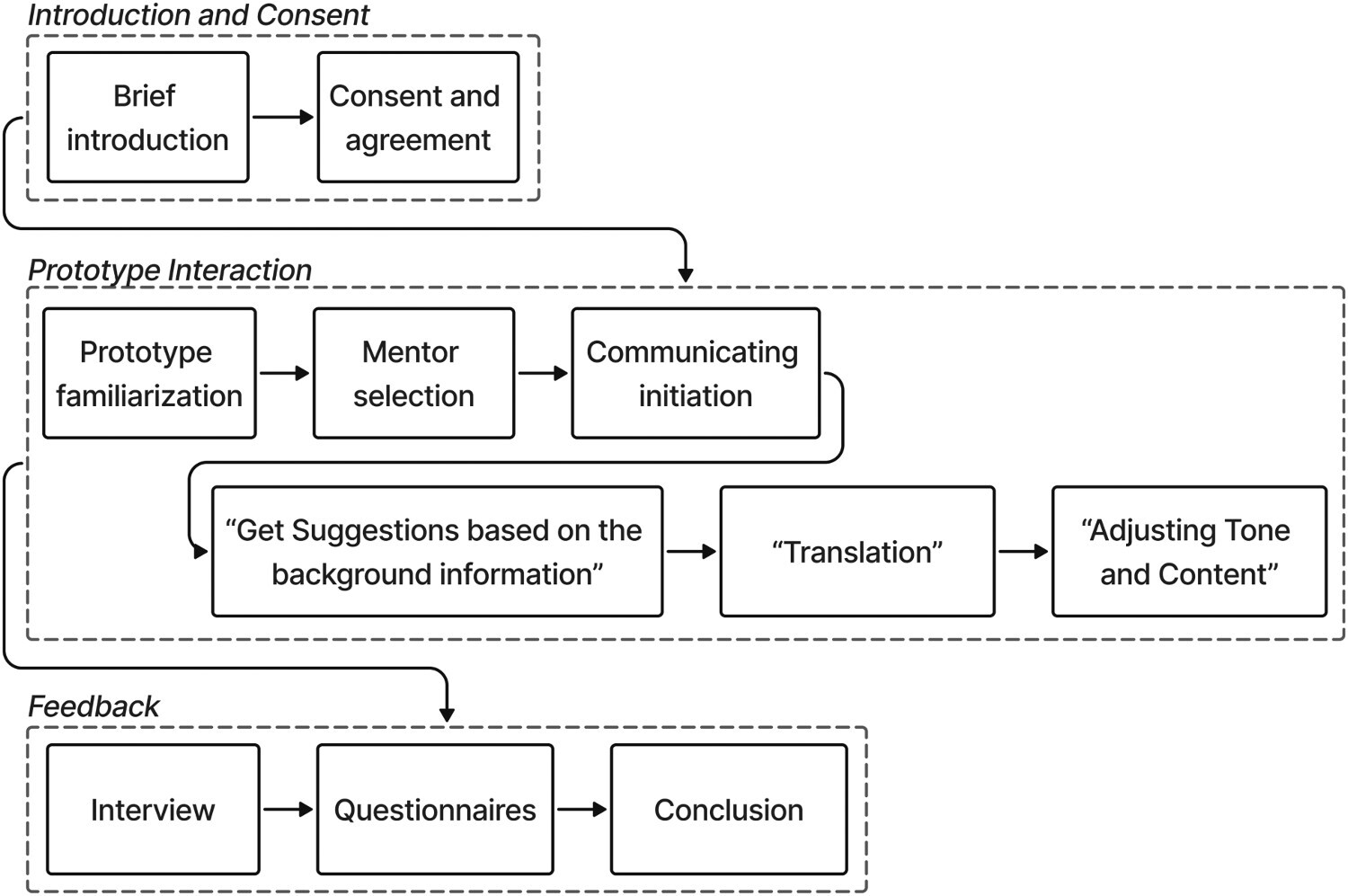
Figure 2. Experimental process.
Technology Overview
The underlying technology utilizes Large Language Models (LLMs) and generative artificial intelligence integrated directly into a chat interface prototype named SparkGrow. This system incorporates adaptive, AI-driven conversation structuring, natural language processing for real-time translation, dynamic tone adjustments, and context-aware content recommendations. These combined tools analyze conversational context to intelligently generate dialogue suggestions for seamless ice-breaking and effective user interaction support.
Applications & Benefits
This framework enhances online education platforms, professional coaching, and remote collaborative learning networks. It effectively reduces the cognitive effort and social anxiety associated with initiating mentorship requests. By boosting user competence and autonomy, the platform facilitates clearer professional communication, bridges intercultural language barriers, and supports highly informed decision-making during crucial initial mentor selection and matching phases for all diverse users.
Abstract:
Recent advancements in Generative AI (GenAI) and Large Language Models (LLMs) have reshaped the potential of AI in education. This study introduces an AI-Mediated Communication (AI-MC) framework designed to enhance mentor-mentee interactions through adaptive AI-driven conversation structuring, content recommendations, and linguistic feedback. A mixed-methods study was conducted using Self-Determination Theory (SDT) and Design Thinking, combining quantitative user surveys (N = 33) and qualitative interviews. Key findings show that the “Suggesting Content using Conversational Context” feature significantly enhanced intrinsic motivation (r =.389, p =.025) and perceived competence (r =.458, p =.007), supporting users’ confidence and autonomy in communication. The platform effectively supported competence and autonomy, although relatedness was rated moderately, reflecting the limitations of text-only interaction. Qualitative data reinforced that AI-MC features facilitated clearer communication and more informed mentor selection. These findings underscore the potential of AI-MC as an adaptive communication tool for mentoring, with applications that could extend to intelligent tutoring, professional coaching, and online learning platforms. Future research should aim to integrate real mentors, utilize multimodal AI communication, and offer long-term relationship support to enhance both ecological validity and relational depth further.
Optimizing mentor-mentee matching: a framework for AI-MC as a UX approach in online learning
Author:Wang Sheng-Ming, Yaqin Muhammad Ainul, Phan Minh Nhan
Year:2026
Source publication: Interactive Learning Environments, Volume 34, 2026 - Issue 4
Subfield Highest percentage: 99% Education #16/1698