Electrochemical Modulation of Precatalysts Tailors the Cu Coordination Environment to Shift CO2RR Products from C1 to C2+
This study addresses the critical challenge of controlling product selectivity in electrochemical carbon dioxide reduction reaction (CO2RR) using copper-based catalysts. While the coordination number (CN) of Cu sites dictates reaction pathways, in situ structural reconstruction under cathodic potentials often complicates precise regulation. The researchers systematically investigate the dynamic transformation of well-defined Cu-based precatalysts under operational conditions. By successfully tailoring the evolving Cu coordination environment, they establish a direct correlation between structural evolution and product selectivity. This strategic modulation enables a dramatic shift in dominant CO2RR products from single-carbon (C1)chemicals to high-value multi-carbon (C2+) hydrocarbons.
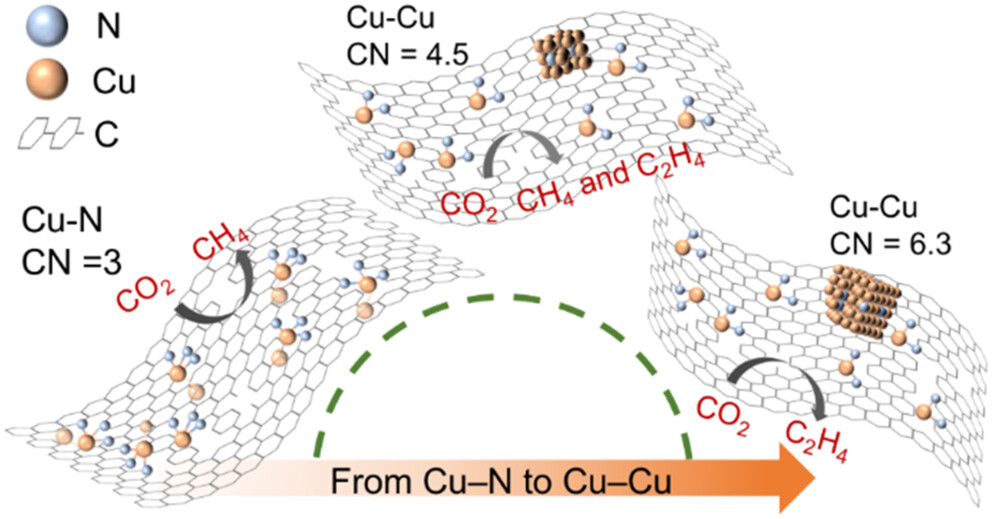
Graphical abstract.
Technology Overview
The active site structure is tuned by controlled electroreduction and precursor design, utilizing in situ ATR-FTIR, EQCM-D, and FTacV to track structural evolution and reaction intermediates.
Applications & Benefits
Applied in electrochemical CO2 reduction, this method enhances C–C coupling efficiency by two orders of magnitude, boosting C2H4/CH4 ratio from 0.37 to 42 for selective fuel synthesis.
Abstract:
Copper-based catalysts show outstanding performance in electrochemical CO2 reduction reaction (CO2RR) toward hydrocarbons, yet controlling product selectivity remains challenging. While the coordination number of Cu sites dictates the reaction pathways and product distributions, structural reconstruction under cathodic operating potentials hampers precise regulation of their atomic coordination environment during catalysis. Herein, we investigate the in situ transformation of Cu-based precatalysts with well-defined initial coordination environments under CO2RR conditions, thereby establishing a direct correlation between the evolving Cu coordination number and product selectivity. The coordination environment evolves significantly from Cu2CN-c, featuring a Cu–N coordination number of 3.0, to Cu10CN-c with Cu–Cu coordination number of 6.3, leading to a shift in product distribution. The Faradaic efficiency (FE) ratio of C2H4/CH4 increases from 0.37 to 42, reflecting an enhancement in C–C coupling efficiency by 2 orders of magnitude. Through comprehensive in situ attenuated total reflection–Fourier transform infrared spectroscopy (in situ ATR-FTIR), electrochemical quartz crystal microbalance with dissipation (EQCM-D), and electrochemical characterizations, we demonstrate that precise modulation of Cu–N and Cu–Cu coordination ratios, achieved by controlled electroreduction and rational precatalyst design, can effectively balance proton-coupled electron transfer and C–C coupling kinetics. This work provides insights into the design principles for efficient Cu-based electrocatalysts enabling selective CO2 conversion to value-added hydrocarbon products.
Electrochemical Modulation of Precatalysts Tailors the Cu Coordination Environment to Shift CO2RR Products from C1 to C2+
Author:Zhan Yinbo, Wu Zihao, Shen Guoqiang, Lu Haijiao, Wu Tong, Dong Yilin, Deng Tao, Chen Ying-Chu, Yi Zhiguo, Liu Peng, Qi Limin, Zhao Yixin, Long Xia
Year:2026
Source publication: ACS Nano, Volume 20, Issue 20, May 2026, 14669-14680
Subfield Highest percentage: 99% General Engineering #2/351