Reliability assessment for multistate semiconductor global logistics networks with freight charges and carbon taxes considerations
This study addresses the critical challenge of evaluating supply chain resilience in the highly globalized semiconductor industry. Recognizing that carrier capacities in global logistics networks (GLNs) frequently fluctuate due to dynamic market demands and disruptions, the researchers model the supply chain as a multistate semiconductor global logistics network (MSGLN). Uniquely, the framework integrates both economic variables and environmental constraints by incorporating freight charges and carbon taxes into the capacity assessment. By utilizing a minimal path algorithm under joint cost and emission constraints, this paper provides a robust quantitative approach to calculating logistics reliability, ensuring stable international semiconductor delivery.
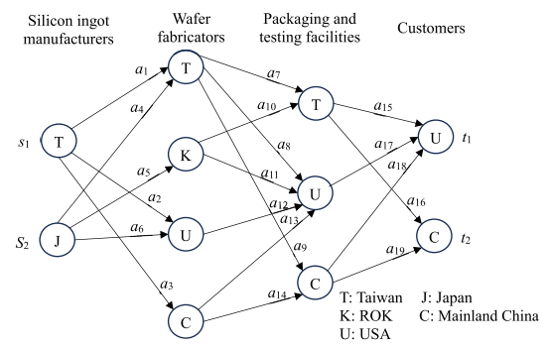
Fig. 3. An MSGLN topology
Technology Overview
The technology introduces a specialized network reliability algorithm tailored for MSGLNs. Methodologically, it defines the system's operational boundaries through the lens of freight charges, carbon tax structures, and multi-state link capacities. By employing a minimal path-based approach, the algorithm systematically determines all lower-boundary capacity vectors that successfully satisfy the predefined transmission demand within strict budget and emission limits.
Applications & Benefits
This research applies to semiconductor supply chain management, international logistics, green freight planning, and corporate environmental policy analysis. It provides significant benefits by allowing multinational enterprises to mathematically balance delivery reliability against carbon taxation risks. Ultimately, it enhances global chip distribution security while optimizing operational costs and advancing sustainable, low-carbon maritime and air transport strategies.
Abstract:
The semiconductor industry is highly globalized and technologically intensive, making supply chain operations critically important for global economic development and industrial stability. Semiconductor enterprises rely heavily on global logistics networks (GLNs) to ensure efficient delivery across international boundaries. Within a semiconductor GLN, the carrier capacity is often affected by bookings from other customers or operational disruptions, resulting in multiple states. Accordingly, the network can be modeled as a multistate semiconductor GLN (MSGLN). This study assesses the logistics reliability of an MSGLN under a transportation cost constraint, in which the transportation cost comprises both freight charges and carbon taxes. An algorithm based on minimal paths is developed to evaluate its reliability. The applicability of the proposed method is demonstrated through a case study that explored the impact of varying carbon tax rates, demands, budget levels, and booking lead times on logistics reliability. The proposed reliability metric offers quantitative decision support to semiconductor enterprises in supply chain risk assessment, transportation budgeting, market prioritization, and the evaluation of order-fulfillment capability, while also aligning with the climate action objectives of the United Nations Sustainable Development Goal 13 (SDG 13).

Reliability assessment for multistate semiconductor global logistics networks with freight charges and carbon taxes considerations
Author:Chang Ping-Chen, Yeh Cheng-Ta, Cheng Tzu-Yun, Yu Vincent F.
Year:2026
Source publication: Reliability Engineering & System Safety, Volume 269, May 2026, 112027
Subfield Highest percentage: 99% Safety, Risk, Reliability and Quality #2/282