Visible-light-prompted photoelectrochemical sensors fabricated using Er3NbO7/P@g-C3N4/SnS2 nanocomposite for detecting mercury ion in environmental water samples
This study developed a visible-light-driven photoelectrochemical (PEC) sensor based on an Er₃NbO₇/P@g-C₃N₄/SnS₂ ternary nanocomposite for ultrasensitive detection of mercury ions (Hg²⁺) in environmental water. The composite enhanced light absorption, charge separation, and electron transfer, resulting in excellent photoelectric performance. The fabricated sensor exhibited an ultralow detection limit of 0.019 pM, high selectivity against other metal ions, and excellent reproducibility and long-term stability. Validation using tap, pond, and river water samples demonstrated high recovery rates, confirming the sensor’s reliability and practical applicability for rapid, accurate, and real-time monitoring of mercury contamination in aquatic environments.
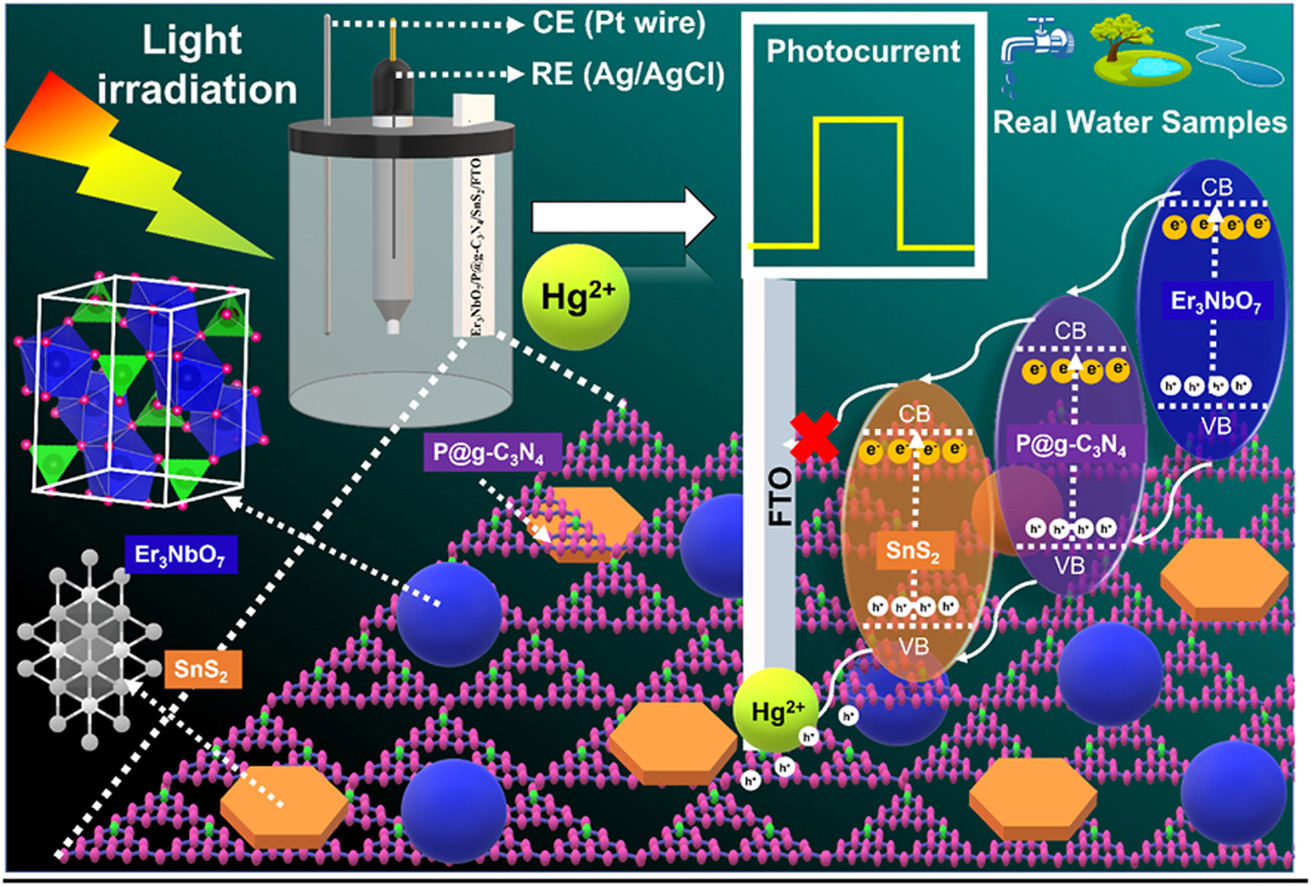
Graphical abstract.
Technology Overview
A visible-light photoelectrochemical sensor was fabricated using an Er₃NbO₇/P@g-C₃N₄/SnS₂ nanocomposite coated on an FTO electrode. The ternary heterostructure improves light harvesting, accelerates charge separation, and enhances electron transfer, enabling highly sensitive, selective, and stable detection of Hg²⁺ through photocurrent response.
Applications & Benefits
The sensor is suitable for environmental water quality monitoring, pollution control, and public health protection. Its ultralow detection limit, rapid response, excellent selectivity, and stable performance enable reliable detection of mercury contamination in real water samples, supporting efficient environmental surveillance and water safety management.
Abstract:
Photoelectrochemical (PEC) detection technology is key for fighting pollution, leveraging the photoelectric conversion of the photoelectrode material. A specialized photoelectrode was developed to detect Hg2+ ions with exceptional sensitivity, utilizing an anodic PEC sensor composed of Er3NbO7/P@g-C3N4/SnS2 ternary nanocomposite. Rare earth metal niobates (RENs) were chosen due to their underexplored potential, whose performance was enhanced through bandgap engineering and surface modification, facilitated by P@g-C3N4 as an immobilization matrix and SnS2, belonging to the I-IV semiconductors category fostering hybrid heterojunction formation for boasting optical properties and suitable redox potentials. Introducing Hg2+ into the system, a specific amalgamation reaction occurs between reduced Hg and Sn. This reaction obstructs electron transfer to the FTO electrode surface, leading to the recombination of charges. The proposed PEC sensor exhibited remarkable analytical performance for Hg2+ detection, high sensitivity, a detection limit of 0.019 pM, excellent selectivity, and a detectable concentration range of 0.002–0.15 nM. Additionally, it demonstrated good recovery and low relative standard deviation when analyzing Hg2+ in water samples, highlighting the potential application of the heterostructure in detecting heavy metal ions via PEC technology.

Visible-light-prompted photoelectrochemical sensors fabricated using Er3NbO7/P@g-C3N4/SnS2 nanocomposite for detecting mercury ion in environmental water samples
Author:Jayapaul Abishek, Lin Yu-Chien, Chen Ying-Chu, Liu Ting-Yu, Chung Ren-Jei
Year:2024
Source publication: Chemosphere, Volume 365, October 2024, 143336
Subfield Highest percentage: 99% Public Health, Environmental and Occupational Health #7/687