In-situ growth of MOF-derived Co3S4@MoS2 heterostructured electrocatalyst for the detection of furazolidone
This paper presents a novel electrochemical sensor for detecting furazolidone (FZ), a banned nitrofuran antibiotic whose abuse severely harms human health and the environment. To address this, the researchers successfully fabricated a metal-organic framework (MOF)-derived hollow Co3S4@MoS2 (CS@MS) heterostructured electrocatalyst. The resulting sensor (CS@MS/GCE) exhibits outstanding electrocatalytic performance, significantly outperforming bare and other modified glassy carbon electrodes. Through systematic characterization, the study demonstrates that the synergistic effects of Co3S4 and MoS2 provide an efficient, highly sensitive, and selective platform for FZ monitoring in real-world samples.
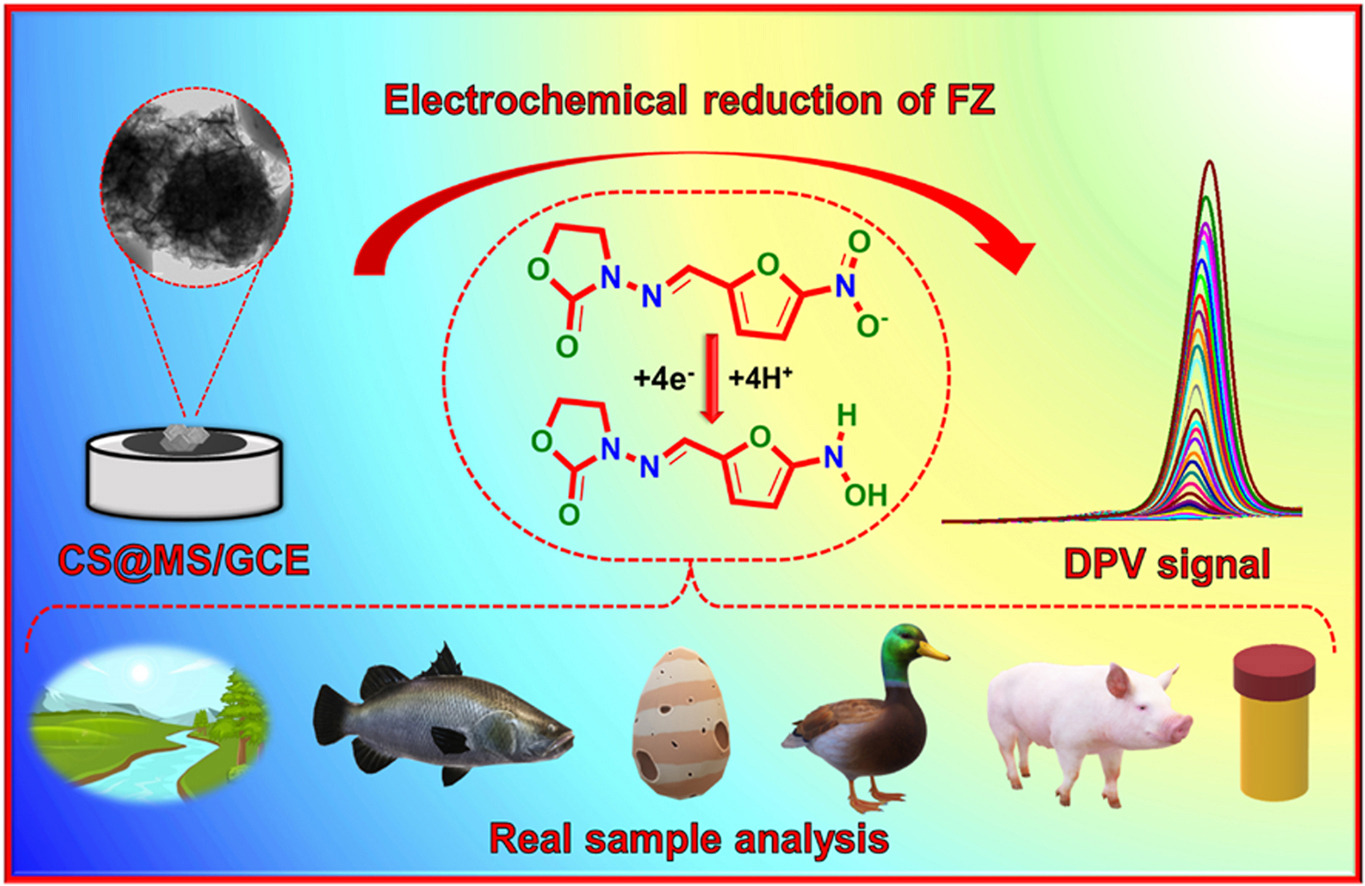
Graphical abstract.
Technology Overview
The CS@MS catalyst is synthesized hydrothermally by dispersing ZIF-67 templates with thioacetamide and sodium molybdate, followed by annealing at 350°C under a nitrogen atmosphere. This self-templated strategy grows MoS2 nanosheets uniformly over cobalt sulfide polyhedrons, forming a 3D flower-like heterostructure. This porous morphology increases active surface area, maximizes edge-site exposure, and dramatically reduces charge transfer resistance to accelerate electrochemical reaction kinetics.
Applications & Benefits
The CS@MS/GCE sensor is primarily applied to monitor FZ contamination in environmental river water and diverse biological samples, including fish, egg, duck, pork, and human urine. It delivers excellent practical benefits, featuring an ultra-low detection limit of 1.0 nM, outstanding sensitivity, strong anti-interference selectivity, and long-term storage stability. These advantages guarantee high reliability and high recovery rates for food safety and clinical diagnostics.
Abstract:
The over-exploitation of antibiotics in food and farming industries ruined the environmental and human health. Consequently, electrochemical sensors offer significant advantages in monitoring these compounds with high accuracy. Herein, MOF-derived hollow Co3S4@MoS2 (CS@MS) heterostructure has been prepared hydrothermally and applied to fabricate an electrochemical sensor to monitor nitrofuran class antibiotic drug. Various spectroscopic methodologies have been employed to elucidate the structural and morphological information. Our prepared electrocatalyst has better electrocatalytic performance than bare and other modified glassy carbon electrodes (GCE). Our CS@MS/GCE sensor exhibited a highly sensitive detection by offering a low limit of detection, good sensitivity, repeatability, reproducibility, and stability results. In addition, our sensor has shown a good selectivity towards the target analyte among other potential interferons. The practical reliability of the sensor was measured by analyzing various real-time environmental and biological samples and obtaining good recovery values. From the results, our fabricated CS@MS could be an active electrocatalyst material for an efficient electrochemical sensing application.

In-situ growth of MOF-derived Co3S4@MoS2 heterostructured electrocatalyst for the detection of furazolidone
Author:Priya Thangavelu Sakthi, Chen Tse-Wei, Chen Shen-Ming, Kokulnathan Thangavelu, Akilarasan Muthumariappan, Liou Wen-Chin, Al-Mohaimeed Amal M., Ali M. Ajmal, Elshikh Mohamed S., Yu Jaysan
Year:2024
Source publication: Chemosphere, Volume 356, May 2024, 141895
Subfield Highest percentage: 99% Public Health, Environmental and Occupational Health #7/687