Experimental study of the external load characteristics on a micro-scale organic Rankine cycle system
This experimental study addresses the critical knowledge gap regarding external load characteristics in small-scale Organic Rankine Cycle (ORC) systems. Utilizing a micro-scale 300 We ORC system running on eco-friendly R1233zd(E) fluid, the research investigates the dynamic operation and performance effects of resistive bulb loads configured at 175 We, 200 We, and 225 We. By modulating pump frequencies, the paper demonstrates how lower rated loads suppress internal scroll expander leakage and Ampere forces. Consequently, systems operating under lower rated loads achieve superior thermal efficiencies.
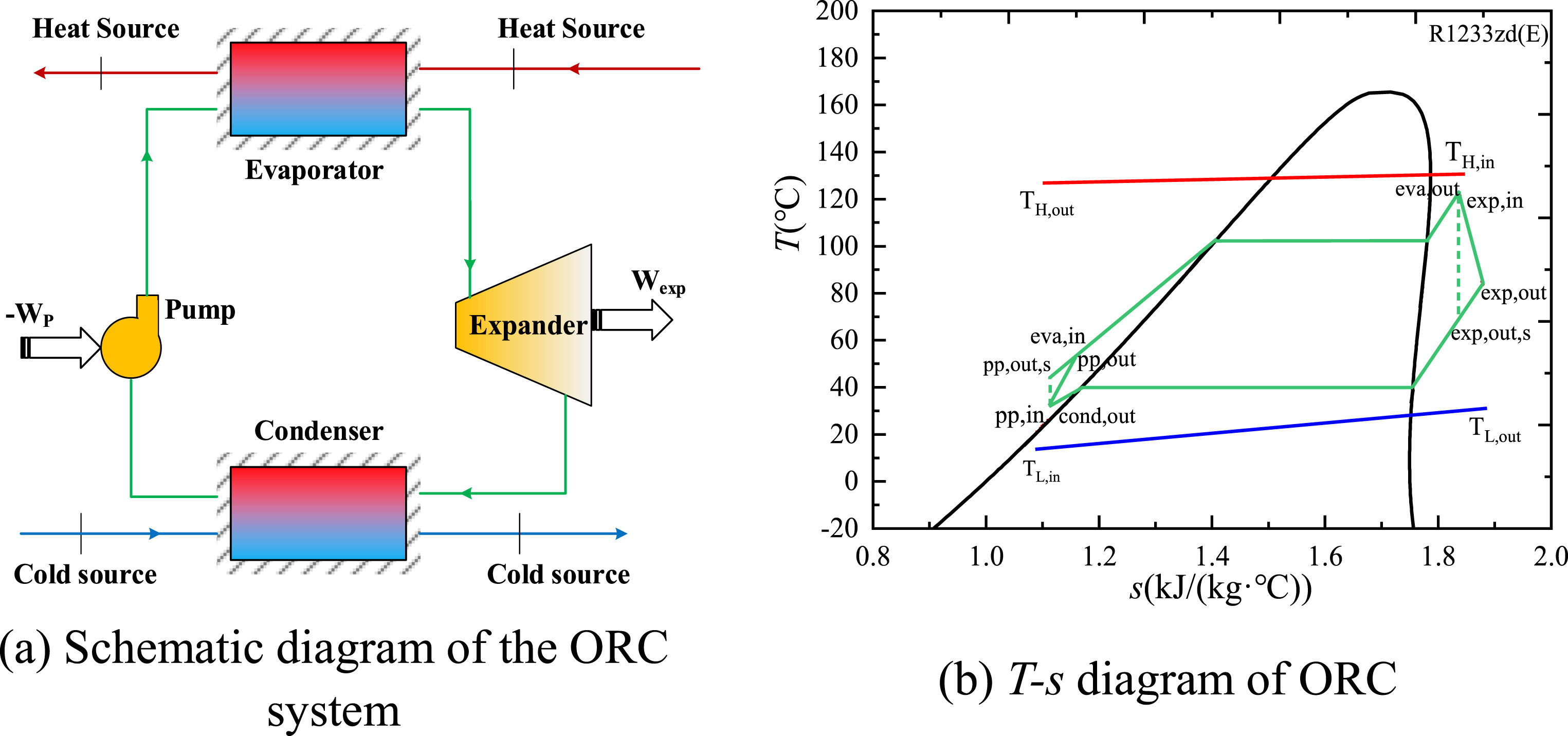
Fig. 1. Layout of the ORC.
Technology Overview
The experiment employs a positive-displacement scroll expander coupled to a DC generator, utilizing parallel-connected 12V/25 We bulbs to simulate adjustable resistive loads. Data acquisition is handled via a Keysight DAQ970A logger. Thermodynamic equations dynamically solve for mass flowrates, pump power consumption, expander isentropic efficiency, and overall cycle thermal efficiency.
Applications & Benefits
This research provides critical design guidelines for industrial low-grade waste heat recovery, solar energy, and geothermal applications. Beneficially, it reveals that matching the ORC capacity optimally with external loads yields thermal efficiency improvements up to 7.27%. This maximizes net power output (reaching up to 707 Wnet) while ensuring safe, stable off-design operations.
Abstract:
The expansion device is considered the crucial equipment in Organic Rankine cycle (ORC). Due to the structure limitation, the scroll expander would be critical affected by the external load characteristics. In this work, to fit the development trend of small-scale ORC and fill the research blank of load resistance, the ORC system with rated power of 300 We was experimentally studied, the dynamic operation characteristics, the direct and indirect influence on each device, and the overall system performance with rated load of 175 We, 200 We and 225 We were evaluated. By adjusting the frequency of the pump, the system dynamic operation characteristics are developed, and the behaviors of the devices are analyzed. According to the system analyses, despite the system with a rated load of 225 We could reach the highest output of 707 Wnet, the system with the lower rated load has the favorable performance, caused by the superior expander and generator behaviors with lower Ampere force. The overall system performance shows that the thermal efficiencies exhibits an increase trend of about 6.67 %, 7.01 %, and 7.27 % sequentially for the system with rated load of 225 We, 200 We, and 175 We.
Experimental study of the external load characteristics on a micro-scale organic Rankine cycle system
Author:Zhang Yifan, Tsai Yu-Chun, Ren Xiao, Tuo Zhaodong, Wang Wei, Gong Liang, Hung Tzu-Chen
Year:2024
Source publication: Energy, Volume 306, 15 October 2024, 132453
Subfield Highest percentage: 99% Modeling and Simulation #2/361