Alkaline metal tungstate anchored on functionalized-MWCNT: A co-active electrocatalyst for the detection of levofloxacin
This study details the fabrication of an innovative electrochemical sensor by decorating strontium tungstate nanospheres onto functionalized multiwall carbon nanotubes (SrWO4/f-MWCNT ) via a hydrothermal approach. Designed for monitoring levofloxacin (LVF) levels, the composite effectively resolves the issues of sluggish adsorptive efficiency and electron-hole pair reinteraction inherent to single oxides. Characterization through XRD, Raman, FTIR, and XPS confirmed its pure crystallinity, high structural defect density, and unique spherical-nanotube morphology. Electrochemical tests (CV and DPV) showed that the modification increases the electroactive surface area and shortens charge pathways, establishing an ultra-sensitive and highly stable platform for precise antibiotic tracking.
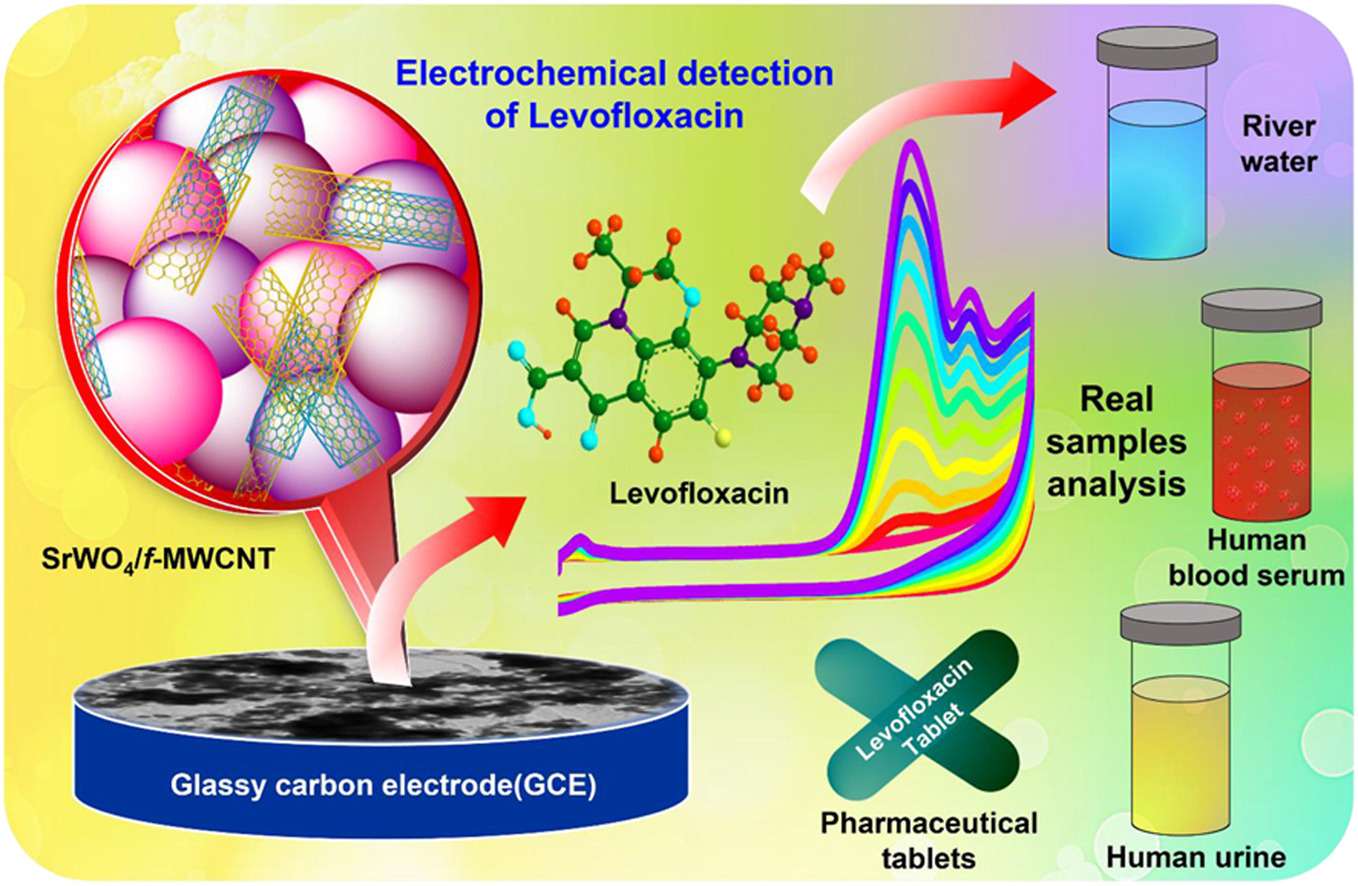
Graphical abstract.
Technology Overview
The sensor relies on a SrWO4/f-MWCNT nanocomposite synthesized through a step-by-step hydrothermal process. Acid treatments introduce oxygenated functional groups to enhance the carbon nanotubes' interfacial coupling and conductivity. Operating via differential pulse voltammetry (DPV), the catalyst exhibits a wide linear range of 0.049 μM–574.73 μM. It achieves an exceptional lower detection limit (LOD) of 0.0149 μM and a notable sensitivity of 2.86 μA μM−1 cm2.
Applications & Benefits
This sensor serves environmental and clinical sectors for tracking hazardous antibiotic residues. It yields superb, steady recovery rates in diverse matrices, including industrial river water, pharmaceutical tablets, human urine, and blood serum. Key benefits include excellent anti-interference, long-term operational stability, reproducibility, and high selectivity. Its low cost and simple preparation provide a scalable scaling alternative for medical and ecological analysis.
Abstract:
The widespread usage of levofloxacin (LVF) intake is executed for several urinary and respiratory systems infections in human. But, its over intake leads to severe damage to humans and the environment by its exposure. Hence the detection of LVF is concerned and we herein developed an electrocatalyst, strontium tungsten oxide nanospheres and later decorated onto the functionalized multiwall carbon nanotubes (SrWO4/f-MWCNT) to perform effective electrochemical recognition of LVF in aquatic and biological samples. Binary metal oxide with carbon composite SrWO4/f-MWCNT was developed due to its specific features as nanostructures. Various methods of investigation have been examined to identify the physiochemical characteristics like X-ray diffraction, Raman spectroscopy, Fourier transform infrared spectroscopy, X-ray photoelectron spectroscopy, and morphological characteristics including field emission scanning electron microscopy, and transmission electron microscopy. The synthesized SrWO4/f-MWCNT sample crystalline size was around 32.9 nm. The SrWO4/f-MWCNT modified glassy carbon electrode (GCE) has been subjected to electrochemical investigation with a wide linear range of 0.049 μM–574.73 μM with good sensitivity 2.86 μA μM−1 cm2, the limit of detection at 14.9 nM for LVF sensing. Furthermore, the designed LVF detection exhibited excellent anti-interference, stability, reproducibility, and repeatability. The as-developed sensor's electrochemical outcomes indicate the superior performance inherent in the developed composite.

Alkaline metal tungstate anchored on functionalized-MWCNT: A co-active electrocatalyst for the detection of levofloxacin
Author:Santhan Aravindan, Hwa Kuo Yuan
Year:2024
Source publication: Chemosphere, Volume 364, September 2024, 143028
Subfield Highest percentage: 99% Public Health, Environmental and Occupational Health #7/687