Ultrasensitive detection and photocatalytic degradation of polyketide drug tetracycline in environment and food samples using dual-functional Ag doped zinc ferrite embedded functionalized carbon nanofibers
This paper presents a novel approach for the dual-functional environmental remediation and food safety monitoring of tetracycline, a widely used polyketide antibiotic. The study addresses public health concerns by demonstrating the ultrasensitive electrochemical detection and efficient photocatalytic degradation of tetracycline residues in diverse environmental and food samples, such as wastewater, soil, milk, shrimp, and chicken feed.
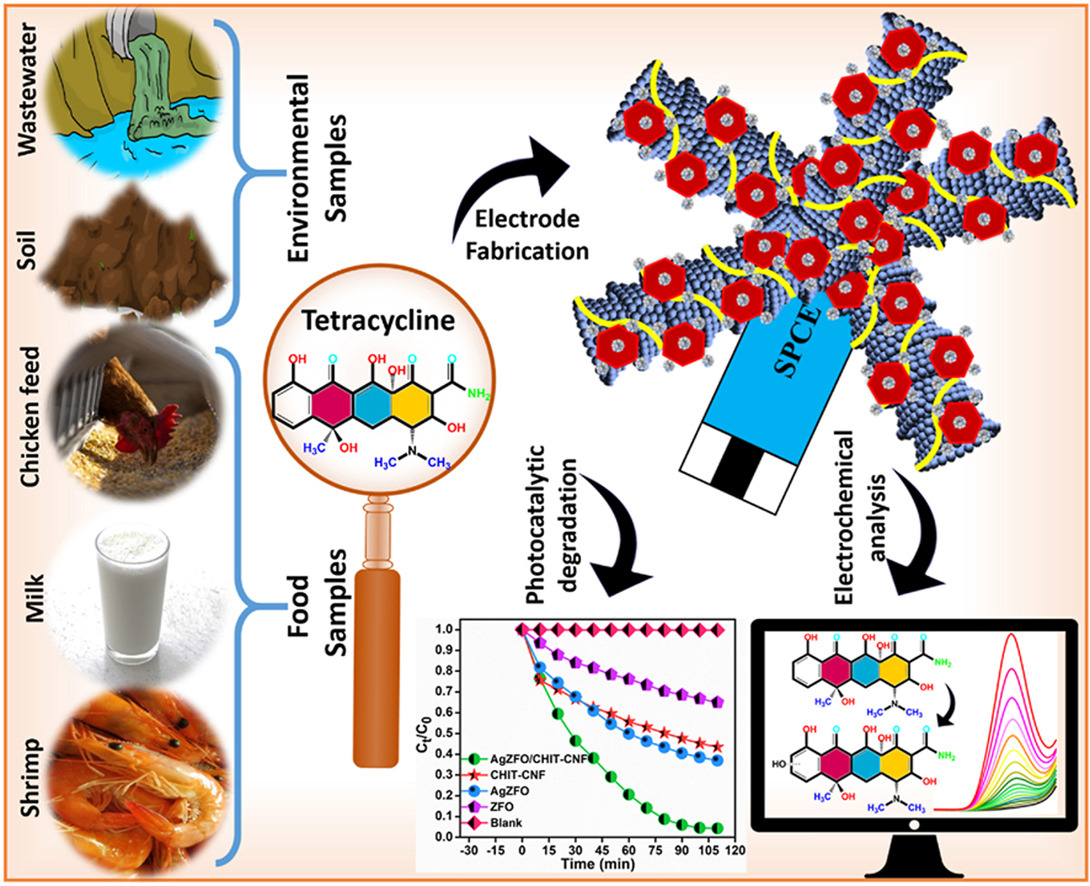
Graphical abstract.
Technology Overview
The proposed technology utilizes a high-performance nanocomposite consisting of silver-doped zinc ferrite nanoparticles embedded within chitosan-functionalized carbon nanofibers (AgZFO/CHIT-CNF). This material enhances synergistic electron transfer for precise electrochemical sensing on screen-printed carbon electrodes and accelerates solar-driven photocatalysis to decompose tetracycline contaminants.
Applications & Benefits
This advanced nanocomposite is highly applicable in environmental remediation (wastewater and soil purification) and food quality control (milk, shrimp, and poultry feed safety). Key benefits include rapid, ultrasensitive detection of antibiotic residues down to 1 nM and the highly efficient (95.72%) solar-driven elimination of toxic pollutants to combat antibiotic resistance.
Abstract:
The efficient degradation and accurate quantification of tetracycline in environment and food samples is pivotal for ensuring public health and safety by monitoring potential contamination and maintaining regulatory standards. Hence, in this study, photocatalytic degradation of tetracycline and its electrochemical detection in environment and food samples based on dual-functional silver-doped zinc ferrite nanoparticles embedded chitosan-functionalized carbon nanofibers fabricated on a screen-printed carbon electrode (AgZFO/CHIT-CNF/SPCE) is presented. A hydrothermal method was used in the synthesis of Ag-doped ZFO, and chitosan was functionalized on the CNF surface using a swift and cost-effective chemical modification process of carboxyl groups. Various techniques, such as XRD, HRTEM, elemental mapping, EIS, XPS, FTIR, VSM, BET, UV–Vis DRS, and Raman spectroscopy were used to analyze the characteristics of the prepared nanocomposite. Cyclic voltammetry and differential pulse voltammetry were used to evaluate the surface-controlled electrocatalytic properties of AgZFO/CHIT-CNF towards tetracycline. Electrochemical tests revealed that the proposed electrode exhibited excellent sensitivity for detecting tetracycline. The fabricated electrode had a low detection limit of 1 nM and a wide linear range (0.2–53.2 μM). The sensor also demonstrated exceptional selectivity, stability, and reusability. The practical feasibility evaluated with real samples, including chicken feed, shrimp, milk, soil, and wastewater, resulted in high recovery values.

Ultrasensitive detection and photocatalytic degradation of polyketide drug tetracycline in environment and food samples using dual-functional Ag doped zinc ferrite embedded functionalized carbon nanofibers
Author:Sebastian Neethu, Yu Wan-Chin, Balram Deepak, Hong Guo-Ting, Alharthi Salman S., Al-Saidi Hamed M.
Year:2024
Source publication: Chemosphere, Volume 348, January 2024, 140692
Subfield Highest percentage: 99% Public Health, Environmental and Occupational Health #7/687