Temperature prediction of submerged arc furnace in ironmaking industry based on residual spatial-temporal convolutional neural network
This paper addresses the challenge of high computational demands in real-time multi-physical field monitoring for submerged arc furnaces, a promising ore smelting technology. The authors propose a temperature prediction model based on a residual spatial-temporal convolutional neural network. By analyzing working conditions on coupled electric, thermal, and mass fields, the model successfully captures temperature variation trends. It establishes mathematical relationships between historical and future times, alongside local and global temperatures. Ultimately, this model achieves an exceptional temperature prediction accuracy of 99.76%, providing a theoretical foundation for intelligent operations.
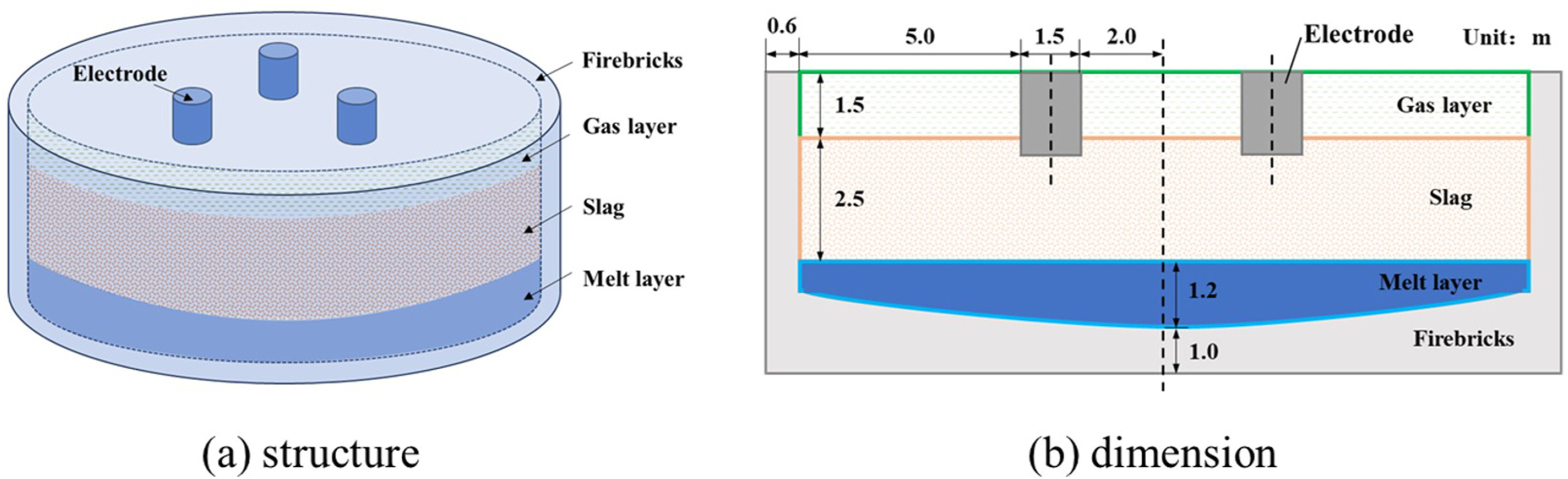
Fig. 1. Submerged arc furnace.
Technology Overview
The technology integrates an electric-heat-mass multi-physical field coupling model to determine Joule heat distributions. It employs a fully-connected neural network to extract deep features from configuration parameters like voltage. Concurrently, a residual spatial-temporal convolutional neural network models historical temperature matrices, utilizing convolutional layers and residual units to extract local and global spatial-temporal features for future temperature predictions.
Applications & Benefits
This model is applied to submerged arc furnaces in metallurgy and ironmaking, and is adaptable to meteorological or power industries. Its primary benefits include enabling safe, automatic, real-time temperature monitoring. It delivers an outstanding 99.76% prediction accuracy, vastly outperforming traditional MLP models (98.18%), which greatly improves smelting efficiency and supports intelligent furnace control.
Abstract:
The submerged arc furnace is widely regarded as one of the most promising ore smelting technologies. However, the real-time monitoring of the multiple physical fields including electric, thermal, and mas, through computational fluid dynamics demands significant computational resources. This paper introduces the spatial-temporal convolutional neural network algorithm to address this challenge. Initially, the influences of various working conditions on these physical fields are analyzed. Subsequently, a prediction model is developed based on the coupling of these multiple physical fields model. The spatial-temporal convolutional neural network algorithm is then employed to elucidate the main parameter distributions, enabling the automatic real-time detection of temperature variation trends and providing a theoretical foundation for intelligent furnace operation. The findings indicate that the electric field is the predominant factor causing non-uniform heat distribution, with localized overheating primarily occurring at the electrode ends. The application of the proposed model facilitates dynamic prediction of the temperature distribution, establishing relationships between historical and future time steps as well as local and global temperature variations. The reliability of the temperature prediction model is confirmed, with the model achieving an accuracy of 99.76 %, surpassing the 98.18 % accuracy of the traditional multi-layer perceptron model.

Temperature prediction of submerged arc furnace in ironmaking industry based on residual spatial-temporal convolutional neural network
Author:Liu Hong-Xuan, Li Ming-Jia, Guo Jia-Qi, Zhang Xuan-Kai, Hung Tzu-Chen
Year:2024
Source publication: Energy, Volume 309, 15 November 2024, 133024
Subfield Highest percentage: 99% Modeling and Simulation #2/361