Photochemical decoration of gold nanoparticles on MoS2 nanoflowers grafted onto the flexible carbon cloth as a recyclable SERS sensor for the detection of antibiotic residues on curved surfaces
This paper presents a novel, highly flexible, and recyclable sensor designed for surface-enhanced Raman spectroscopy by anchoring plasmonic gold nanoparticles onto flower-like molybdenum disulfide grown on a carbon cloth substrate. This hybrid structure successfully addresses the common challenges of fabricating flexible sensors for real-time analysis on uneven surfaces. It delivers an ultra-low detection limit and exceptional signal enhancement. Furthermore, its built-in self-cleaning capability under ultraviolet light ensures excellent reusability. This makes the sensor a highly promising and practical platform for rapid, trace-level chemical detection.
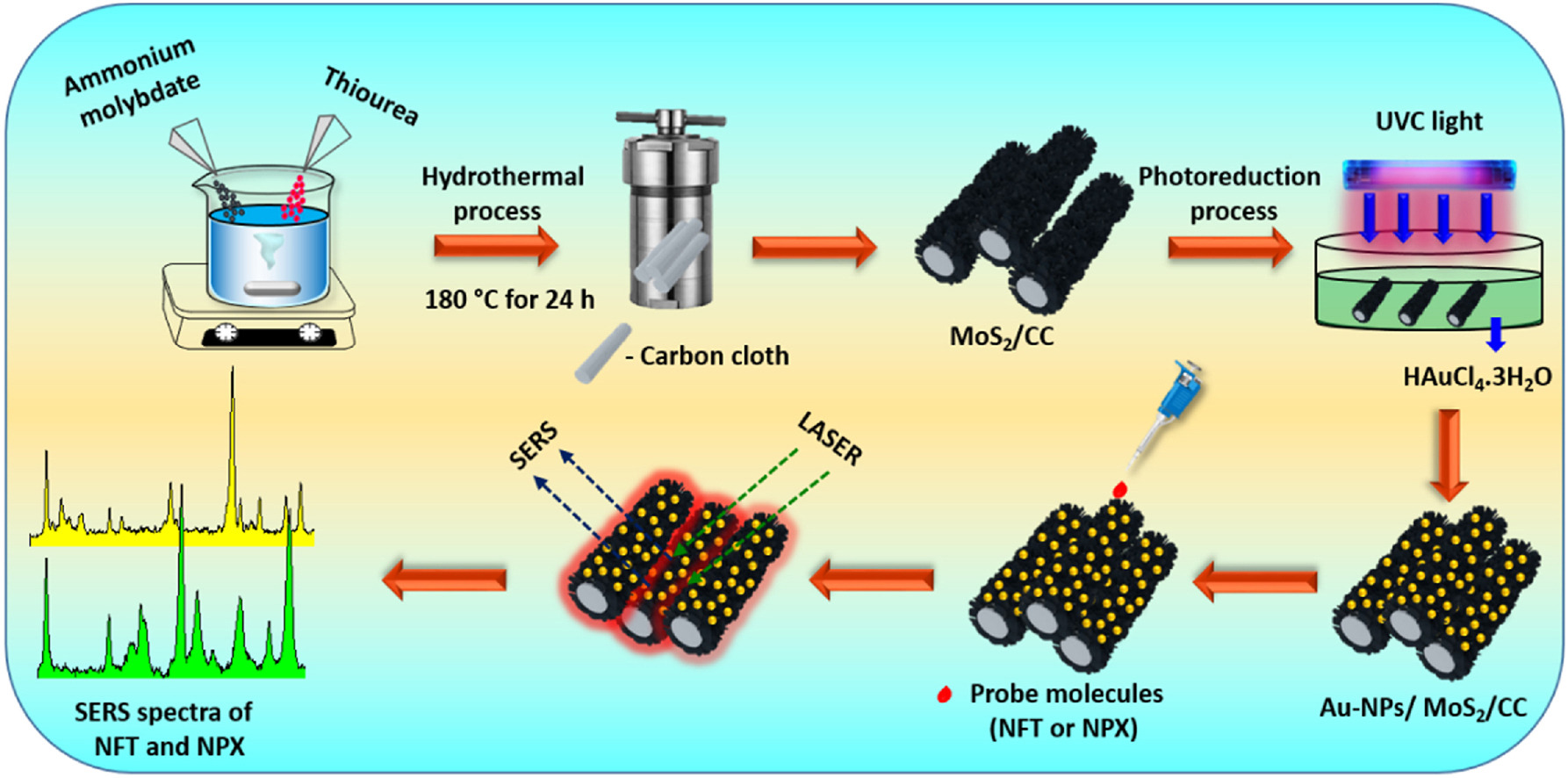
Graphical abstract.
Technology Overview
The fabrication process combines a simple hydrothermal reaction and a rapid photoreduction route. First, three-dimensional flower-like molybdenum disulfide nanosheets are synthesized on carbon cloth at 180 degrees Celsius. Next, gold nanoparticles are photodeposited onto the molybdenum disulfide surfaces using ultraviolet C light. This design combines physical and chemical mechanisms to significantly amplify the detection signals.
Applications & Benefits
This sensor is highly beneficial for food safety and environmental monitoring, specifically for detecting trace antibiotic residues on curved meat surfaces using a non-destructive swab technique. Key advantages include outstanding mechanical flexibility, robust signal reproducibility, and ultraviolet-assisted self-cleaning, which allows the substrate to be fully recycled and reused for at least four cycles.
Abstract:
Surface-enhanced Raman spectroscopy (SERS)-based flexible substrate has recently been demonstrated to be effective in detecting molecules on curved surfaces, however a suitable method for fabricating the flexible SERS substrate still remains a hurdle. In this paper, we fabricated a flexible SERS substrate by anchoring the plasmonic gold nanoparticles (Au-NPs) onto the hydrothermally grown flower-like molybdenum disulfide (MoS2) grafted onto carbon cloth (CC) via a facile photoreduction route. Benefitting from the abundant hotspots generation of the Au-NPs and photo-induced charge-transfer ability of MoS2, the constructed Au-NPs/MoS2/CC substrate exhibit a superior SERS sensing ability, excellent SERS enhancement factor, high flexibility and mechanical stability towards the nitrofurantoin (NFT) with an ultra-low detection limit of 10−11 M. As a trial for practical applications, the flexible substrate was used to detect NFT (10−4 M) in the curved surfaces of meat samples via swab technique. The ability of the flexible Au-NPs/MoS2/CC substrate to sustain the robust Raman signals of NFT even after recycling up to 4 cycles validated its reusability. The proposed flexible SERS substrate with reusable capability indicates its great potential in practical applications for the detection of target molecules on the curved surfaces.

Photochemical decoration of gold nanoparticles on MoS2 nanoflowers grafted onto the flexible carbon cloth as a recyclable SERS sensor for the detection of antibiotic residues on curved surfaces
Author:Barveen Nazar Riswana, Chinnapaiyan Sathishkumar, Wang Tzyy-Jiann, Huang Chi-Hsien
Year:2024
Source publication: Chemosphere, Volume 346, January 2024, 140677
Subfield Highest percentage: 99% Public Health, Environmental and Occupational Health #7/687