High-performance flexible asymmetric supercapacitors based on Hy-NiCoS/CNTs composites on porous graphene films
This research introduces high-performance flexible asymmetric supercapacitors fabricated by drop-casting synthesized hydrothermal NiCoS/carbon nanotube (Hy-NiCoS/CNTs) composites onto porous laser-induced graphene (LIG) films on polyimide substrates. The optimized bimetallic sulfide electrode successfully achieves excellent electrochemical performance and remarkably low internal resistance. The assembled asymmetric device (Hy-NiCoS/AC) demonstrates outstanding energy and power densities under practical current loads, while maintaining exceptional electrochemical stability and structural integrity even under severe bending deformation. This work presents a highly promising strategy for developing robust, scalable energy storage solutions.
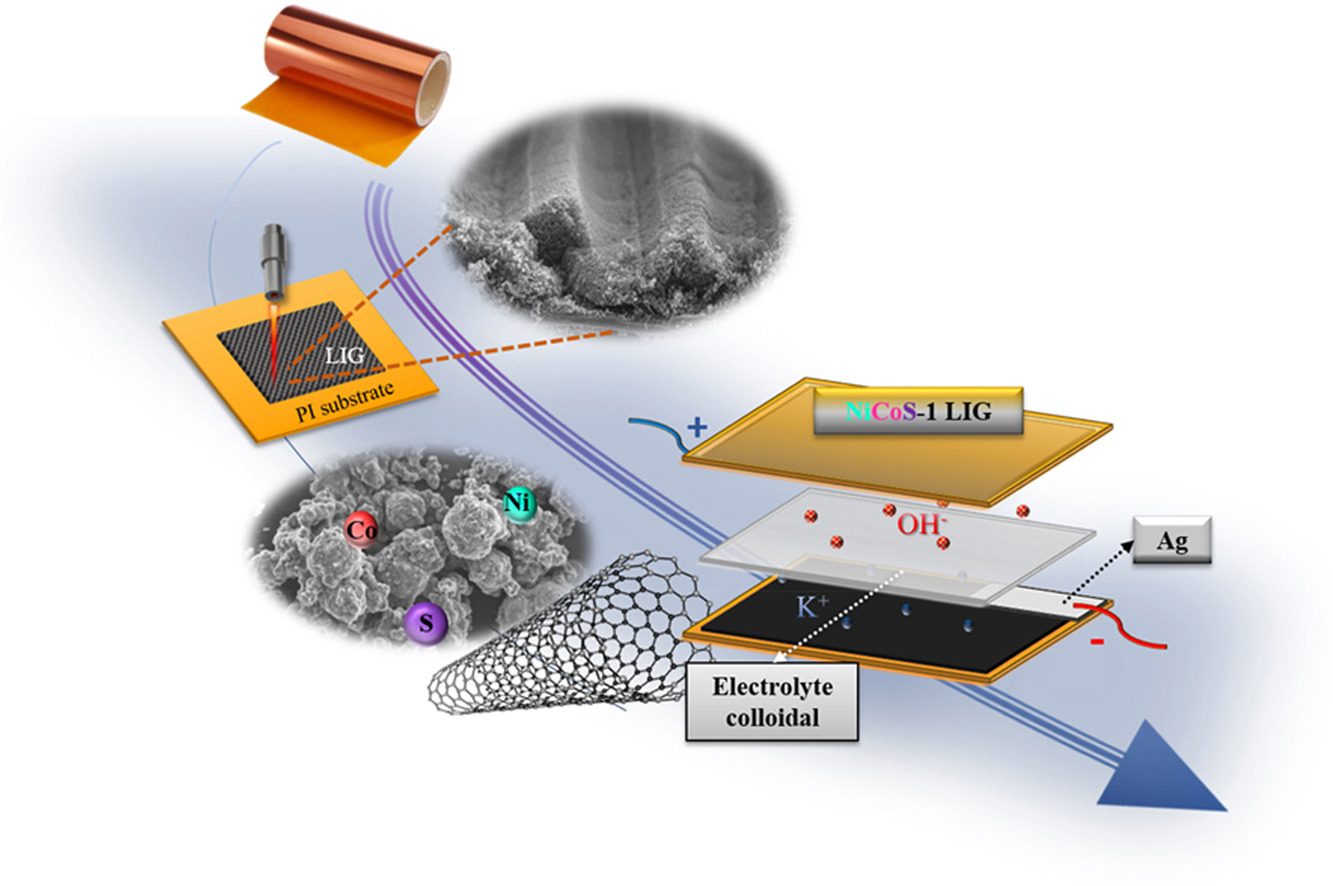
Graphical abstract.
Technology Overview
The fabrication utilizes a 1064 nm fiber laser system to rapidly induce porous multilayer graphene on polyimide films. Active electrode materials of Hy-NiCoS/CNTs are synthesized via a hydrothermal process using thiourea. The resulting multi-layered nanospherical structures, combined with LIG's dense porous network, significantly enhance electrolyte penetration, accelerate charge-transfer kinetics, and facilitate multiple faradaic redox reactions.
Applications & Benefits
These flexible asymmetric supercapacitors provide critical benefits, including excellent mechanical flexibility, high capacitance retention under bending, and robust charge-storage capacity. Successfully demonstrated by powering a red LED for over 100 seconds, this cost-effective and highly stable energy storage technology offers promising applications for next-generation wearable electronics, portable power supplies, and personalized healthcare monitoring products.
Abstract:
This research focused on the synthesized NiCoS/CNT composites by a hydrothermal method using thiourea and then drop-cast on laser-induced graphene (LIG) with porous structures for an active electrode of flexible asymmetric supercapacitors. Surface topography, cross-sectional outline, chemical structure and properties, and electrical properties of LIG, NiCoS, and Hy-NiCoS materials were measured and analyzed. In the two-electrode device, the Hy-NiCoS electrode has a high areal capacitance of 817 mF/cm2 under 0.5 mA/cm2 current density and a low internal resistance of 5.19 Ω. Furthermore, the prepared flexible asymmetric supercapacitors (Hy-NiCoS/AC) demonstrated excellent energy density of 0.017 mWh/cm2, power density of 3.2 mW/cm2, and areal capacitance of 85 mF/cm2 under 0.5 mA/cm2 current density. When the bending angles were 0°, 45°, and 90°, the areal capacitances of the prepared flexible asymmetric supercapacitors were 77.7, 75.0, and 70.8 mF/cm2, respectively. There is no obvious capacitance decay even at a large bending angle of 90°, which means that the asymmetric supercapacitor has excellent flexibility and stability. Based on the flexible asymmetric supercapacitors with excellent electrochemical performance, the proposed supercapacitors can be widely used in wearable electronic devices and healthcare products.
High-performance flexible asymmetric supercapacitors based on Hy-NiCoS/CNTs composites on porous graphene films
Author:Tseng Shih-Feng, Lin Jhih-Yi, Lin Jeng-Yu
Year:2024
Source publication: Energy, Volume 291, 15 March 2024, 130365
Subfield Highest percentage: 99% Modeling and Simulation #2/361