Solid fuel recovered from food waste dechlorination: Proof of concept and cost analysis
This study demonstrates a novel waste-to-energy method that converts municipal food waste, wood waste, and plastics into clean solid-recovered fuel (SRF). Focusing on the critical parameter of chlorine content, which typically induces high-temperature corrosion in boilers, the researchers evaluated an efficient dechlorination pretreatment phase. Results showed that utilizing calcium hydroxide as a detergent successfully extracted the majority of the chlorine while simultaneously improving the fuel's heating values, mass yield, and energy yield. Furthermore, a comprehensive cost analysis was provided to guide large-scale manufacturing.
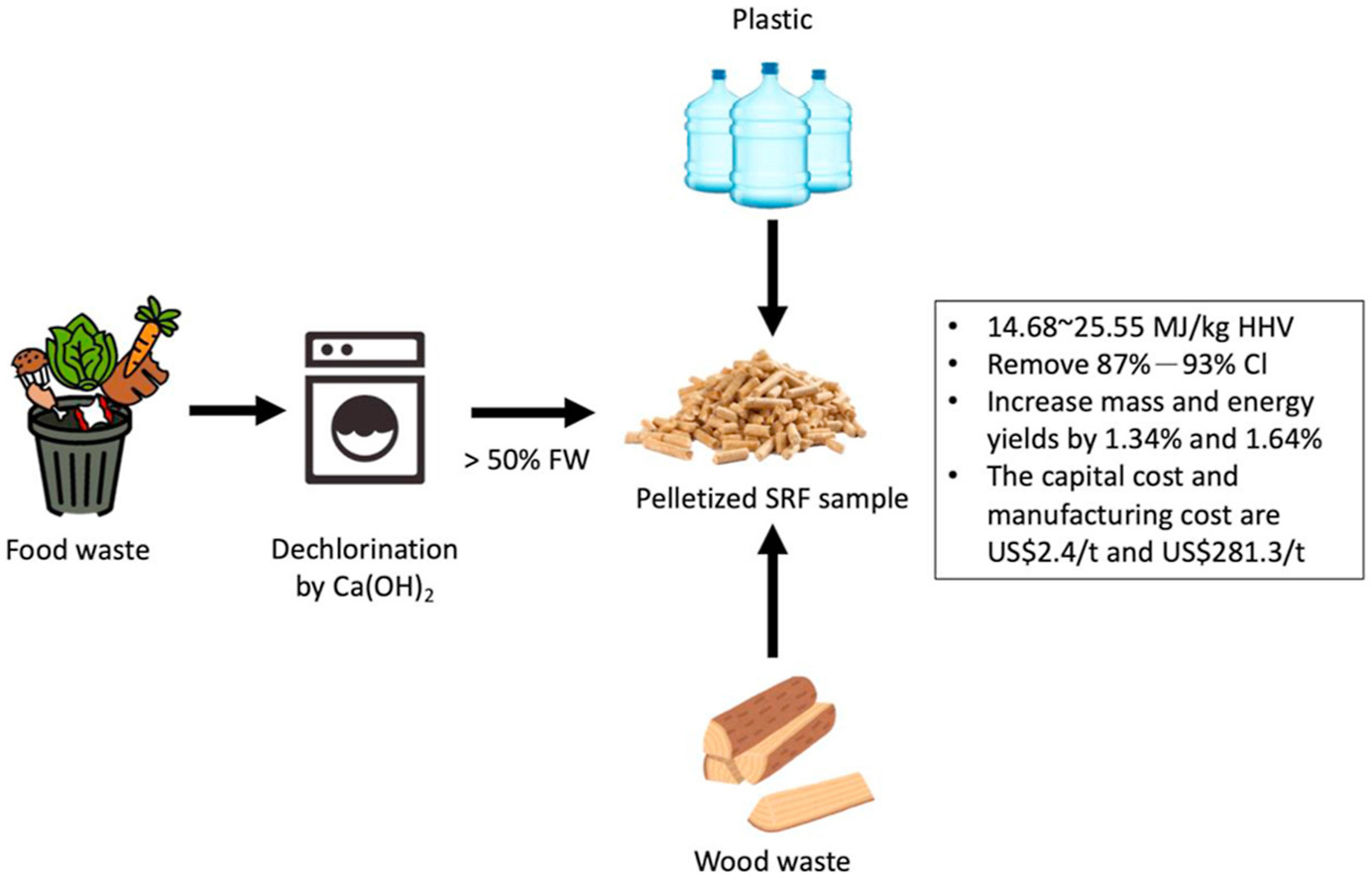
Graphical abstract.
Technology Overview
The technical process involves washing multi-material waste mixtures—specifically food waste, wood waste, and polypropylene—with a calcium hydroxide solvent (pH 12.5) or deionized water. Operating at a stirring speed of 65 rpm over multiple washing runs under specified liquid-to-solid ratios, the calcium hydroxide pretreatment effectively removes 87–93% of raw chlorine content during the second washing stage. The materials are subsequently pelletized and mildly torrefied at 300°C to optimize energy density.
Applications & Benefits
This technology applies directly to municipal solid waste management facilities and Waste-to-Energy (WTE) power plants. Economically, it delivers high-standard SRF with an upgraded heating value up to 25.55 MJ/kg at a cut-down cost of US$62.4/t when transport is optimized. Environmentally, it mitigates hazardous acidic gas emissions and boiler corrosion by successfully eliminating chlorine pollution.
Abstract:
Chlorine content is one of the key performance metrics for solid-recovered fuel. In this study, food waste, wood waste, and plastics were collected from municipal solid waste to prepare solid-recovered fuel, which was then used to evaluate several parameters in the dechlorination process. Approximately 87–93% of the chlorine content of the raw materials was effectively removed using calcium hydroxide as a detergent under a range of liquid-to-solid ratios and washing times during the pretreatment phase. Using calcium hydroxide was beneficial for increasing the high heating value, whereas elution with deionized water was beneficial for ash removal. The high heating value of the dechlorinated solid-recovered fuel was 4.54% higher than that of the untreated solid-recovered fuel, and the highest high heating value achieved was 25.55 MJ/kg. The dechlorination process increased the mass yield by 1.34% and the energy yield by 1.64%. To produce, store, and transport solid-recovered fuel on a large scale, the capital and manufacturing costs were calculated to be US$2.4/t and US$281.3/t, respectively, and the total cost could be reduced substantially by minimizing the transportation cost. The dechlorination technologies investigated in this study provide guidance for producing high-standard solid-recovered fuel at a lower cost and with less chlorine pollution compared with the currently used processes.
Solid fuel recovered from food waste dechlorination: Proof of concept and cost analysis
Author:Chen Ying-Chu, Lin Hsing-Chou, Chen Li-Yun
Year:2022
Source publication: Journal of Cleaner Production, Volume 360, August 2022, 132240
Subfield Highest percentage: 99% Strategy and Management #4/473