An adaptive high-voltage direct current detection algorithm using cognitive wavelet transform
This paper introduces a novel algorithm designed to detect and identify high-voltage direct current (HVDC) discharge using cathodic protection (CP) time-series data. Identifying HVDC discharge is critical for ensuring the safety of nearby buried energy pipelines and maintaining the optimal operation of electrical power systems. The authors construct a wavelet-based application framework capable of separating transient discharge signals from massive noise in real-time. This research provides new perspectives on time-series data classification and prevents hazardous pipeline corrosion and energy leakage.
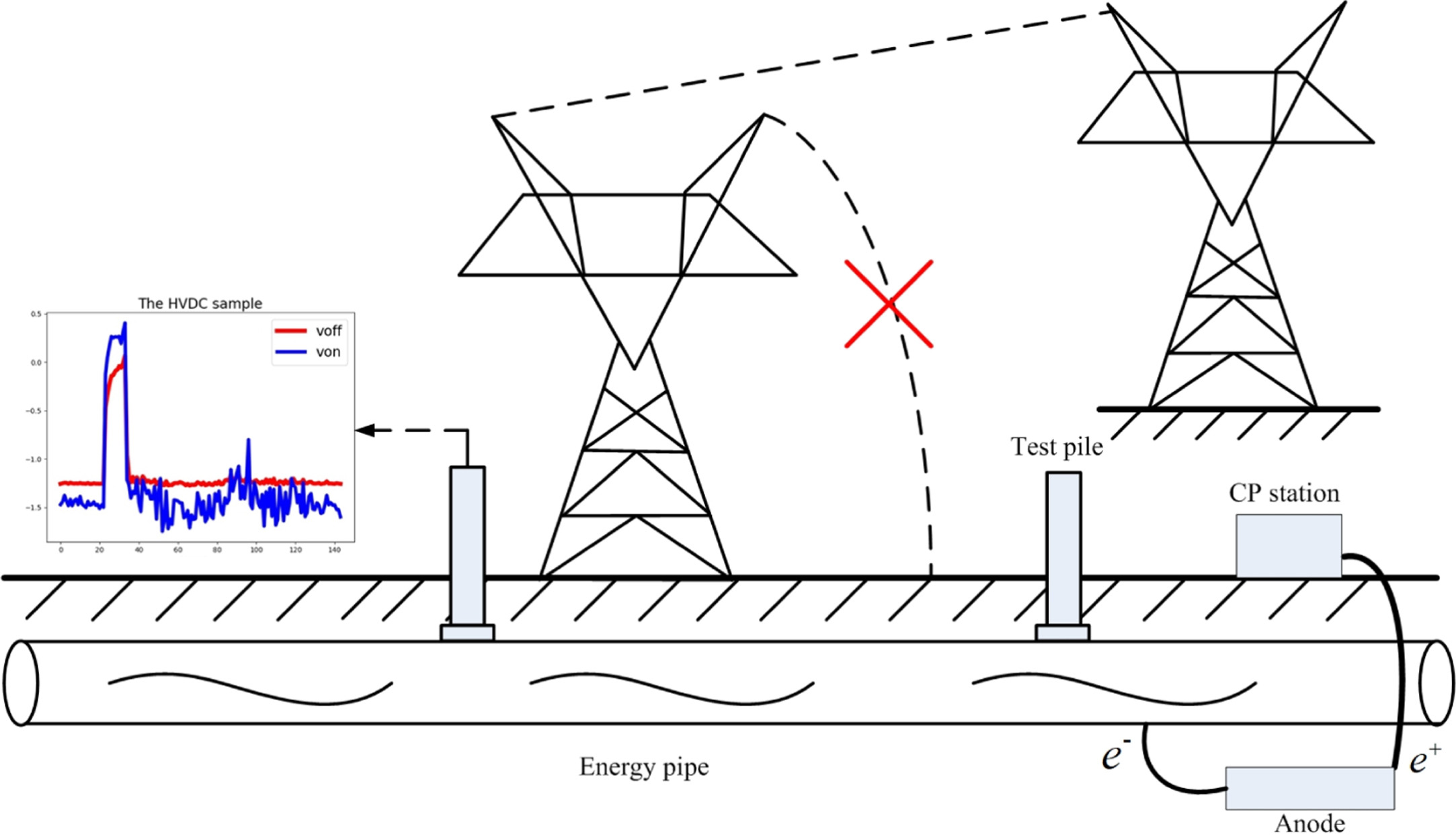
Fig. 1. Schematic diagram.
Technology Overview
The core technology, named AWL-WE, integrates Discrete Wavelet Transform (DWT), Wavelet Packet Transform (WPT), and relative wavelet energy. It overcomes the conventional limitation of WPT by adaptively determining the optimal decomposition level based on relative energy changes. The framework incorporates quantitative and qualitative approaches to select the ideal mother wavelet function and applies Linear Discriminant Analysis (LDA) for effective feature dimension reduction.
Applications & Benefits
The primary application domain is the health monitoring and safety protection of power systems and oil/fuel energy pipelines. By enabling real-time detection of potential changes in cathodic protection systems, the algorithm successfully mitigates stray current corrosion risks. The benefit is a highly stable, automated framework that achieves up to a 93.9% accuracy rate, significantly optimizing industrial pipeline safety and operational longevity.
Abstract:
This paper proposes an algorithm that uses wavelet level adaptive decision-making for detecting high-voltage direct current (HVDC) discharge in wavelet transform cognitively. The identification and detection of HVDC discharge is an essential area of investigation, which contributes to ensuring pipeline safety and the optimal operation of an electrical power system. The proposed algorithm overcomes the wavelet packet transform's disadvantage of needing to determine the level in advance. The decomposition level of wavelet packet transform is controlled by calculating relative wavelet energy change to decide its wavelet level. Our proposal extracts richer features of HVDC discharge by comparing other feature extraction algorithms. To select the best-suited mother wavelet function, we also design a selection method based on quantitative and qualitative approaches. An additional objective of this study is to detect the phenomenon of HVDC discharge using CP time-series data to assess the corrosion of energy pipelines. Moreover, a third primary discovery is that a wavelet-based application framework is designed to detect the HVDC discharge and further protect the energy pipeline. These discoveries can be valuably applied to the protection of power systems. They also provide brighter perspectives on future opportunities to expand on studies-to-date on the detection and classification of time-series data.

An adaptive high-voltage direct current detection algorithm using cognitive wavelet transform
Author:Wang Yanan, Li Jianqiang, Pei Yan, Ma Zerui, Jia Yanhe, Wei Yu-Chih
Year:2022
Source publication: Information Processing and Management, Volume 59, Issue 2, March 2022, 102867
Subfield Highest percentage: 99% Media Technology #1/62