Enhanced electrochemical performance of in-situ synthesized Cu nanoparticle/C spheres composite for highly sensitive sensing of azathioprine immunosuppressive drug
This study introduces an in-situ synthesized copper nanoparticle-decorated carbon sphere (Cu NPs/C) composite designed for the highly sensitive electrochemical sensing of azathioprine (AZP). AZP is an immunosuppressive drug widely suggested for treating innate immune-responsive diseases; however, its long-term usage poses severe health risks, including bone marrow suppression and various cancers. To address the limitations of conventional detection methods, which are often expensive, slow, and complex, this research presents a rapid, low-cost, and reliable alternative. The modified electrode demonstrates exceptional electrocatalytic reduction performance, establishing a robust framework for advanced pharmaceutical safety monitoring.
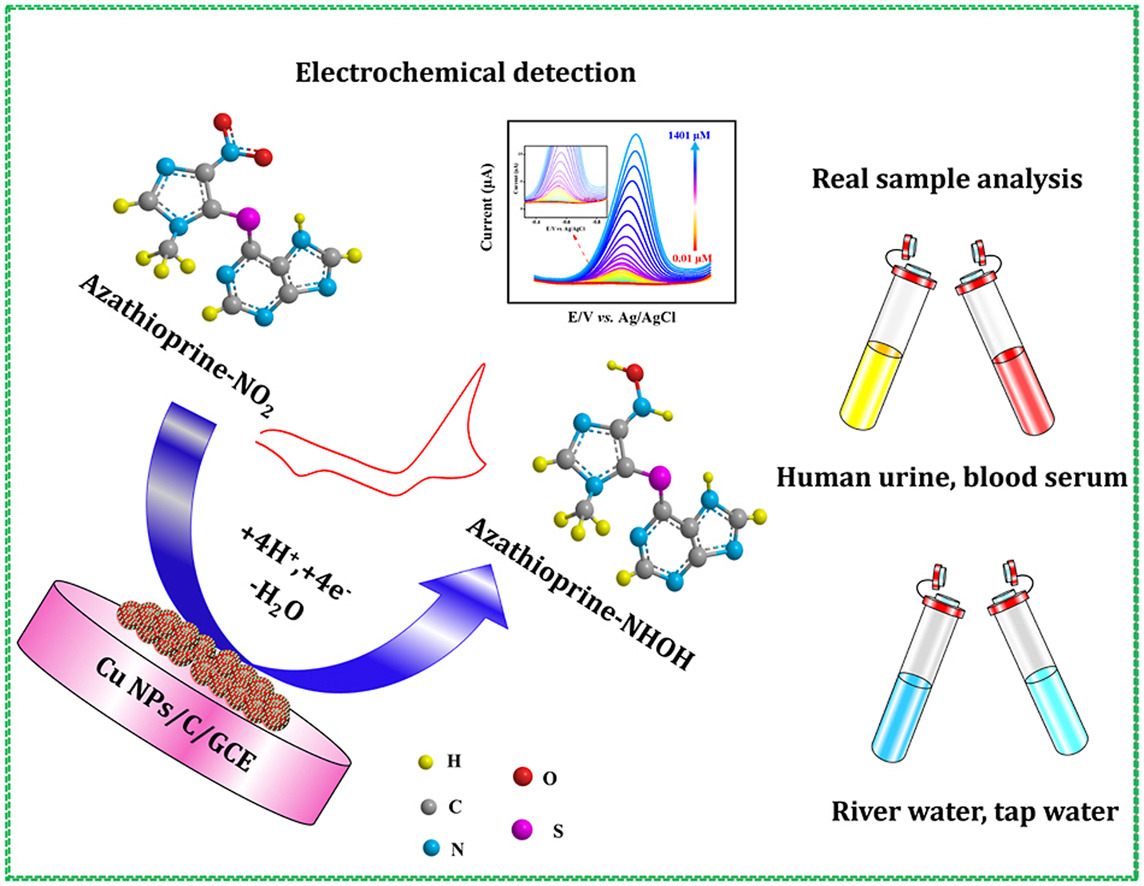
Graphical abstract.
Technology Overview
The synthesis involves a two-step process: initial hydrothermal carbonization of glucose to produce carbon microspheres, followed by the in-situ decoration of Cu nanoparticles under a nitrogen atmosphere. The successful material compilation and structural properties were verified using XRD, FT-IR, FE-SEM, HRTEM, and XPS. Electrochemical detection was primarily operated via the highly sensitive differential pulse voltammetry (DPV) technique.
Applications & Benefits
The Cu NPs/C modified electrode provides a large surface area, outstanding mass transportability, and remarkably low charge transfer resistance. It benefits from a wide linear detection range 0.01–1401 μM, an ultralow detection limit of 3.5 nM, and high selectivity. This practical sensor is highly beneficial for real-time AZP monitoring in environmental water and human body fluids.
Abstract:
Sustainable development of carbon composites and unraveling its applications in the field of sensors requires a greater understanding of materials chemistry insights. An in-situ synthesized copper nanoparticle decorated carbon (Cu NPs/C) spheres composite is deployed for the detection of azathioprine (AZP), an immunosuppressive drug. As in-situ synthesized Cu NPs/C composite were characterized by various analytical techniques such as XRD, FT-IR, FE-SEM, and XPS analysis. The Cu NPs/C composite modified GCE is resulting in excellent mass/ion transportability, high surface area, and low charge transfer resistance in the electrochemical system. The Cu NPs/C/GCE operated by using the voltammetry (DPV) technique resulted in a highly sensitive AZP detection in the wide linear level of 0.01–1401 μM. Moreover, the Cu NPs/C/GCE exhibited a high sensitivity and low detection limit (LOD) of 0.194 μAμM−1cm−2 and 3.5 nM to AZP detection respectively. The practical AZP detection performances of the Cu NPs/C/GCE were also verified with environmental and human body fluid samples. Based on these results, we believe that the as-prepared Cu NPs/C composite will be a potential material for AZP sensors in environmental applications.

Enhanced electrochemical performance of in-situ synthesized Cu nanoparticle/C spheres composite for highly sensitive sensing of azathioprine immunosuppressive drug
Author:Anupriya Jeyaraman, Velmurugan Sethupathi, Chen Shen-Ming, Hahn Yoon-Bong
Year:2022
Source publication: Composites Part B: Engineering, Volume 242, 1 August 2022, 110079
Subfield Highest percentage: 99% Industrial and Manufacturing Engineering #2/355