Achieving sustainable industrial ecosystems by design: A study of the ICT and electronics industry in Taiwan
This study investigates how computer, communication, and consumer electronics (3C) companies in Taiwan transition from traditional business-as-usual models to sustainable ecosystems. Based on semi-structured interviews with design practitioners across eight companies, the research highlights that ecodesign and circular design are the primary proactive strategies deployed to realize environmental sustainability and industrial dematerialization. By exploring internal and external driving forces, the paper identifies the main institutional obstacles in organizational culture and waste recovery. Ultimately, it emphasizes a necessary paradigm shift from pure product-level enhancements to holistic socio-technical system innovations.
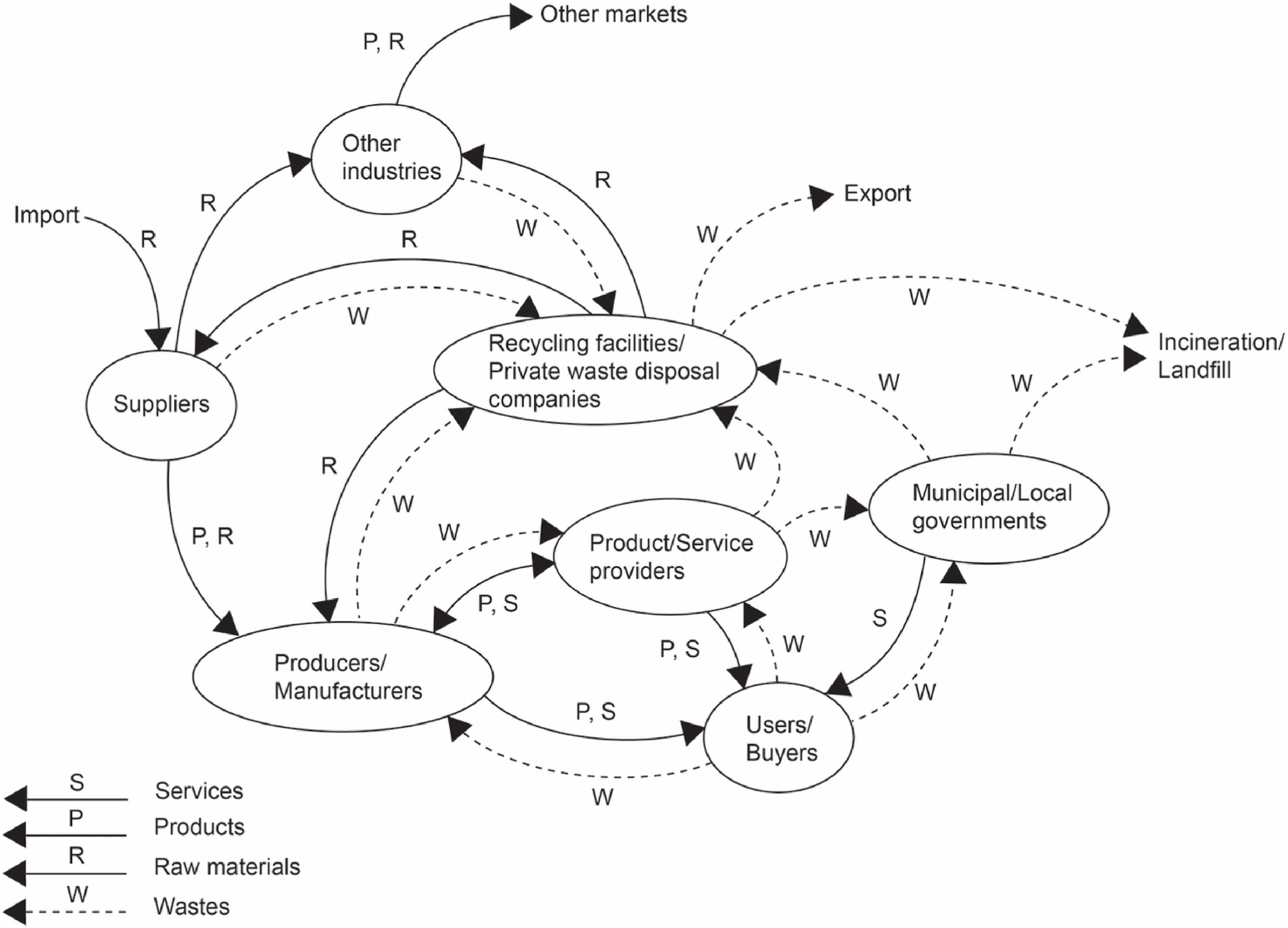
Fig. 2. Service, product, raw material, and waste flows within the ecosystem of the 3C industry in Taiwan.
Technology Overview
The framework integrates three categories of pragmatic tools: life cycle thinking tools (e.g., LCA and circularity assessments) for environmental hotspots, design thinking tools for human-centric innovation, and business model tools for economic value. Structurally, the ecosystem maps stakeholder collaborations into three distinct actor subsystems: drivers, facilitators, and supporters.
Applications & Benefits
Applied directly to the ICT, 3C electronics, and manufacturing industries, this systemic approach guides firms in advancing product longevity, green packaging, and product-service systems (PSS) like leasing. The corporate benefits include enhanced brand reputation, accelerated carbon neutrality, minimized global e-waste generation, and the creation of socially inclusive business partnerships.
Abstract:
The environmental and economic aspects of sustainability have been the most common subjects in the manufacturing industry, while the social one tends to be neglected. The process of semistructured interviews is conducted with design practitioners in the computer, communication, and consumer electronics industry in Taiwan to comprehend how the participating companies can move from a business-as-usual model to a more sustainable business by design. Results show that ecodesign and design for circular economy are commonly applied as sustainable design strategies, highlighting the concept of dematerialization. The three pragmatic tools applied alongside for balancing the three pillars of sustainability are life cycle thinking, design thinking, and business model tools. To achieve sustainable industrial ecosystems, three key actors, namely, a driver, a facilitator, and a supporter, play an important role to create stakeholder engagement and supply chain collaboration. Hence, the companies must tackle major challenges related to organizational culture, social reputation and communication, resource availability, service at the end of life, and effective waste treatment. Relying solely on product level for sustainability is insufficient; the companies need to tap into socio-technical systems by creating new partnerships, supporting multidisciplinary teams, embracing new markets, integrating emerging technologies for social sustainability, and promoting innovative and social inclusive thinking.

Achieving sustainable industrial ecosystems by design: A study of the ICT and electronics industry in Taiwan
Author:Suppipat Suphichaya, Hu Allen H.
Year:2022
Source publication: Journal of Cleaner Production, Volume 369, October 2022, 133393
Subfield Highest percentage: 99% Business, Management and Accounting #4/437