Label-free electrochemical immunosensor based on L-cysteine-functionalized AuNP on reduced graphene oxide for the detection of dengue virus E-protein in dengue blood serum
This paper describes a novel, label-free electrochemical immunosensor designed for the rapid and precise detection of the dengue virus type E-protein (DENV-E) in human blood serum. The researchers fabricated an efficient sensing platform using heteroatom-doped reduced graphene oxide decorated with gold nanoparticles (AuNPs/NSG). This nanohybrid material was synthesized via a green, one-step in situ reduction process utilizing L-cysteine as a non-toxic reducing and stabilizing agent. The sensor successfully addresses the limitations of conventional diagnostic methods, offering a sensitive, selective, and cost-effective approach to early clinical diagnosis of dengue fever.
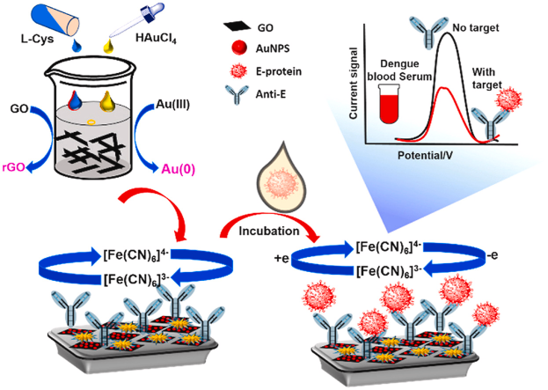
Graphical abstract.
Technology Overview
The technology utilizes L-cysteine for green reduction and functionalization of gold nanoparticles on 2D graphene sheets. The L-cysteine acts as a link, facilitating strong covalent bonding for anti-DENV-E antibody immobilization. Target binding is analyzed via electrochemical signals (CV and SWV), achieving a wide linear range 0.01–100 ng mL−1 and a ultra-low detection limit of 1.6 pg mL-1.
Applications & Benefits
This immunosensor is primarily applied in clinical medical diagnostics and point-of-care testing for dengue fever. By replacing hazardous linkers with eco-friendly L-cysteine, it provides a safe, low-cost, and portable alternative to RT-PCR. It delivers high selectivity in real human serum, significantly contributing to early epidemic prevention.
Abstract:
Dengue fever is one of the most deadly viruses, and it has become a recurring public health problem in tropical areas. The increase in dengue cases worldwide has increased the demand for rapid and accurate diagnostic methods. In order to detect the content of dengue virus type E-proteins (DENV-E protein), we fabricated an efficient label-free electrochemical immunosensor platform that was constructed based on in situ reduction and functionalized gold nanoparticles decorated heteroatom-doped reduced graphene oxides nanocomposites (AuNPs/NSG). Here, L-cystein (L-cys) is introduced to green reducing and stabilizing agent of Au(III) and graphene oxide. The sensing platform offers a suitable higher number of antibody immobilization by providing L-cys. The highly crystalline AuNP was unfoirmly grafting on 2D graphene sheet. Under the optimized conditions, the as-designed immunosensor exhibited a wide linear working range from 0.01–100 ng mL−1 with a low detection limit of 1.6 pg mL−1 for DENV-E detection. The proposed immunosensor shows high selective for discriminating DENV-E against antibodies of their antibodies, including the closely related DENV. The reliability of fabricated immunosensor had been used to detect the viral E-protein contents in serum samples collected from patients, and obtained results were compared with the enzyme-linked immunosorbend assay. Furthermore, the developed AuNPs/NSG immunosensor can be used as a potential probe for future prospective clinical diagnostic applications.

Label-free electrochemical immunosensor based on L-cysteine-functionalized AuNP on reduced graphene oxide for the detection of dengue virus E-protein in dengue blood serum
Author:Sangili Arumugam, Kalyani Thangapandi, Chen Shen-Ming, Rajendran Kokilavani, Rajendran Kokilavani
Year:2022
Source publication: Composites Part B: Engineering, Volume 238, June 2022, 109876
Subfield Highest percentage: 99% Engineering #2/355