Experimental, economic and life cycle assessments of recycling end-of-life monocrystalline silicon photovoltaic modules
This study proposes an efficient laboratory-scale recycling process for end-of-life (EoL) monocrystalline silicon photovoltaic panels using module delamination, acid etching, and sequential electrodeposition. The process achieved high recovery efficiencies for silver (86%), lead (95%), and aluminum (97%). Scaled-up simulations for life cycle assessment (LCA) revealed that the recycling method reduces global warming potential by approximately 393% compared to conventional landfilling. Additionally, economic analysis demonstrated that at a treatment capacity of 892.5 kg/h, the process is highly feasible with a 28.2% internal rate of return and a payback period under a year, provided waste collection is subsidized.
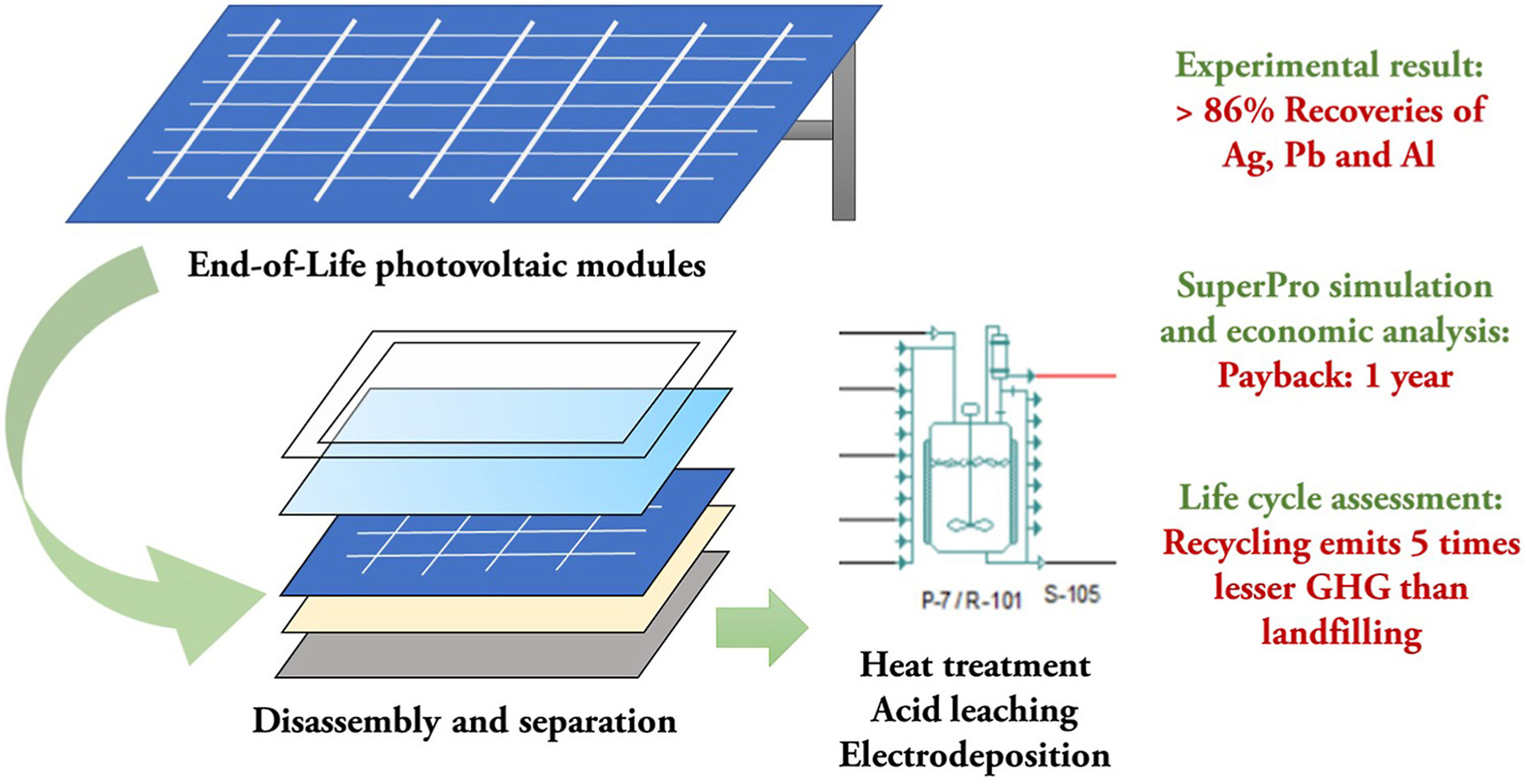
Graphical abstract.
Technology Overview
The technology establishes a closed-loop recycling process for EoL PV modules. Methodologically, it utilizes physical separation to remove exterior frames, followed by thermal decomposition to dissolve encapsulated polymers. Finally, hydrometallurgical acid leaching is applied to selectively recover high-purity silicon and trace metals. The entire pipeline is systematically quantified and optimized using economic modeling and comprehensive LCA software.
Applications & Benefits
This research applies to solar energy waste management, electronic waste recycling industries, circular economy planning, and green energy policy formulation. It delivers substantial benefits by mitigating the environmental hazards of heavy metals in landfills. Ultimately, it secures critical raw material supplies for manufacturing, reduces carbon footprints, and ensures the long-term sustainability of renewable energy infrastructure.
Abstract:
The utilization of solar technology for clean energy generation has seen a dramatic increase over the past decade. Eyeing the ever-growing solar capacity and the subsequent inevitable deluge of solar panel wastes, the ideal approach to handle End-of-Life (EoL) solar photovoltaic (PV) panels is to recycle their materials for reuse. This present study explores an optimal recycling process with a high resource recovery efficiency on a laboratory scale, which comprises of three main steps: module delamination, acid etching and sequential electrodeposition. High recoveries of 86, 95 and 97% were achieved for silver, lead and aluminum, respectively. The acquired results are further applied in a life cycle assessment. The process was scaled up to simulate an industrial process and its human and environmental impacts were compared to those of the landfilling disposal method, with six main impact categories analyzed and described: global warming potential, human toxicity potential, freshwater ecotoxicity potential, acidification potential, eutrophication potential and ozone depletion potential. Mitigation strategies are also proposed. Lastly, economic analysis demonstrated that at a treatment capacity of 892.5 kg/h, the process is feasible with an internal revenue rate of 28.2% and a payback time of less than a year, provided the waste collection is subsidized.
Experimental, economic and life cycle assessments of recycling end-of-life monocrystalline silicon photovoltaic modules
Author:Lim Mitchell Shyan Wei, He Dong, Tiong Jasmine Sie Ming, Hanson Svenja, Yang Thomas Chung-Kuang, Tiong Timm Joyce, Pan Guan-Ting, Chong Siewhui
Year:2022
Source publication: Journal of Cleaner Production, Volume 340, March 2022, 130796
Subfield Highest percentage: 99% Business, Management and Accounting #4/473