Getting hooked on mobile games: Strengthening purchase intentions towards mobile games using investment model and parasocial interactions
This study investigates the factors influencing in-game purchase intentions in gacha mobile games by integrating the Investment Model and Parasocial Interaction (PSI) theory. Using survey data from 2,045 Chinese players, the research examines how satisfaction, investment size, perceived alternatives, game commitment, and emotional attachment to game characters affect purchasing behavior. The results reveal that satisfaction, investment size, and game commitment significantly increase purchase intentions, while PSI strengthens player engagement and commitment, particularly in romance simulation games. The findings provide valuable insights into player psychology and game monetization strategies.
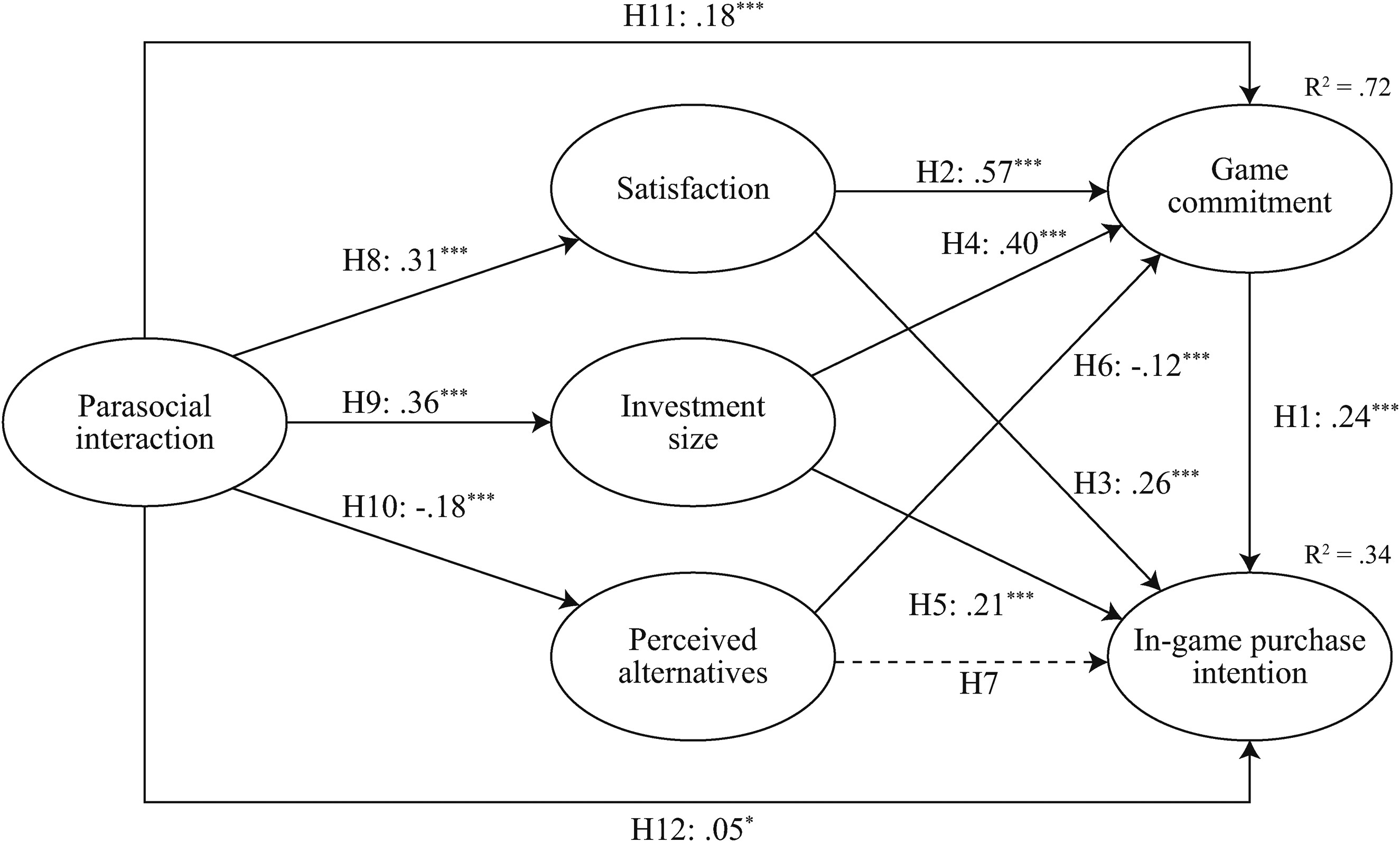
Fig. 1. Estimates of structural model.
Technology Overview
A behavioral analytics framework combining the Investment Model and Parasocial Interaction (PSI) theory was developed to analyze player engagement in gacha games. The model evaluates how emotional attachment, satisfaction, commitment, and investment behaviors influence in-game purchase intentions across different game genres.
Applications & Benefits
The framework can support game design, player engagement analysis, and digital marketing strategies. It helps developers enhance user retention, strengthen emotional connections with game characters, improve monetization effectiveness, and optimize player experiences through data-driven behavioral insights.
Abstract:
Free-to-play has become a common business strategy in the game market, the associated microtransactions of which have attracted academic attention. In recent years, gacha games have gathered a considerable consumer base in the mobile gaming market, and these players have demonstrated strong purchasing power with regard to additional game resources. Within the framework of parasocial interaction and the investment model, this study explored factors influencing players’ game commitment and purchase intentions. This study used structural equation modeling and moderation analysis to examine data collected from 2,045 Chinese mobile game players. Satisfaction and investment size were positively correlated with game commitment and in-game purchase intention. Perceived alternatives were negatively correlated with game commitment. Furthermore, parasocial interaction was positively correlated with satisfaction, investment size, and game commitment and negatively correlated with perceived alternatives. The results indicate that these correlations were moderated by game genre.

Getting hooked on mobile games: Strengthening purchase intentions towards mobile games using investment model and parasocial interactions
Author:Gong An-Di, Huang Yi-Ting, Liu Keren, Sugiura Kazunori
Year:2025
Source publication: Mobile Media and Communication, Volume 13, Issue 1, Jan 2025
Subfield Highest percentage: 99% Cultural Studies #8/1434