Spatially controlled lithium utilization in anode-free all-solid-state batteries via diffusive interface
This study presents an anode-free all-solid-state battery using a thin indium (In) interlayer on a garnet-type LLZTO solid electrolyte. During the initial charging process, the indium layer forms a Li-rich Li–In alloy that promotes uniform lithium deposition, reduces void formation, and enhances lithium utilization. The diffusive interface improves interfacial stability without requiring excess lithium or external stack pressure. As a result, the battery achieves a first discharge capacity of 2.3 mAh cm⁻² and maintains 78.9% capacity retention after 20 cycles, demonstrating a promising strategy for high-energy-density solid-state batteries.
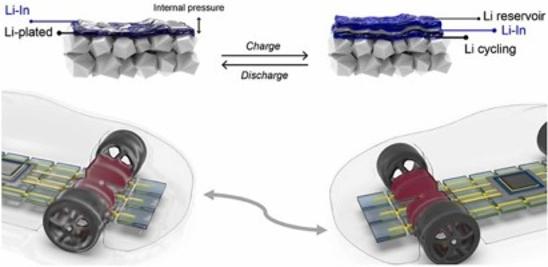
Fig. 1. Graphical Abstract.
Technology Overview
A 500 nm indium interlayer is introduced between the current collector and LLZTO solid electrolyte. The in-situ formed Li–In alloy acts as a highly diffusive lithium reservoir, enabling uniform lithium plating/stripping, suppressing void accumulation, and maintaining interfacial contact during cycling without external pressure.
Applications & Benefits
The technology is suitable for next-generation anode-free solid-state batteries in electric vehicles and portable electronics. It improves lithium utilization, cycle life, safety, and energy density while reducing the need for excess lithium and complex pressure-management systems.
Abstract:
The anode-free solid-state battery represents the perfect balance of safety, cost-effectiveness, and high energy density for future batteries. However, it encounters significant challenges that result in rapid capacity fade in performance. An in situ-formed Li-rich interlayer can establish a diffusive Li-ion dynamic interface where spatially distributed Li+ enclosing reduces the rate of void accumulation. Moreover, the uneven Li+ flux at the electrolyte interface can be uniform through the Li-rich diffusive interface, leading to uniform deposition of Li0 on the current collector. The garnet solid-electrolyte LLZO-Ta (Li6.75La3Zr1.75Ta0.25O12) has been explored in an all-solid anode-free battery fabrication with a focus on uniform lithium deposition governed by operating conditions through a 500 nm Indium interlayer for enhancing anode-free battery performance. The evolved internal pressure due to the Li–In intermetallic crystal phase change preserves the dimensional stability of the interlayer during Li+ diffusion. More Li utilization is achieved through Li–In interlayer without introducing an excess Li source or applying external stack pressure. A Li-rich interphase coupled with cycling protocols can provide more lithium accessibility during cycling in limited-capacity Li batteries.
Spatially controlled lithium utilization in anode-free all-solid-state batteries via diffusive interface
Author:Bazri Behrouz, Huang Jheng-Yi, Liu Chia-Erh, Liao Shih-Chieh, Wei Da-Hua, Hu Shu-Fen, Liu Ru-Shi
Year:2025
Source publication: Nano Energy, Volume 142, Part B, September 2025, 111222
Subfield Highest percentage: 99% Electrical and Electronic Engineering #9/1030