Too vulnerable to resist: Problematic use of dating apps associated with social appearance anxiety, social interaction anxiety, and rejection sensitivity
This study investigates the psychological predictors behind the problematic use of dating applications among young adults. Analyzing a cross-sectional online questionnaire from 5,427 Taiwanese participants using structural equation modeling (SEM), the research explores how social appearance anxiety, social interaction anxiety, and rejection sensitivity positively influence the perceived benefits of digital communication. These perceived benefits subsequently exacerbate problematic dating app usage. The findings reveal critical mediating mechanisms, illustrating that individuals with high psychosocial vulnerabilities tend to rely excessively on dating apps for interpersonal connection and self-presentation control, leading to potential behavioral risks.
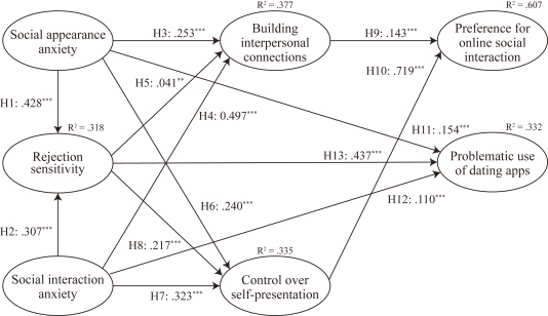
Fig. 1. Estimates of structural model (**p < .01, ***p < .001)
Technology Overview
This research employs Structural Equation Modeling (SEM) to evaluate complex, multi-variable psychological frameworks. By validating a cross-sectional dataset of 5,427 participants, the technological methodology quantifies direct and indirect paths, demonstrating how online communication benefits (such as enhanced self-presentation control and interpersonal bridging) serve as statistical mediators between initial social anxieties and ultimate problematic behavior.
Applications & Benefits
Applied to mental health and digital well-being, this study offers data-driven insights for designing targeted interventions. By identifying specific psychological triggers like rejection sensitivity and appearance anxiety, it enables counselors and app developers to mitigate technological addiction, promote healthier digital social interactions, and formulate public health strategies to support socially vulnerable young adults.
Abstract:
Dating apps have become a prevalent method for young adults to build relationships. Although young adults with psychosocial vulnerabilities do benefit from dating apps, there remains the potential for problematic use. This study applied structural equation modeling to a sample of 5427 Taiwanese participants (mean age of 27.39 ± 4.51) collected using a cross-sectional online questionnaire. We found that social appearance anxiety, social interaction anxiety, and rejection sensitivity positively predicted the perceived benefits of digital communication (i.e., building interpersonal connections and control over self-presentation). Furthermore, we found a positive correlation between the perceived benefits of digital communication and a preference for online social interaction via dating apps. In addition, social appearance anxiety and social interaction anxiety positively predicted rejection sensitivity; social appearance anxiety, social interaction anxiety, and rejection sensitivity were positively correlated with the problematic use of dating apps; and rejection sensitivity mediated the relationship between social appearance anxiety, social interaction anxiety, and problematic use of dating apps. Exploring the dual psychological outcomes of dating app use revealed new findings related to dating app use among young adults and offered recommendations on effectively leveraging digital communication to foster beneficial interpersonal relationships.
Too vulnerable to resist: Problematic use of dating apps associated with social appearance anxiety, social interaction anxiety, and rejection sensitivity
Author:Huang Yi-Ting, Gong An-Di
Year:2025
Source publication: Computers in Human Behavior, Volume 165, April 2025, 108566
Subfield Highest percentage: 99% Arts and Humanities #1/692