Promoting sustainable hospitality: examining the impact of voice assistant recommendations on customer engagement in pre-travel decision-making: moderating effects of use purpose and cultural orientation
This study investigates the role of Voice Assistants (VAs) in advancing green tourism by examining how environmental sustainability content in VA recommendations influences customer engagement and choices during pre-travel planning. Utilizing online and lab experiments grounded in self-affirmation theory, the research demonstrates that embedding sustainability details significantly increases user engagement and the likelihood of adopting green recommendations. It also uncovers critical interaction effects, showing that user response depends heavily on whether the VA is used for transactional or non-transactional purposes, and how these purposes align with the user's distinct cultural orientation.
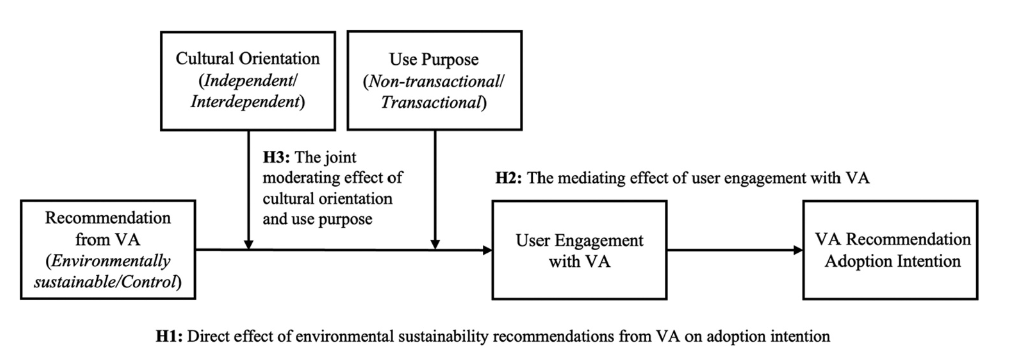
Fig. 1. Research framework.
Technology Overview
The technology centers on conversational Voice Assistants (VAs) integrated with sustainability-focused recommendation algorithms. By delivering personalized, hands-free information that highlights eco-certified and environmentally friendly practices during early travel planning, the system acts as an automated nudge mechanism. It dynamically shapes pre-travel choices by aligning value propositions with user profiles.
Applications & Benefits
Applied to pre-travel hospitality marketing, this technology bridges the gap between pro-environmental intentions and actual purchasing behavior. By enhancing customer engagement, it encourages eco-friendly bookings, boosts hoteliers' green compliance, and positions environmental sustainability as a powerful, data-driven value proposition that fosters both corporate responsibility and customer retention.
Abstract:
Voice assistants (VAs) are increasingly used to offer hospitality recommendations to guests, but few studies have examined their role in promoting sustainable hospitality practices. This study examines the impact of environmental sustainability-related content on user engagement with VAs and the adoption of their recommendations during the “pre-travel” stage. An online scenario-based experiment and a lab-based experiment revealed that incorporating sustainability content into VA recommendations boosts engagement and increases the likelihood of adopting sustainable VA recommendations. The findings also demonstrate the interaction effects of cultural orientations on engagement, depending on whether the purpose of VA use is transactional or non-transactional. This study advances the hospitality marketing and technology management literature by incorporating self-affirmation theory into VA adoption and illustrating how sustainability-focused content from VAs can enhance engagement and shape decision-making. It also provides marketers with insights for promoting sustainable hotel practices and positioning sustainability as a compelling value proposition.
Promoting sustainable hospitality: examining the impact of voice assistant recommendations on customer engagement in pre-travel decision-making: moderating effects of use purpose and cultural orientation
Author:Jiang Han-Ling, Lu Lin-Hua, Yuen Tsunwai Wesley, Liu Yu-Lun
Year:2025
Source publication: Journal of Hospitality Marketing and Management, VOL. 34, NO. 6, 767–805
Subfield Highest percentage: 99% Tourism, Leisure and Hospitality Management #1/156