Machine learning enabled assessment of the vacuum freeze-drying of the kiwifruit
This study proposes an optimized Deep Neural Framework (DNF) to predict the quality and performance of vacuum freeze-drying (VFD) for kiwifruits under varying operational conditions. To address data scarcity, Generative Adversarial Networks (GANs) are utilized to synthesize robust training datasets. Hyperparameters are tuned using Gaussian Process optimization to minimize prediction errors. The final model demonstrates reliable predictive capability, achieving an overall R2 of 0.863 for evaluating dried kiwifruit quality indexes.
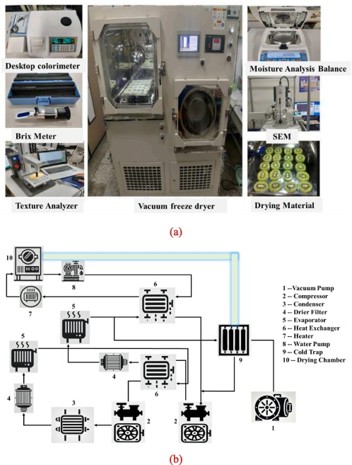
Fig. 1. Experimental setup and its related components (a) original diagram and (b) simplified representation.
Technology Overview
The core technology utilizes a Deep Neural Network (DNN) integrated with Gaussian Process (GP) for hyperparameter optimization and predictive modeling. Additionally, a Generative Adversarial Network (GAN) was implemented to synthesize high-fidelity virtual data, effectively resolving data scarcity challenges and enhancing the AI model's training accuracy regarding complex food-drying variables.
Applications & Benefits
This technology enables food processors to simulate and optimize kiwifruit drying conditions digitally without costly physical trials. By accurately forecasting flavor, appearance, and energy metrics, it empowers smarter decision-making that maximizes product quality, reduces processing waste, and significantly minimizes energy consumption for sustainable agricultural manufacturing.
Abstract:
Drying technologies have been essential for extending the shelf-life of perishable fruits and vegetables for over a century. Vacuum freeze-drying (VFD), though invented over a hundred years ago, remains one of the most advanced drying techniques, known for sustainably drying perishable products while maintaining quality indices and morphological properties comparable to their fresh state. The performance of the VFD system is sensitive to the operating conditions and features of the drying product which is assessed using experimental and/or numerical methods. However, the qualitative aspects of the dried product are not predictable. In this context, the present study aims to create a deep neural framework (DNF) that predicts the performance of a Vacuum Freeze Drying (VFD) system for kiwifruit, based on its morphology and nutritional value under varying conditions. This involves translating the fruit's morphological features into trainable data and using a Generative Adversarial Network (GAN) to create diverse, unlabeled datasets. The framework is optimized using Gaussian Process (GP) for hyper-parameter tuning, focusing on minimizing errors like mean square error (MSE), mean absolute error (MAE), and mean absolute percentage error (MAPE). The maximum MSE of 1.243 is found in the prediction of rehydration rate, followed by color (0.725), energy consumption (0.426), moisture content (0.379), texture (0.320), sensory (0.250), and Brix (0.215), respectively. The maximum MAE and MAPE values are recorded 0.833 and 32.99 % while the minimum is observed 0.368 and 7.019 % in the case of rehydration rate and Brix, respectively. Overall, the R2 value was computed 0.863 which is reasonable for the quality assessment of kiwifruit dried by the VFD system.
Machine learning enabled assessment of the vacuum freeze-drying of the kiwifruit
Author:Sajjad Uzair, Bibi Farzana, Hussain Imtiyaz, Abbas Naseem, Sultan Muhammad, Muhammad Asfahan Hafiz, Aleem Muhammad, Yan Wei-Mon
Year:2025
Source publication: Information Processing in Agriculture, Volume 12, Issue 2, June 2025, 245-259
Subfield Highest percentage: 99% Agronomy and Crop Science #2/422