Trajectory Control and Fair Communications for Multi-UAV Networks: A Federated Multi-Agent Deep Reinforcement Learning Approach
This paper proposes a Trajectory Control and Fair Communications (TCFC) scheme for multi-UAV networks, addressing limitations of prior work that overlooked fairness and computation time. Using a two-stage learning approach — a GRU-based link quality estimation model followed by a Federated Multi-Agent Deep Reinforcement Learning (FedMADRL) algorithm — the system optimizes UAV trajectories to maximize ground user data rates and coverage while ensuring service fairness. Evaluated on real channel measurement data, it reduces computation time by 26.91% over centralized baselines.
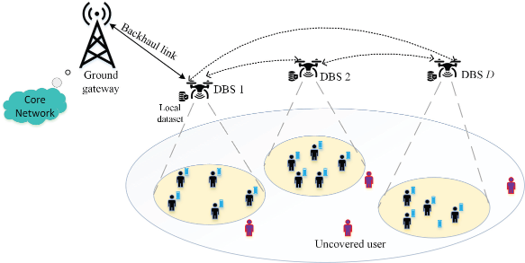
Fig. 1. The considered multi-drone-enabled wireless communications system. The blue-black and red ground users represent the covered and uncovered users in deployed drone base stations due to blockage and suboptimal DBS deployment, respectively.
Technology Overview
The system combines GRU neural networks for real-time link quality estimation with FedMADRL for decentralized UAV trajectory control. Each drone trains a local DRL model independently, periodically synchronizing parameters via a federated parameter server using FedAvg — sharing only model weights, not raw user data — to build a privacy-preserving global model.
Applications & Benefits
Applicable in emergency communications, disaster response, and traffic offloading where terrestrial infrastructure is unavailable. Key benefits include improved communication coverage, fairer data rate distribution among users, reduced computation overhead versus centralized approaches, and enhanced privacy by avoiding raw data sharing between UAV agents.
Abstract:
Due to their highly flexible deployment and agility features, unmanned aerial vehicles (UAVs) serving as aerial base stations are increasingly being used in challenging environments, including emergency communication, traffic offloading, and failures of existing communications infrastructure. A reliable and effective communication service requires 3D deployment and autonomous UAV trajectory optimization in each time slot. While most prior approaches focus on trajectory design that maximizes communication coverage or network throughput without considering fairness as well as computation time. This paper presents a multi-UAV trajectory control and fair communication (TCFC) scheme that maximizes ground user data rate and communication coverage while ensuring service fairness in a UAV-aided wireless communications system. The proposed TCFC scheme employs a two-stage learning approach. Firstly, it develops a gated recurrent unit-based link quality estimation model to assess each user’s link quality over time. Then, a federated multi-agent deep reinforcement learning (FedMADRL) algorithm is utilized to continuously adjust the trajectory of the UAVs, optimizing communication performance. We evaluated our proposed system using real channel measurement data, i.e., amplitude and phase signal information. The results show that the proposed TCFC scheme reduces computation time by 26.91% and provides comparable network performance with the baseline methods while improving DRL agents’ privacy.
Trajectory Control and Fair Communications for Multi-UAV Networks: A Federated Multi-Agent Deep Reinforcement Learning Approach
Author:Tarekegn Getaneh Berie, Tesfaw Belayneh Abebe, Juang Rong-Terng, Saha Dola, Tarekegn Robel Berie, Lin Hsin-Piao, Tai Li-Chia
Year:2025
Source publication: IEEE Transactions on Wireless Communications, Volume 24, Issue 9, September 2025, 7598 - 7611
Subfield Highest percentage: 99% Applied Mathematics #6/680