Enhancing perspective-taking and empathy in children with autism spectrum disorder through asymmetric VR games and peer collaboration
This study investigates the use of an asymmetric virtual reality (VR) game system, called Share VR, to enhance perspective-taking and empathy in children with Autism Spectrum Disorder (ASD). By combining peer collaboration, cooperative gameplay, and role-switching interactions, the system encourages children to understand others’ intentions, emotions, and viewpoints. Five children with ASD and three typically developing peers participated in a multi-stage intervention. Results showed that asymmetric VR games effectively promoted social cognition, empathy, communication, and collaborative skills, demonstrating the potential of VR-based interventions for improving social interaction in children with ASD.
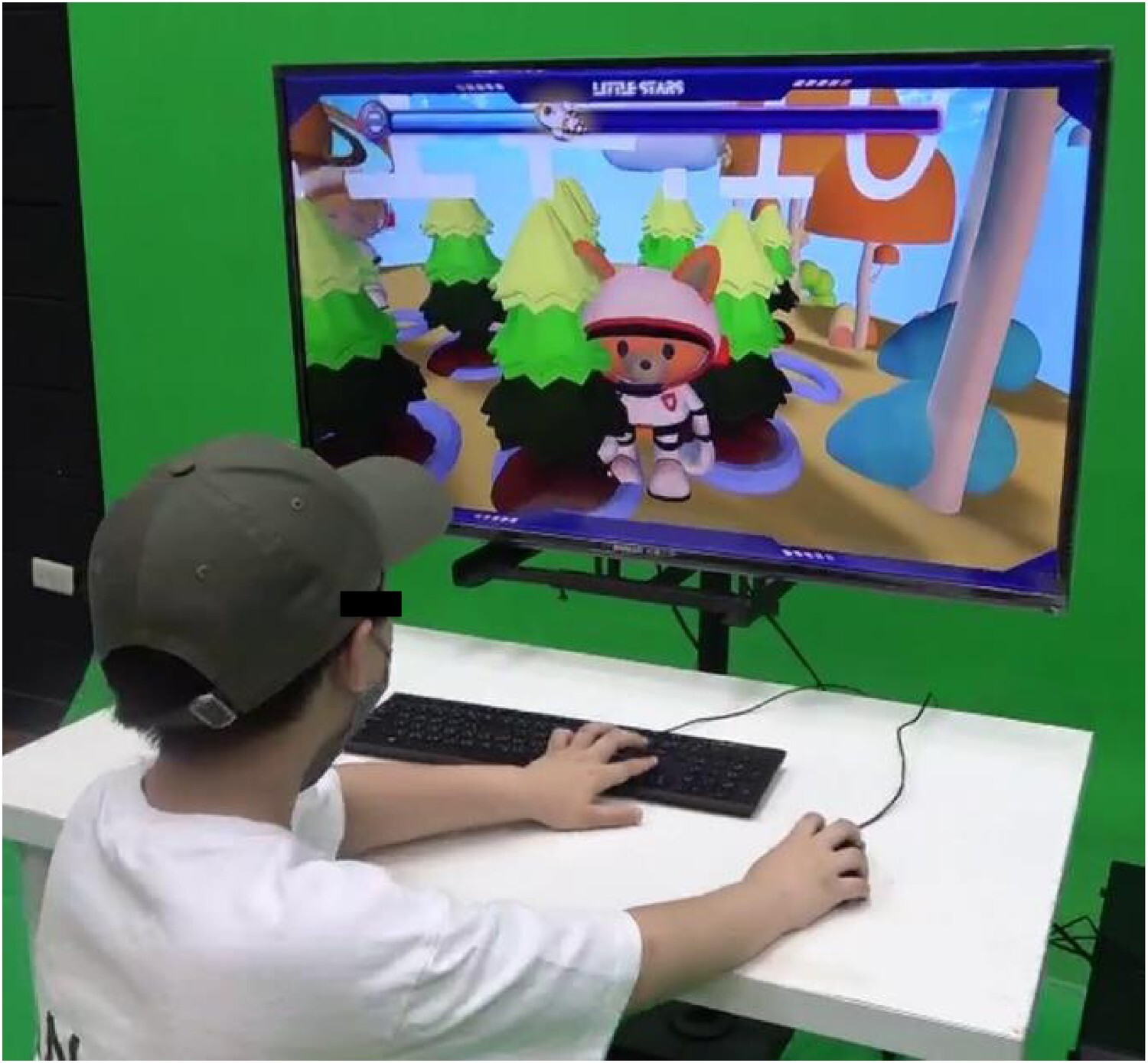
Figure 1. The PC player, as the little fox, observes and controls the character, fostering perspective-taking and empathy for children with autism.
Technology Overview
Share VR is an asymmetric multiplayer VR system where one player uses a VR headset and another uses a PC. Different viewpoints, roles, and abilities require players to communicate, cooperate, and switch perspectives to complete tasks, fostering empathy, Theory of Mind, and social understanding in children with ASD.
Applications & Benefits
The technology can be applied in autism intervention and social skills training. It improves perspective-taking, empathy, verbal communication, peer collaboration, and social reciprocity through engaging cooperative, competitive, and exploratory gameplay, while increasing motivation and facilitating the transfer of learned skills to real-world social situations.
Abstract:
Children with ASD experience pervasive social cognitive impairments, primarily manifested as challenges in social communication and reciprocal social behavior. These inherent deficits indirectly affect the development, based on the Theory of Mind, and empathy capacity in children with ASD, which are crucial in developing social skills and communicative interaction abilities. Research suggests that children with ASD struggle to judge and interpret the intentions, behaviors, and metaphors involved in social interaction. This impacts their abilities to engage in effective interpersonal communication and social interaction. Therefore, the present study developed a tool called Share VR. This asymmetric VR technology combines peer collaboration and cooperative games to hone the empathetic abilities in children with ASD. The objective is to stimulate the application of their abilities while enhancing their understanding of others’ behavioral intentions. In the experimental verification phase, the study recruited five children with ASD and three typically developing children to participate in Asymmetric VR multiplayer games. The games involved cooperation, competition, and exploration across three different game levels. Further, we used a three-stage experimental validation using a multiple-baseline across subjects design to confirm whether this method effectively enables children with ASD to acquire empathy through peer collaboration, game participation, and cooperative assistance.
Enhancing perspective-taking and empathy in children with autism spectrum disorder through asymmetric VR games and peer collaboration
Author:Lee I-Jui, Yang Wan-Chen
Year:2025
Source publication: Interactive Learning Environments, Volume 33, Issue 1, February 2025
Subfield Highest percentage: 99% Education #16/1698